

9 Operator Perturbation Theory for Atomic Systems
167
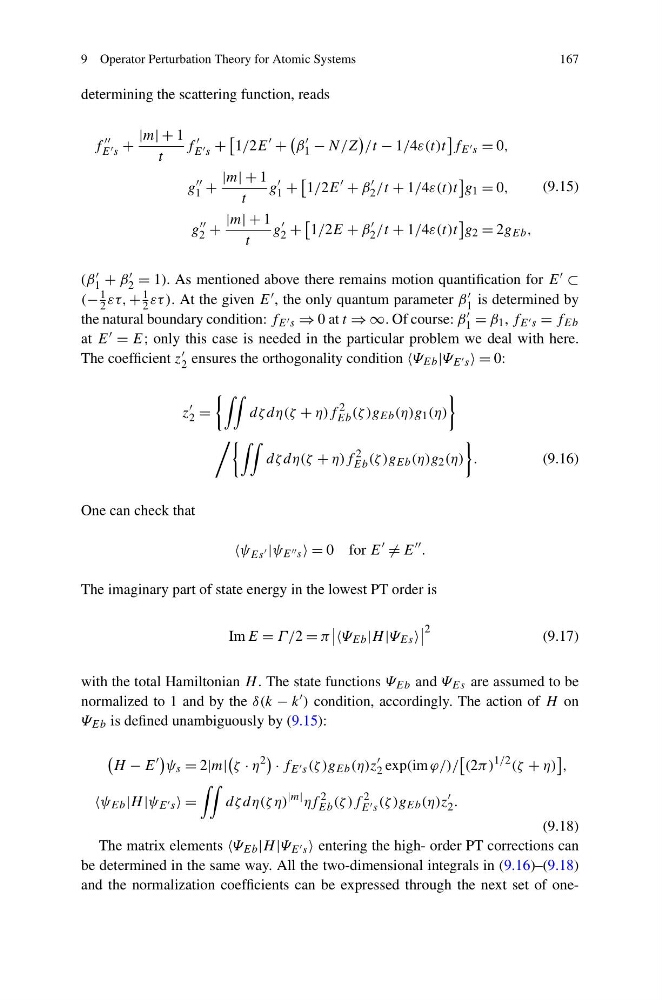
determining the scattering function, reads
f
E s +
|m| + 1
t
f
E s +
1/2E
+
β
1 − N/Z
/t − 1/4ε(t)t
f E s = 0,
g
1 +
|m| + 1
t
g
1 +
1/2E
+ β
2 /t + 1/4ε(t)t
g 1 = 0,
g
2 +
|m| + 1
t
g
2 +
1/2E + β
2 /t + 1/4ε(t)t
g 2 = 2g Eb ,
(9.15)
(β
1 + β
2 = 1). As mentioned above there remains motion quantification for E ⊂
(−
1
2 ετ, +
1
2 ετ ). At the given E , the only quantum parameter β
1 is determined by
the natural boundary condition: f E s ⇒ 0 at t ⇒ ∞. Of course: β
1 = β 1 , f E s = f Eb
at E = E; only this case is needed in the particular problem we deal with here.
The coefficient z
2 ensures the orthogonality condition Ψ Eb |Ψ E s = 0:
z
2 =
dζ dη(ζ + η)f
2
Eb (ζ )g Eb (η)g 1 (η)
dζ dη(ζ + η)f
2
Eb (ζ )g Eb (η)g 2 (η)
.
(9.16)
One can check that
ψ Es |ψ E s = 0 for E
= E
.
The imaginary part of state energy in the lowest PT order is
Im E = Γ /2 = π
Ψ Eb |H |Ψ Es
2
(9.17)
with the total Hamiltonian H . The state functions Ψ Eb and Ψ Es are assumed to be
normalized to 1 and by the δ(k − k ) condition, accordingly. The action of H on
Ψ Eb is defined unambiguously by (9.15):
H − E
ψ s = 2|m|
ζ · η
2
· f E s (ζ )g Eb (η)z
2 exp(im ϕ/)/
(2π)
1/2 (ζ + η)
,
ψ Eb |H |ψ E s =
dζ dη(ζ η)
|m| ηf
2
Eb (ζ )f
2
E s (ζ )g Eb (η)z
2 .
(9.18)
The matrix elements Ψ Eb |H |Ψ E s entering the high- order PT corrections can
be determined in the same way. All the two-dimensional integrals in (9.16)–(9.18)
and the normalization coefficients can be expressed through the next set of one-
167
determining the scattering function, reads
f
E s +
|m| + 1
t
f
E s +
1/2E
+
β
1 − N/Z
/t − 1/4ε(t)t
f E s = 0,
g
1 +
|m| + 1
t
g
1 +
1/2E
+ β
2 /t + 1/4ε(t)t
g 1 = 0,
g
2 +
|m| + 1
t
g
2 +
1/2E + β
2 /t + 1/4ε(t)t
g 2 = 2g Eb ,
(9.15)
(β
1 + β
2 = 1). As mentioned above there remains motion quantification for E ⊂
(−
1
2 ετ, +
1
2 ετ ). At the given E , the only quantum parameter β
1 is determined by
the natural boundary condition: f E s ⇒ 0 at t ⇒ ∞. Of course: β
1 = β 1 , f E s = f Eb
at E = E; only this case is needed in the particular problem we deal with here.
The coefficient z
2 ensures the orthogonality condition Ψ Eb |Ψ E s = 0:
z
2 =
dζ dη(ζ + η)f
2
Eb (ζ )g Eb (η)g 1 (η)
dζ dη(ζ + η)f
2
Eb (ζ )g Eb (η)g 2 (η)
.
(9.16)
One can check that
ψ Es |ψ E s = 0 for E
= E
.
The imaginary part of state energy in the lowest PT order is
Im E = Γ /2 = π
Ψ Eb |H |Ψ Es
2
(9.17)
with the total Hamiltonian H . The state functions Ψ Eb and Ψ Es are assumed to be
normalized to 1 and by the δ(k − k ) condition, accordingly. The action of H on
Ψ Eb is defined unambiguously by (9.15):
H − E
ψ s = 2|m|
ζ · η
2
· f E s (ζ )g Eb (η)z
2 exp(im ϕ/)/
(2π)
1/2 (ζ + η)
,
ψ Eb |H |ψ E s =
dζ dη(ζ η)
|m| ηf
2
Eb (ζ )f
2
E s (ζ )g Eb (η)z
2 .
(9.18)
The matrix elements Ψ Eb |H |Ψ E s entering the high- order PT corrections can
be determined in the same way. All the two-dimensional integrals in (9.16)–(9.18)
and the normalization coefficients can be expressed through the next set of one-