

168
A.V. Glushkov
dimensional integrals:
I 1 =
dtf
2
b (t)t
|m| ,
I 2 =
dtf
2
b (t)t
|m|+1 ,
I 3 =
dtg b (t)g 1 (t)t
|m| ,
I 4 =
dtg b (t)g 1 (t)t
|m|+1 ,
I 5 =
dtg b (t)g 2 (t)t
|m| ,
I 6 =
dtg b (t)g 2 (t)t
|m|+1 ,
I 7 =
dtg
2
b (t)t
|m| ,
I 8 =
dtg
2
b (t)t
|m|+1 ,
(9.19)
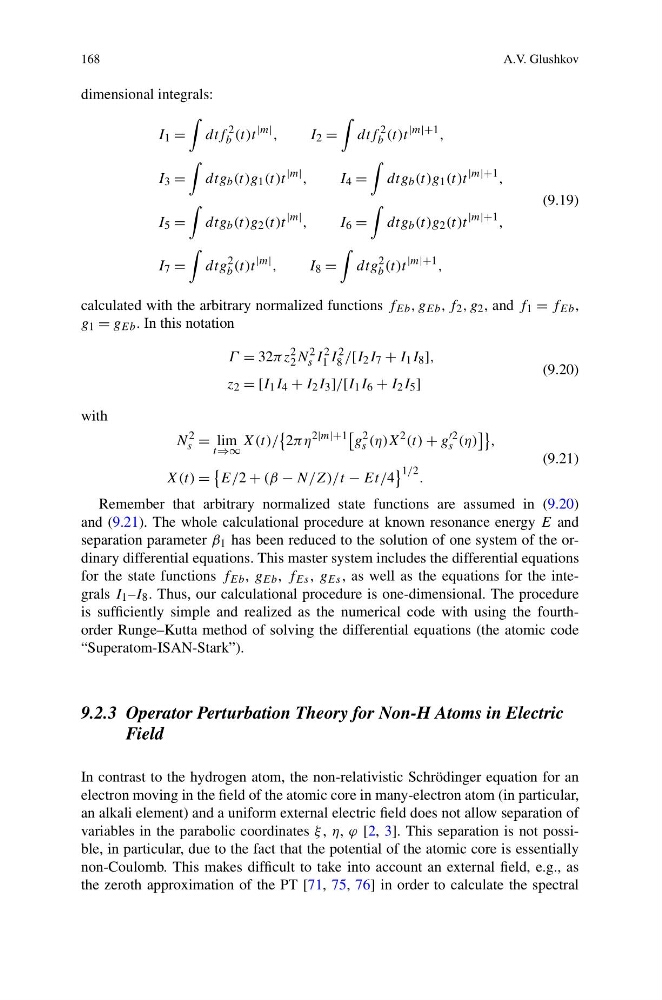
calculated with the arbitrary normalized functions f Eb , g Eb , f 2 , g 2 , and f 1 = f Eb ,
g 1 = g Eb . In this notation
Γ = 32πz
2
2 N
2
s I
2
1 I
2
8 /[I 2 I 7 + I 1 I 8 ],
z 2 = [I 1 I 4 + I 2 I 3 ]/[I 1 I 6 + I 2 I 5 ]
(9.20)
with
N
2
s = lim
t⇒∞
X(t)/
2πη
2|m|+1
g
2
s (η)X
2 (t) + g
2
s (η)
,
X(t) =
E/2 + (β − N/Z)/t − Et/4
1/2 .
(9.21)
Remember that arbitrary normalized state functions are assumed in (9.20)
and (9.21). The whole calculational procedure at known resonance energy E and
separation parameter β 1 has been reduced to the solution of one system of the ordinary differential equations. This master system includes the differential equations
for the state functions f Eb , g Eb , f Es , g Es , as well as the equations for the integrals I 1 –I 8 . Thus, our calculational procedure is one-dimensional. The procedure
is sufficiently simple and realized as the numerical code with using the fourthorder Runge–Kutta method of solving the differential equations (the atomic code
“Superatom-ISAN-Stark”).
9.2.3 Operator Perturbation Theory for Non-H Atoms in Electric
Field
In contrast to the hydrogen atom, the non-relativistic Schrödinger equation for an
electron moving in the field of the atomic core in many-electron atom (in particular,
an alkali element) and a uniform external electric field does not allow separation of
variables in the parabolic coordinates ξ , η, ϕ [2, 3]. This separation is not possible, in particular, due to the fact that the potential of the atomic core is essentially
non-Coulomb. This makes difficult to take into account an external field, e.g., as
the zeroth approximation of the PT [71, 75, 76] in order to calculate the spectral
A.V. Glushkov
dimensional integrals:
I 1 =
dtf
2
b (t)t
|m| ,
I 2 =
dtf
2
b (t)t
|m|+1 ,
I 3 =
dtg b (t)g 1 (t)t
|m| ,
I 4 =
dtg b (t)g 1 (t)t
|m|+1 ,
I 5 =
dtg b (t)g 2 (t)t
|m| ,
I 6 =
dtg b (t)g 2 (t)t
|m|+1 ,
I 7 =
dtg
2
b (t)t
|m| ,
I 8 =
dtg
2
b (t)t
|m|+1 ,
(9.19)
calculated with the arbitrary normalized functions f Eb , g Eb , f 2 , g 2 , and f 1 = f Eb ,
g 1 = g Eb . In this notation
Γ = 32πz
2
2 N
2
s I
2
1 I
2
8 /[I 2 I 7 + I 1 I 8 ],
z 2 = [I 1 I 4 + I 2 I 3 ]/[I 1 I 6 + I 2 I 5 ]
(9.20)
with
N
2
s = lim
t⇒∞
X(t)/
2πη
2|m|+1
g
2
s (η)X
2 (t) + g
2
s (η)
,
X(t) =
E/2 + (β − N/Z)/t − Et/4
1/2 .
(9.21)
Remember that arbitrary normalized state functions are assumed in (9.20)
and (9.21). The whole calculational procedure at known resonance energy E and
separation parameter β 1 has been reduced to the solution of one system of the ordinary differential equations. This master system includes the differential equations
for the state functions f Eb , g Eb , f Es , g Es , as well as the equations for the integrals I 1 –I 8 . Thus, our calculational procedure is one-dimensional. The procedure
is sufficiently simple and realized as the numerical code with using the fourthorder Runge–Kutta method of solving the differential equations (the atomic code
“Superatom-ISAN-Stark”).
9.2.3 Operator Perturbation Theory for Non-H Atoms in Electric
Field
In contrast to the hydrogen atom, the non-relativistic Schrödinger equation for an
electron moving in the field of the atomic core in many-electron atom (in particular,
an alkali element) and a uniform external electric field does not allow separation of
variables in the parabolic coordinates ξ , η, ϕ [2, 3]. This separation is not possible, in particular, due to the fact that the potential of the atomic core is essentially
non-Coulomb. This makes difficult to take into account an external field, e.g., as
the zeroth approximation of the PT [71, 75, 76] in order to calculate the spectral