

stereopentad intensities with polymerization temperature. The data indicate that the
syndiotacticity of the polymers produced with the 10/MAO catalyst system at
different polymerization temperatures, measured as the concentration of racemic
pentads rrrr, are relatively high. The catalysts’ enantioselectivity, judged by the
concentration of the rmmr pentad sequences, are also very high and close to the
enantioselectivities measured as rmmr pentads for the catalyst systems consisting of
(1, 5, 6 and 9)/MAO.
The overall stereoregularity and melting points of the polymer are, however,
lower for the syndiotactic polymers produced with the 10/MAO catalyst system due
to the presence of high concentration of site epimerization related stereo-errors
(rrmr pentads). A rather frequent or fast site epimerization rate at higher polymerization temperatures is probably facilitated by the flexibility of the molecular
structure of 10 (dynamic umbrella-type reversible inversion at the amido-nitrogen
center see: [148]) and the rapid “same site” contact ion-pairing.
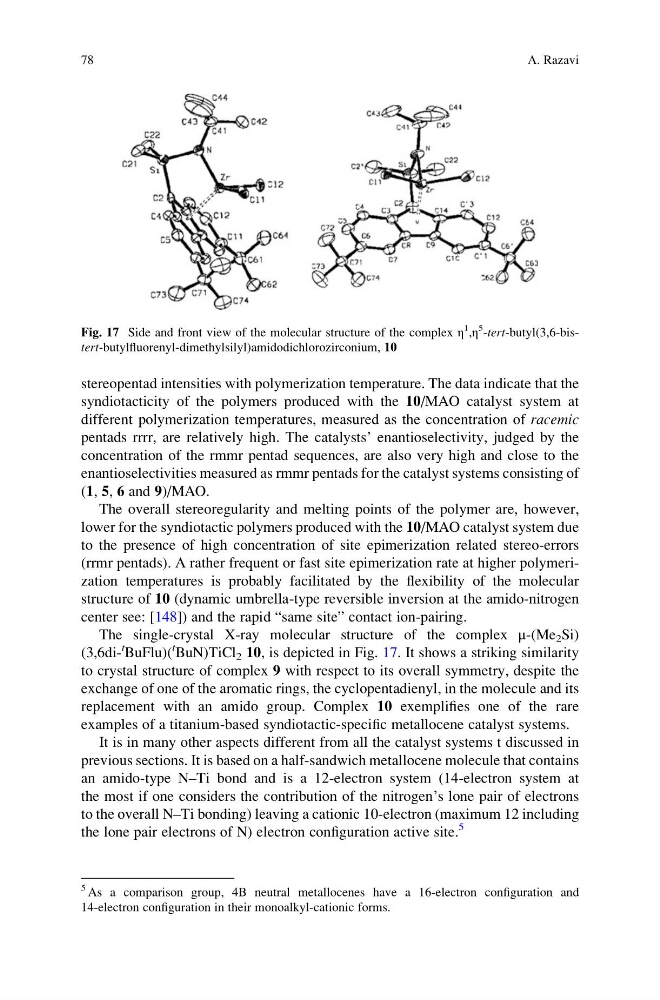
The single-crystal X-ray molecular structure of the complex μ-(Me 2 Si)
(3,6dit
BuFlu)(
t
BuN)TiCl 2 10, is depicted in Fig. 17. It shows a striking similarity
to crystal structure of complex 9 with respect to its overall symmetry, despite the
exchange of one of the aromatic rings, the cyclopentadienyl, in the molecule and its
replacement with an amido group. Complex 10 exemplifies one of the rare
examples of a titanium-based syndiotactic-specific metallocene catalyst systems.
It is in many other aspects different from all the catalyst systems t discussed in
previous sections. It is based on a half-sandwich metallocene molecule that contains
an amido-type N–Ti bond and is a 12-electron system (14-electron system at
the most if one considers the contribution of the nitrogen’s lone pair of electrons
to the overall N–Ti bonding) leaving a cationic 10-electron (maximum 12 including
the lone pair electrons of N) electron configuration active site.
5
Fig. 17 Side and front view of the molecular structure of the complex η
1
,η
5
-tert-butyl(3,6-bistert-butylfluorenyl-dimethylsilyl)amidodichlorozirconium, 10
5 As a comparison group, 4B neutral metallocenes have a 16-electron configuration and
14-electron configuration in their monoalkyl-cationic forms.
78
A. Razavi
syndiotacticity of the polymers produced with the 10/MAO catalyst system at
different polymerization temperatures, measured as the concentration of racemic
pentads rrrr, are relatively high. The catalysts’ enantioselectivity, judged by the
concentration of the rmmr pentad sequences, are also very high and close to the
enantioselectivities measured as rmmr pentads for the catalyst systems consisting of
(1, 5, 6 and 9)/MAO.
The overall stereoregularity and melting points of the polymer are, however,
lower for the syndiotactic polymers produced with the 10/MAO catalyst system due
to the presence of high concentration of site epimerization related stereo-errors
(rrmr pentads). A rather frequent or fast site epimerization rate at higher polymerization temperatures is probably facilitated by the flexibility of the molecular
structure of 10 (dynamic umbrella-type reversible inversion at the amido-nitrogen
center see: [148]) and the rapid “same site” contact ion-pairing.
The single-crystal X-ray molecular structure of the complex μ-(Me 2 Si)
(3,6dit
BuFlu)(
t
BuN)TiCl 2 10, is depicted in Fig. 17. It shows a striking similarity
to crystal structure of complex 9 with respect to its overall symmetry, despite the
exchange of one of the aromatic rings, the cyclopentadienyl, in the molecule and its
replacement with an amido group. Complex 10 exemplifies one of the rare
examples of a titanium-based syndiotactic-specific metallocene catalyst systems.
It is in many other aspects different from all the catalyst systems t discussed in
previous sections. It is based on a half-sandwich metallocene molecule that contains
an amido-type N–Ti bond and is a 12-electron system (14-electron system at
the most if one considers the contribution of the nitrogen’s lone pair of electrons
to the overall N–Ti bonding) leaving a cationic 10-electron (maximum 12 including
the lone pair electrons of N) electron configuration active site.
5
Fig. 17 Side and front view of the molecular structure of the complex η
1
,η
5
-tert-butyl(3,6-bistert-butylfluorenyl-dimethylsilyl)amidodichlorozirconium, 10
5 As a comparison group, 4B neutral metallocenes have a 16-electron configuration and
14-electron configuration in their monoalkyl-cationic forms.
78
A. Razavi