

The fact that the catalyst system 10/MAO owes its high enantioselectivity
mainly to the presence and the steric bulk of the tert-butyl substituents implanted
at positions 3 and 6 of the fluorenyl moiety of its ligand can be demonstrated by
reviewing the polymerization behavior of a similar complex, namely η
1 ,η
5 -tertbutyl(2,7-bis-tert-butyl-fluorenyl-dimethylsilyl)amido-TiCl 2 , 11 [29]. The only
difference between the structures of complexes 11 and 10 lies in the different
positions of the fluorenyl moiety where the tert-butyl substituents have been
introduced. Complex 11 is prepared according to known synthetic procedures
developed for constrained geometry, half-sandwich-type metallocene complexes.
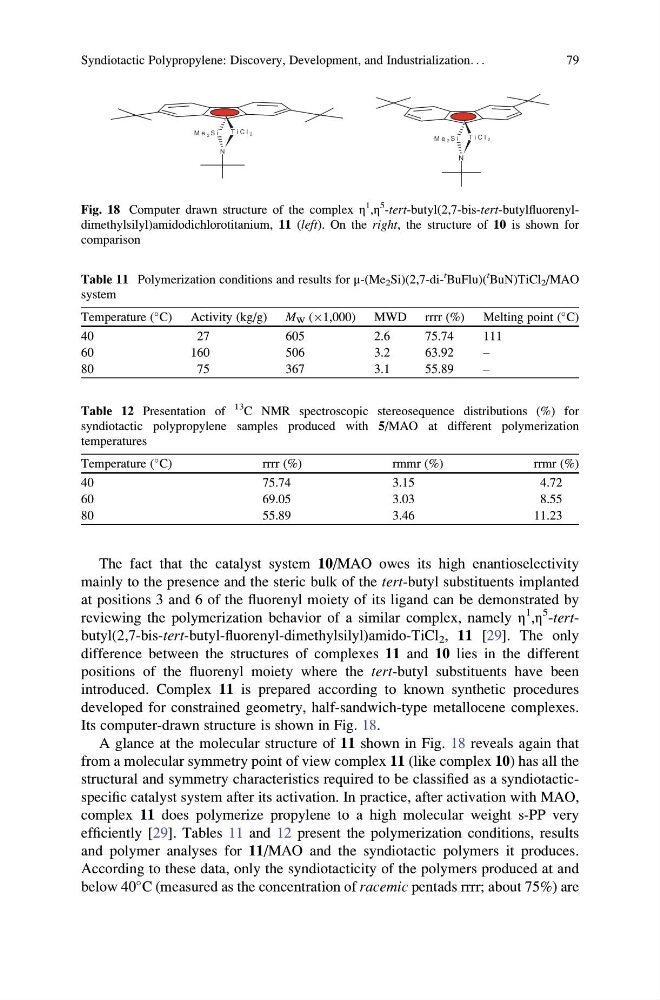
Its computer-drawn structure is shown in Fig. 18.
A glance at the molecular structure of 11 shown in Fig. 18 reveals again that
from a molecular symmetry point of view complex 11 (like complex 10) has all the
structural and symmetry characteristics required to be classified as a syndiotacticspecific catalyst system after its activation. In practice, after activation with MAO,
complex 11 does polymerize propylene to a high molecular weight s-PP very
efficiently [29]. Tables 11 and 12 present the polymerization conditions, results
and polymer analyses for 11/MAO and the syndiotactic polymers it produces.
According to these data, only the syndiotacticity of the polymers produced at and
below 40
C (measured as the concentration of racemic pentads rrrr; about 75%) are
M e 2 S i
M e 2 S i
T i C l 2
T i C l 2
N
N
Fig. 18 Computer drawn structure of the complex η
1
,η
5
-tert-butyl(2,7-bis-tert-butylfluorenyldimethylsilyl)amidodichlorotitanium, 11 (left). On the right, the structure of 10 is shown for
comparison
Table 11 Polymerization conditions and results for μ-(Me 2 Si)(2,7-dit
BuFlu)(
t
BuN)TiCl 2 /MAO
system
Temperature (
C) Activity (kg/g) M W (Â1,000) MWD rrrr (%) Melting point (
C)
40
27
605
2.6
75.74
111
60
160
506
3.2
63.92
–
80
75
367
3.1
55.89
–
Table 12 Presentation of
13
C NMR spectroscopic stereosequence distributions (%) for
syndiotactic polypropylene samples produced with 5/MAO at different polymerization
temperatures
Temperature (
C)
rrrr (%)
rmmr (%)
rrmr (%)
40
75.74
3.15
4.72
60
69.05
3.03
8.55
80
55.89
3.46
11.23
Syndiotactic Polypropylene: Discovery, Development, and Industrialization. . .
79
mainly to the presence and the steric bulk of the tert-butyl substituents implanted
at positions 3 and 6 of the fluorenyl moiety of its ligand can be demonstrated by
reviewing the polymerization behavior of a similar complex, namely η
1 ,η
5 -tertbutyl(2,7-bis-tert-butyl-fluorenyl-dimethylsilyl)amido-TiCl 2 , 11 [29]. The only
difference between the structures of complexes 11 and 10 lies in the different
positions of the fluorenyl moiety where the tert-butyl substituents have been
introduced. Complex 11 is prepared according to known synthetic procedures
developed for constrained geometry, half-sandwich-type metallocene complexes.
Its computer-drawn structure is shown in Fig. 18.
A glance at the molecular structure of 11 shown in Fig. 18 reveals again that
from a molecular symmetry point of view complex 11 (like complex 10) has all the
structural and symmetry characteristics required to be classified as a syndiotacticspecific catalyst system after its activation. In practice, after activation with MAO,
complex 11 does polymerize propylene to a high molecular weight s-PP very
efficiently [29]. Tables 11 and 12 present the polymerization conditions, results
and polymer analyses for 11/MAO and the syndiotactic polymers it produces.
According to these data, only the syndiotacticity of the polymers produced at and
below 40
C (measured as the concentration of racemic pentads rrrr; about 75%) are
M e 2 S i
M e 2 S i
T i C l 2
T i C l 2
N
N
Fig. 18 Computer drawn structure of the complex η
1
,η
5
-tert-butyl(2,7-bis-tert-butylfluorenyldimethylsilyl)amidodichlorotitanium, 11 (left). On the right, the structure of 10 is shown for
comparison
Table 11 Polymerization conditions and results for μ-(Me 2 Si)(2,7-dit
BuFlu)(
t
BuN)TiCl 2 /MAO
system
Temperature (
C) Activity (kg/g) M W (Â1,000) MWD rrrr (%) Melting point (
C)
40
27
605
2.6
75.74
111
60
160
506
3.2
63.92
–
80
75
367
3.1
55.89
–
Table 12 Presentation of
13
C NMR spectroscopic stereosequence distributions (%) for
syndiotactic polypropylene samples produced with 5/MAO at different polymerization
temperatures
Temperature (
C)
rrrr (%)
rmmr (%)
rrmr (%)
40
75.74
3.15
4.72
60
69.05
3.03
8.55
80
55.89
3.46
11.23
Syndiotactic Polypropylene: Discovery, Development, and Industrialization. . .
79