

differ completely from the ligands of complexes 1, 5, 6, and 9 by lacking
a cyclopentadienyl ring. Let us start first with the complex η
1 ,η
5
-tert-butyl
(3,6-bis-tert-butylfluorenyl-dimethylsilyl)amidoTiCl 2 , the half-sandwich complex
10. After activation with MAO, complex 10 very efficiently polymerizes propylene
to high molecular weight s-PP chains [32].
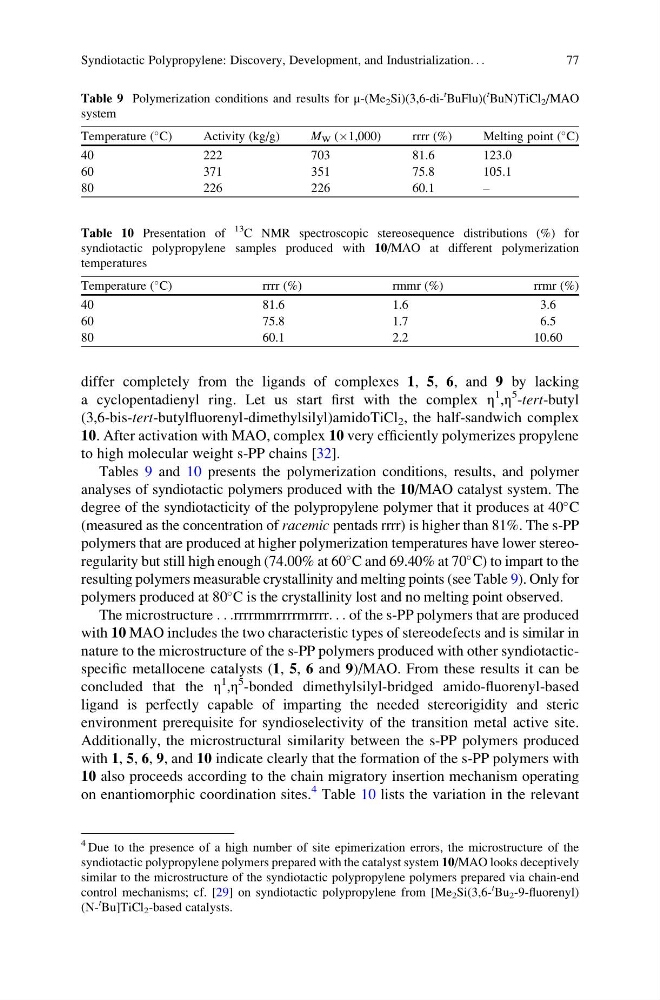
Tables 9 and 10 presents the polymerization conditions, results, and polymer
analyses of syndiotactic polymers produced with the 10/MAO catalyst system. The
degree of the syndiotacticity of the polypropylene polymer that it produces at 40
C
(measured as the concentration of racemic pentads rrrr) is higher than 81%. The s-PP
polymers that are produced at higher polymerization temperatures have lower stereoregularity but still high enough (74.00% at 60
C and 69.40% at 70
C) to impart to the
resulting polymers measurable crystallinity and melting points (see Table 9). Only for
polymers produced at 80
C is the crystallinity lost and no melting point observed.
The microstructure . . .rrrrmmrrrrmrrrr. . . of the s-PP polymers that are produced
with 10 MAO includes the two characteristic types of stereodefects and is similar in
nature to the microstructure of the s-PP polymers produced with other syndiotacticspecific metallocene catalysts (1, 5, 6 and 9)/MAO. From these results it can be
concluded that the η
1 ,η
5 -bonded dimethylsilyl-bridged amido-fluorenyl-based
ligand is perfectly capable of imparting the needed stereorigidity and steric
environment prerequisite for syndioselectivity of the transition metal active site.
Additionally, the microstructural similarity between the s-PP polymers produced
with 1, 5, 6, 9, and 10 indicate clearly that the formation of the s-PP polymers with
10 also proceeds according to the chain migratory insertion mechanism operating
on enantiomorphic coordination sites.
4 Table 10 lists the variation in the relevant
Table 9 Polymerization conditions and results for μ-(Me 2 Si)(3,6-dit
BuFlu)(
t
BuN)TiCl 2 /MAO
system
Temperature (
C)
Activity (kg/g)
M W (Â1,000)
rrrr (%)
Melting point (
C)
40
222
703
81.6
123.0
60
371
351
75.8
105.1
80
226
226
60.1
–
Table 10 Presentation of
13
C NMR spectroscopic stereosequence distributions (%) for
syndiotactic polypropylene samples produced with 10/MAO at different polymerization
temperatures
Temperature (
C)
rrrr (%)
rmmr (%)
rrmr (%)
40
81.6
1.6
3.6
60
75.8
1.7
6.5
80
60.1
2.2
10.60
4 Due to the presence of a high number of site epimerization errors, the microstructure of the
syndiotactic polypropylene polymers prepared with the catalyst system 10/MAO looks deceptively
similar to the microstructure of the syndiotactic polypropylene polymers prepared via chain-end
control mechanisms; cf. [29] on syndiotactic polypropylene from [Me 2 Si(3,6t Bu 2 -9-fluorenyl)
(Nt
Bu]TiCl 2 -based catalysts.
Syndiotactic Polypropylene: Discovery, Development, and Industrialization. . .
77
a cyclopentadienyl ring. Let us start first with the complex η
1 ,η
5
-tert-butyl
(3,6-bis-tert-butylfluorenyl-dimethylsilyl)amidoTiCl 2 , the half-sandwich complex
10. After activation with MAO, complex 10 very efficiently polymerizes propylene
to high molecular weight s-PP chains [32].
Tables 9 and 10 presents the polymerization conditions, results, and polymer
analyses of syndiotactic polymers produced with the 10/MAO catalyst system. The
degree of the syndiotacticity of the polypropylene polymer that it produces at 40
C
(measured as the concentration of racemic pentads rrrr) is higher than 81%. The s-PP
polymers that are produced at higher polymerization temperatures have lower stereoregularity but still high enough (74.00% at 60
C and 69.40% at 70
C) to impart to the
resulting polymers measurable crystallinity and melting points (see Table 9). Only for
polymers produced at 80
C is the crystallinity lost and no melting point observed.
The microstructure . . .rrrrmmrrrrmrrrr. . . of the s-PP polymers that are produced
with 10 MAO includes the two characteristic types of stereodefects and is similar in
nature to the microstructure of the s-PP polymers produced with other syndiotacticspecific metallocene catalysts (1, 5, 6 and 9)/MAO. From these results it can be
concluded that the η
1 ,η
5 -bonded dimethylsilyl-bridged amido-fluorenyl-based
ligand is perfectly capable of imparting the needed stereorigidity and steric
environment prerequisite for syndioselectivity of the transition metal active site.
Additionally, the microstructural similarity between the s-PP polymers produced
with 1, 5, 6, 9, and 10 indicate clearly that the formation of the s-PP polymers with
10 also proceeds according to the chain migratory insertion mechanism operating
on enantiomorphic coordination sites.
4 Table 10 lists the variation in the relevant
Table 9 Polymerization conditions and results for μ-(Me 2 Si)(3,6-dit
BuFlu)(
t
BuN)TiCl 2 /MAO
system
Temperature (
C)
Activity (kg/g)
M W (Â1,000)
rrrr (%)
Melting point (
C)
40
222
703
81.6
123.0
60
371
351
75.8
105.1
80
226
226
60.1
–
Table 10 Presentation of
13
C NMR spectroscopic stereosequence distributions (%) for
syndiotactic polypropylene samples produced with 10/MAO at different polymerization
temperatures
Temperature (
C)
rrrr (%)
rmmr (%)
rrmr (%)
40
81.6
1.6
3.6
60
75.8
1.7
6.5
80
60.1
2.2
10.60
4 Due to the presence of a high number of site epimerization errors, the microstructure of the
syndiotactic polypropylene polymers prepared with the catalyst system 10/MAO looks deceptively
similar to the microstructure of the syndiotactic polypropylene polymers prepared via chain-end
control mechanisms; cf. [29] on syndiotactic polypropylene from [Me 2 Si(3,6t Bu 2 -9-fluorenyl)
(Nt
Bu]TiCl 2 -based catalysts.
Syndiotactic Polypropylene: Discovery, Development, and Industrialization. . .
77