

It is commonly accepted that the syndiotactic-specific catalyst systems are highly
regioselective (the regio-errors are either not present or very low in concentration
and not easily detectable), and the single main source of the stereo-errors in the
syndiospecific polymerization of propylene is enantiomeric mis-insertion, i.e., the
insertion of a monomer unit with the “wrong” enantio-face. The “right” enantio-face
would be the one that allows minimization of repulsive steric interactions between
the olefin’s side group and the growing polymer chain, as well as between the ligands
and the growing polymer chain. This arrangement is best attained when the olefin’s
substituent and the alkyl (polymer) chain are in an “anti” relationship (versus a “syn”
relationship), while at the same time the polymer (alkyl) chain is as far away as
possible from the bulkier sections of the ligand. An enantiomeric mis-insertion event
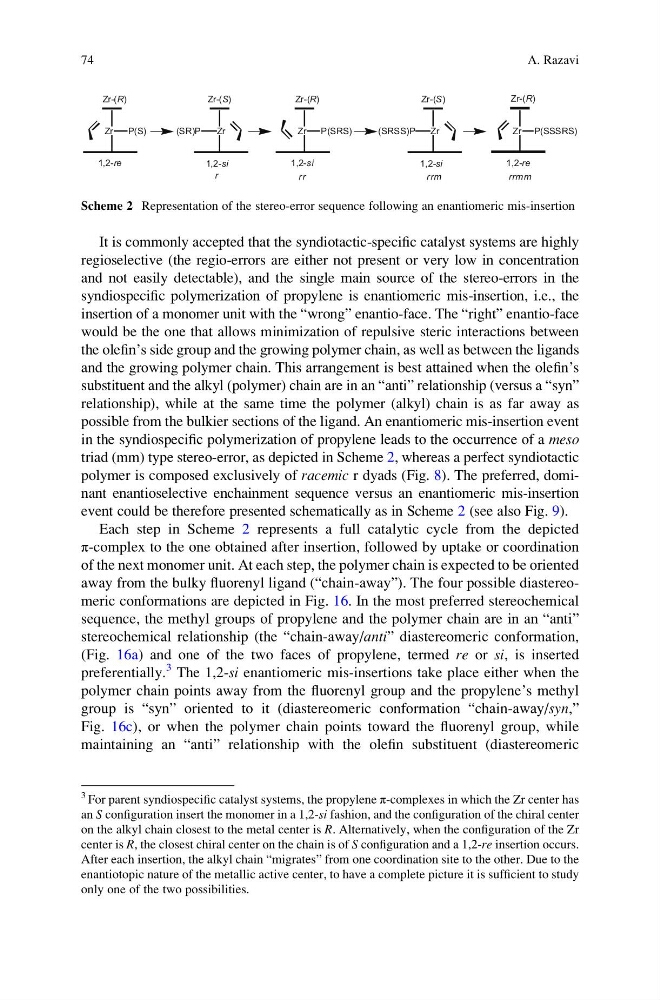
in the syndiospecific polymerization of propylene leads to the occurrence of a meso
triad (mm) type stereo-error, as depicted in Scheme 2, whereas a perfect syndiotactic
polymer is composed exclusively of racemic r dyads (Fig. 8). The preferred, dominant enantioselective enchainment sequence versus an enantiomeric mis-insertion
event could be therefore presented schematically as in Scheme 2 (see also Fig. 9).
Each step in Scheme 2 represents a full catalytic cycle from the depicted
π-complex to the one obtained after insertion, followed by uptake or coordination
of the next monomer unit. At each step, the polymer chain is expected to be oriented
away from the bulky fluorenyl ligand (“chain-away”). The four possible diastereomeric conformations are depicted in Fig. 16. In the most preferred stereochemical
sequence, the methyl groups of propylene and the polymer chain are in an “anti”
stereochemical relationship (the “chain-away/anti” diastereomeric conformation,
(Fig. 16a) and one of the two faces of propylene, termed re or si, is inserted
preferentially.
3 The 1,2-si enantiomeric mis-insertions take place either when the
polymer chain points away from the fluorenyl group and the propylene’s methyl
group is “syn” oriented to it (diastereomeric conformation “chain-away/syn,”
Fig. 16c), or when the polymer chain points toward the fluorenyl group, while
maintaining an “anti” relationship with the olefin substituent (diastereomeric
Zr
P(S)
Zr
(SR)P
Zr
P(SRS)
Zr
(SRSS)P
Zr P(SSSRS)
Zr-(R)
Z r - ( S)
Z r - ( R)
Z r - ( S)
Zr-(R)
1,2-re
1,2-si
1,2-si
1,2-si
1,2-re
r
rr
rrm
rrmm
Scheme 2 Representation of the stereo-error sequence following an enantiomeric mis-insertion
3 For parent syndiospecific catalyst systems, the propylene π-complexes in which the Zr center has
an S configuration insert the monomer in a 1,2-si fashion, and the configuration of the chiral center
on the alkyl chain closest to the metal center is R. Alternatively, when the configuration of the Zr
center is R, the closest chiral center on the chain is of S configuration and a 1,2-re insertion occurs.
After each insertion, the alkyl chain “migrates” from one coordination site to the other. Due to the
enantiotopic nature of the metallic active center, to have a complete picture it is sufficient to study
only one of the two possibilities.
74
A. Razavi
regioselective (the regio-errors are either not present or very low in concentration
and not easily detectable), and the single main source of the stereo-errors in the
syndiospecific polymerization of propylene is enantiomeric mis-insertion, i.e., the
insertion of a monomer unit with the “wrong” enantio-face. The “right” enantio-face
would be the one that allows minimization of repulsive steric interactions between
the olefin’s side group and the growing polymer chain, as well as between the ligands
and the growing polymer chain. This arrangement is best attained when the olefin’s
substituent and the alkyl (polymer) chain are in an “anti” relationship (versus a “syn”
relationship), while at the same time the polymer (alkyl) chain is as far away as
possible from the bulkier sections of the ligand. An enantiomeric mis-insertion event
in the syndiospecific polymerization of propylene leads to the occurrence of a meso
triad (mm) type stereo-error, as depicted in Scheme 2, whereas a perfect syndiotactic
polymer is composed exclusively of racemic r dyads (Fig. 8). The preferred, dominant enantioselective enchainment sequence versus an enantiomeric mis-insertion
event could be therefore presented schematically as in Scheme 2 (see also Fig. 9).
Each step in Scheme 2 represents a full catalytic cycle from the depicted
π-complex to the one obtained after insertion, followed by uptake or coordination
of the next monomer unit. At each step, the polymer chain is expected to be oriented
away from the bulky fluorenyl ligand (“chain-away”). The four possible diastereomeric conformations are depicted in Fig. 16. In the most preferred stereochemical
sequence, the methyl groups of propylene and the polymer chain are in an “anti”
stereochemical relationship (the “chain-away/anti” diastereomeric conformation,
(Fig. 16a) and one of the two faces of propylene, termed re or si, is inserted
preferentially.
3 The 1,2-si enantiomeric mis-insertions take place either when the
polymer chain points away from the fluorenyl group and the propylene’s methyl
group is “syn” oriented to it (diastereomeric conformation “chain-away/syn,”
Fig. 16c), or when the polymer chain points toward the fluorenyl group, while
maintaining an “anti” relationship with the olefin substituent (diastereomeric
Zr
P(S)
Zr
(SR)P
Zr
P(SRS)
Zr
(SRSS)P
Zr P(SSSRS)
Zr-(R)
Z r - ( S)
Z r - ( R)
Z r - ( S)
Zr-(R)
1,2-re
1,2-si
1,2-si
1,2-si
1,2-re
r
rr
rrm
rrmm
Scheme 2 Representation of the stereo-error sequence following an enantiomeric mis-insertion
3 For parent syndiospecific catalyst systems, the propylene π-complexes in which the Zr center has
an S configuration insert the monomer in a 1,2-si fashion, and the configuration of the chiral center
on the alkyl chain closest to the metal center is R. Alternatively, when the configuration of the Zr
center is R, the closest chiral center on the chain is of S configuration and a 1,2-re insertion occurs.
After each insertion, the alkyl chain “migrates” from one coordination site to the other. Due to the
enantiotopic nature of the metallic active center, to have a complete picture it is sufficient to study
only one of the two possibilities.
74
A. Razavi