

4.2 Computational Calculations: Determination and/or
Prediction of Enantioselectivity of Syndiospecific
Catalyst Systems
The experimental results concerning the effect of frontal substituent on the enantioselectivity of syndiotactic-specific metallocene catalysts can be further consolidated by
computational calculations in a general and universal way. The computational
calculations deliver the means for not only calculating the enantioselectivity of real
and experimentally tested catalyst systems but also the ability to predict the enantioselectivity of hypothetical systems. In this section, the results of such computational
calculations for three catalyst systems with a basic isopropylidene-bridged
cyclopentadienyl-fluorenyl ligand skeleton are presented. The three chosen structures,
for the reasons mentioned above, differ only by the gradually increasing size of the
substituents located at positions 3 and 6 of their fluorenyl moieties. For the real catalyst
systems, the catalysts 1/MAO (system 1) and 9/MAO (system 3) were selected.
Additionally, a catalyst with a hypothetical structure, the isopropylidene(cyclopentadienyl-bis-3,6-dimethyl-fluorenyl)ZrCl 2 , 3,6-dimethyfluorenyl-substituted version
of complex 1 (system 2), is included for the calculation. The geometry of the model
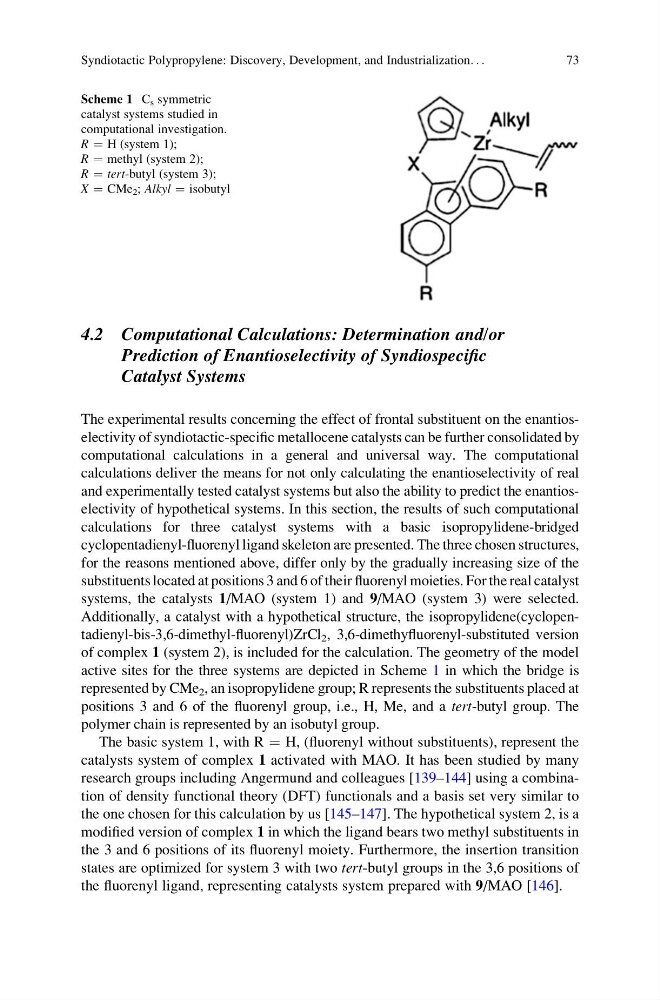
active sites for the three systems are depicted in Scheme 1 in which the bridge is
represented by CMe 2 , an isopropylidene group; R represents the substituents placed at
positions 3 and 6 of the fluorenyl group, i.e., H, Me, and a tert-butyl group. The
polymer chain is represented by an isobutyl group.
The basic system 1, with R ¼ H, (fluorenyl without substituents), represent the
catalysts system of complex 1 activated with MAO. It has been studied by many
research groups including Angermund and colleagues [139–144] using a combination of density functional theory (DFT) functionals and a basis set very similar to
the one chosen for this calculation by us [145–147]. The hypothetical system 2, is a
modified version of complex 1 in which the ligand bears two methyl substituents in
the 3 and 6 positions of its fluorenyl moiety. Furthermore, the insertion transition
states are optimized for system 3 with two tert-butyl groups in the 3,6 positions of
the fluorenyl ligand, representing catalysts system prepared with 9/MAO [146].
Scheme 1 C s symmetric
catalyst systems studied in
computational investigation.
R ¼ H (system 1);
R ¼ methyl (system 2);
R ¼ tert-butyl (system 3);
X ¼ CMe 2 ; Alkyl ¼ isobutyl
Syndiotactic Polypropylene: Discovery, Development, and Industrialization. . .
73
Prediction of Enantioselectivity of Syndiospecific
Catalyst Systems
The experimental results concerning the effect of frontal substituent on the enantioselectivity of syndiotactic-specific metallocene catalysts can be further consolidated by
computational calculations in a general and universal way. The computational
calculations deliver the means for not only calculating the enantioselectivity of real
and experimentally tested catalyst systems but also the ability to predict the enantioselectivity of hypothetical systems. In this section, the results of such computational
calculations for three catalyst systems with a basic isopropylidene-bridged
cyclopentadienyl-fluorenyl ligand skeleton are presented. The three chosen structures,
for the reasons mentioned above, differ only by the gradually increasing size of the
substituents located at positions 3 and 6 of their fluorenyl moieties. For the real catalyst
systems, the catalysts 1/MAO (system 1) and 9/MAO (system 3) were selected.
Additionally, a catalyst with a hypothetical structure, the isopropylidene(cyclopentadienyl-bis-3,6-dimethyl-fluorenyl)ZrCl 2 , 3,6-dimethyfluorenyl-substituted version
of complex 1 (system 2), is included for the calculation. The geometry of the model
active sites for the three systems are depicted in Scheme 1 in which the bridge is
represented by CMe 2 , an isopropylidene group; R represents the substituents placed at
positions 3 and 6 of the fluorenyl group, i.e., H, Me, and a tert-butyl group. The
polymer chain is represented by an isobutyl group.
The basic system 1, with R ¼ H, (fluorenyl without substituents), represent the
catalysts system of complex 1 activated with MAO. It has been studied by many
research groups including Angermund and colleagues [139–144] using a combination of density functional theory (DFT) functionals and a basis set very similar to
the one chosen for this calculation by us [145–147]. The hypothetical system 2, is a
modified version of complex 1 in which the ligand bears two methyl substituents in
the 3 and 6 positions of its fluorenyl moiety. Furthermore, the insertion transition
states are optimized for system 3 with two tert-butyl groups in the 3,6 positions of
the fluorenyl ligand, representing catalysts system prepared with 9/MAO [146].
Scheme 1 C s symmetric
catalyst systems studied in
computational investigation.
R ¼ H (system 1);
R ¼ methyl (system 2);
R ¼ tert-butyl (system 3);
X ¼ CMe 2 ; Alkyl ¼ isobutyl
Syndiotactic Polypropylene: Discovery, Development, and Industrialization. . .
73