

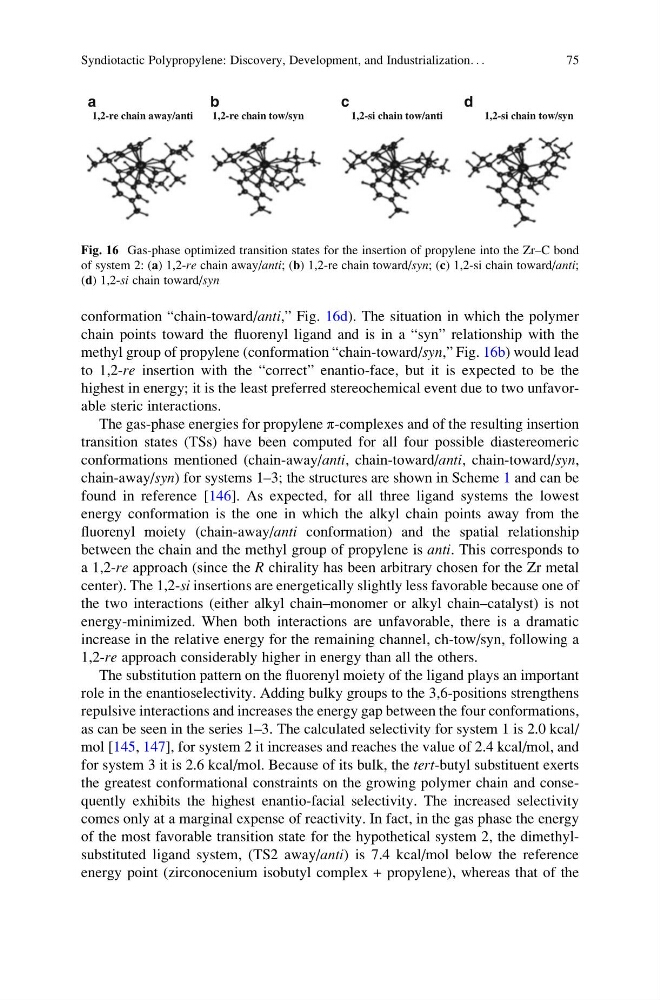
conformation “chain-toward/anti,” Fig. 16d). The situation in which the polymer
chain points toward the fluorenyl ligand and is in a “syn” relationship with the
methyl group of propylene (conformation “chain-toward/syn,” Fig. 16b) would lead
to 1,2-re insertion with the “correct” enantio-face, but it is expected to be the
highest in energy; it is the least preferred stereochemical event due to two unfavorable steric interactions.
The gas-phase energies for propylene π-complexes and of the resulting insertion
transition states (TSs) have been computed for all four possible diastereomeric
conformations mentioned (chain-away/anti, chain-toward/anti, chain-toward/syn,
chain-away/syn) for systems 1–3; the structures are shown in Scheme 1 and can be
found in reference [146]. As expected, for all three ligand systems the lowest
energy conformation is the one in which the alkyl chain points away from the
fluorenyl moiety (chain-away/anti conformation) and the spatial relationship
between the chain and the methyl group of propylene is anti. This corresponds to
a 1,2-re approach (since the R chirality has been arbitrary chosen for the Zr metal
center). The 1,2-si insertions are energetically slightly less favorable because one of
the two interactions (either alkyl chain–monomer or alkyl chain–catalyst) is not
energy-minimized. When both interactions are unfavorable, there is a dramatic
increase in the relative energy for the remaining channel, ch-tow/syn, following a
1,2-re approach considerably higher in energy than all the others.
The substitution pattern on the fluorenyl moiety of the ligand plays an important
role in the enantioselectivity. Adding bulky groups to the 3,6-positions strengthens
repulsive interactions and increases the energy gap between the four conformations,
as can be seen in the series 1–3. The calculated selectivity for system 1 is 2.0 kcal/
mol [145, 147], for system 2 it increases and reaches the value of 2.4 kcal/mol, and
for system 3 it is 2.6 kcal/mol. Because of its bulk, the tert-butyl substituent exerts
the greatest conformational constraints on the growing polymer chain and consequently exhibits the highest enantio-facial selectivity. The increased selectivity
comes only at a marginal expense of reactivity. In fact, in the gas phase the energy
of the most favorable transition state for the hypothetical system 2, the dimethylsubstituted ligand system, (TS2 away/anti) is 7.4 kcal/mol below the reference
energy point (zirconocenium isobutyl complex + propylene), whereas that of the
1,2-re chain away/anti
1,2-re chain tow/syn
1,2-si chain tow/anti
1,2-si chain tow/syn
a
b
c
d
Fig. 16 Gas-phase optimized transition states for the insertion of propylene into the Zr–C bond
of system 2: (a) 1,2-re chain away/anti; (b) 1,2-re chain toward/syn; (c) 1,2-si chain toward/anti;
(d) 1,2-si chain toward/syn
Syndiotactic Polypropylene: Discovery, Development, and Industrialization. . .
75
chain points toward the fluorenyl ligand and is in a “syn” relationship with the
methyl group of propylene (conformation “chain-toward/syn,” Fig. 16b) would lead
to 1,2-re insertion with the “correct” enantio-face, but it is expected to be the
highest in energy; it is the least preferred stereochemical event due to two unfavorable steric interactions.
The gas-phase energies for propylene π-complexes and of the resulting insertion
transition states (TSs) have been computed for all four possible diastereomeric
conformations mentioned (chain-away/anti, chain-toward/anti, chain-toward/syn,
chain-away/syn) for systems 1–3; the structures are shown in Scheme 1 and can be
found in reference [146]. As expected, for all three ligand systems the lowest
energy conformation is the one in which the alkyl chain points away from the
fluorenyl moiety (chain-away/anti conformation) and the spatial relationship
between the chain and the methyl group of propylene is anti. This corresponds to
a 1,2-re approach (since the R chirality has been arbitrary chosen for the Zr metal
center). The 1,2-si insertions are energetically slightly less favorable because one of
the two interactions (either alkyl chain–monomer or alkyl chain–catalyst) is not
energy-minimized. When both interactions are unfavorable, there is a dramatic
increase in the relative energy for the remaining channel, ch-tow/syn, following a
1,2-re approach considerably higher in energy than all the others.
The substitution pattern on the fluorenyl moiety of the ligand plays an important
role in the enantioselectivity. Adding bulky groups to the 3,6-positions strengthens
repulsive interactions and increases the energy gap between the four conformations,
as can be seen in the series 1–3. The calculated selectivity for system 1 is 2.0 kcal/
mol [145, 147], for system 2 it increases and reaches the value of 2.4 kcal/mol, and
for system 3 it is 2.6 kcal/mol. Because of its bulk, the tert-butyl substituent exerts
the greatest conformational constraints on the growing polymer chain and consequently exhibits the highest enantio-facial selectivity. The increased selectivity
comes only at a marginal expense of reactivity. In fact, in the gas phase the energy
of the most favorable transition state for the hypothetical system 2, the dimethylsubstituted ligand system, (TS2 away/anti) is 7.4 kcal/mol below the reference
energy point (zirconocenium isobutyl complex + propylene), whereas that of the
1,2-re chain away/anti
1,2-re chain tow/syn
1,2-si chain tow/anti
1,2-si chain tow/syn
a
b
c
d
Fig. 16 Gas-phase optimized transition states for the insertion of propylene into the Zr–C bond
of system 2: (a) 1,2-re chain away/anti; (b) 1,2-re chain toward/syn; (c) 1,2-si chain toward/anti;
(d) 1,2-si chain toward/syn
Syndiotactic Polypropylene: Discovery, Development, and Industrialization. . .
75