

2.3 Polymerization Behavior of 1/MAO and 2/MAO Catalyst
Systems
As mentioned above, the activation of the metallocene dichlorides 1 and 2 with MAO
provides very efficient catalysts for polymerization of propylene to high molecular
weight, highly crystalline s-PP polymers. Detailed propylene polymerization
conditions, results, and polymer analysis with 1 and 2/MAO catalyst systems are
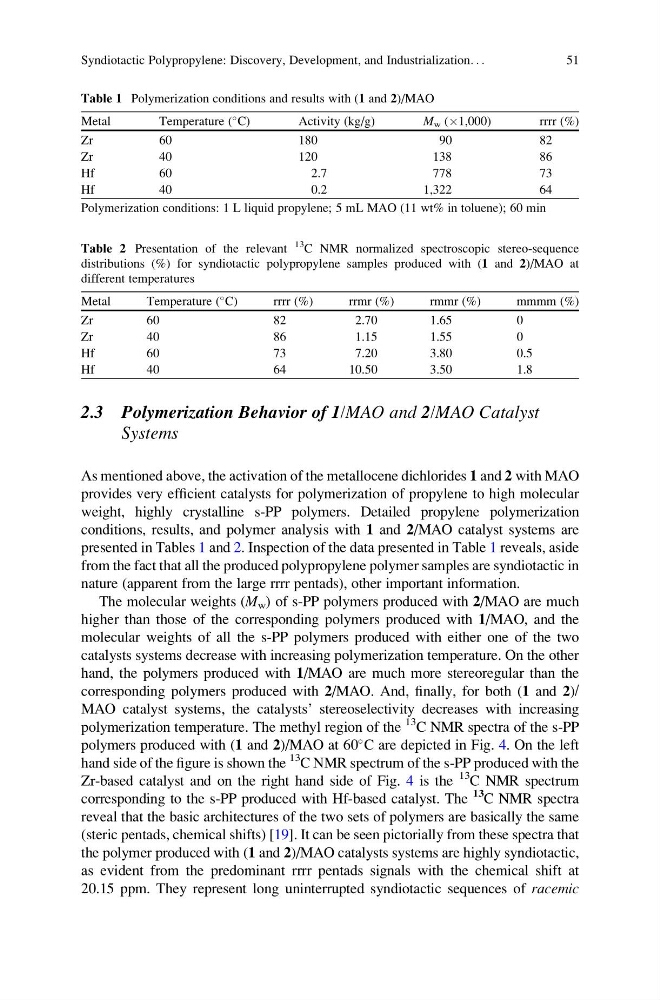
presented in Tables 1 and 2. Inspection of the data presented in Table 1 reveals, aside
from the fact that all the produced polypropylene polymer samples are syndiotactic in
nature (apparent from the large rrrr pentads), other important information.
The molecular weights (M w ) of s-PP polymers produced with 2/MAO are much
higher than those of the corresponding polymers produced with 1/MAO, and the
molecular weights of all the s-PP polymers produced with either one of the two
catalysts systems decrease with increasing polymerization temperature. On the other
hand, the polymers produced with 1/MAO are much more stereoregular than the
corresponding polymers produced with 2/MAO. And, finally, for both (1 and 2)/
MAO catalyst systems, the catalysts’ stereoselectivity decreases with increasing
polymerization temperature. The methyl region of the
13
C NMR spectra of the s-PP
polymers produced with (1 and 2)/MAO at 60
C are depicted in Fig. 4. On the left
hand side of the figure is shown the
13
C NMR spectrum of the s-PP produced with the
Zr-based catalyst and on the right hand side of Fig. 4 is the
13
C NMR spectrum
corresponding to the s-PP produced with Hf-based catalyst. The
13
C NMR spectra
reveal that the basic architectures of the two sets of polymers are basically the same
(steric pentads, chemical shifts) [19]. It can be seen pictorially from these spectra that
the polymer produced with (1 and 2)/MAO catalysts systems are highly syndiotactic,
as evident from the predominant rrrr pentads signals with the chemical shift at
20.15 ppm. They represent long uninterrupted syndiotactic sequences of racemic
Table 1 Polymerization conditions and results with (1 and 2)/MAO
Metal
Temperature (
C)
Activity (kg/g)
M w (Â1,000)
rrrr (%)
Zr
60
180
90
82
Zr
40
120
138
86
Hf
60
2.7
778
73
Hf
40
0.2
1,322
64
Polymerization conditions: 1 L liquid propylene; 5 mL MAO (11 wt% in toluene); 60 min
Table 2 Presentation of the relevant
13
C NMR normalized spectroscopic stereo-sequence
distributions (%) for syndiotactic polypropylene samples produced with (1 and 2)/MAO at
different temperatures
Metal
Temperature (
C)
rrrr (%)
rrmr (%)
rmmr (%)
mmmm (%)
Zr
60
82
2.70
1.65
0
Zr
40
86
1.15
1.55
0
Hf
60
73
7.20
3.80
0.5
Hf
40
64
10.50
3.50
1.8
Syndiotactic Polypropylene: Discovery, Development, and Industrialization. . .
51
Systems
As mentioned above, the activation of the metallocene dichlorides 1 and 2 with MAO
provides very efficient catalysts for polymerization of propylene to high molecular
weight, highly crystalline s-PP polymers. Detailed propylene polymerization
conditions, results, and polymer analysis with 1 and 2/MAO catalyst systems are
presented in Tables 1 and 2. Inspection of the data presented in Table 1 reveals, aside
from the fact that all the produced polypropylene polymer samples are syndiotactic in
nature (apparent from the large rrrr pentads), other important information.
The molecular weights (M w ) of s-PP polymers produced with 2/MAO are much
higher than those of the corresponding polymers produced with 1/MAO, and the
molecular weights of all the s-PP polymers produced with either one of the two
catalysts systems decrease with increasing polymerization temperature. On the other
hand, the polymers produced with 1/MAO are much more stereoregular than the
corresponding polymers produced with 2/MAO. And, finally, for both (1 and 2)/
MAO catalyst systems, the catalysts’ stereoselectivity decreases with increasing
polymerization temperature. The methyl region of the
13
C NMR spectra of the s-PP
polymers produced with (1 and 2)/MAO at 60
C are depicted in Fig. 4. On the left
hand side of the figure is shown the
13
C NMR spectrum of the s-PP produced with the
Zr-based catalyst and on the right hand side of Fig. 4 is the
13
C NMR spectrum
corresponding to the s-PP produced with Hf-based catalyst. The
13
C NMR spectra
reveal that the basic architectures of the two sets of polymers are basically the same
(steric pentads, chemical shifts) [19]. It can be seen pictorially from these spectra that
the polymer produced with (1 and 2)/MAO catalysts systems are highly syndiotactic,
as evident from the predominant rrrr pentads signals with the chemical shift at
20.15 ppm. They represent long uninterrupted syndiotactic sequences of racemic
Table 1 Polymerization conditions and results with (1 and 2)/MAO
Metal
Temperature (
C)
Activity (kg/g)
M w (Â1,000)
rrrr (%)
Zr
60
180
90
82
Zr
40
120
138
86
Hf
60
2.7
778
73
Hf
40
0.2
1,322
64
Polymerization conditions: 1 L liquid propylene; 5 mL MAO (11 wt% in toluene); 60 min
Table 2 Presentation of the relevant
13
C NMR normalized spectroscopic stereo-sequence
distributions (%) for syndiotactic polypropylene samples produced with (1 and 2)/MAO at
different temperatures
Metal
Temperature (
C)
rrrr (%)
rrmr (%)
rmmr (%)
mmmm (%)
Zr
60
82
2.70
1.65
0
Zr
40
86
1.15
1.55
0
Hf
60
73
7.20
3.80
0.5
Hf
40
64
10.50
3.50
1.8
Syndiotactic Polypropylene: Discovery, Development, and Industrialization. . .
51