

dyads, r, in the backbone of the individual polymer chains. The
13
C NMR spectra also
reveal the appearance of other small signals characteristic for stereodefects in
the backbone syndiotactic polymer chains due to occasional errors made by the
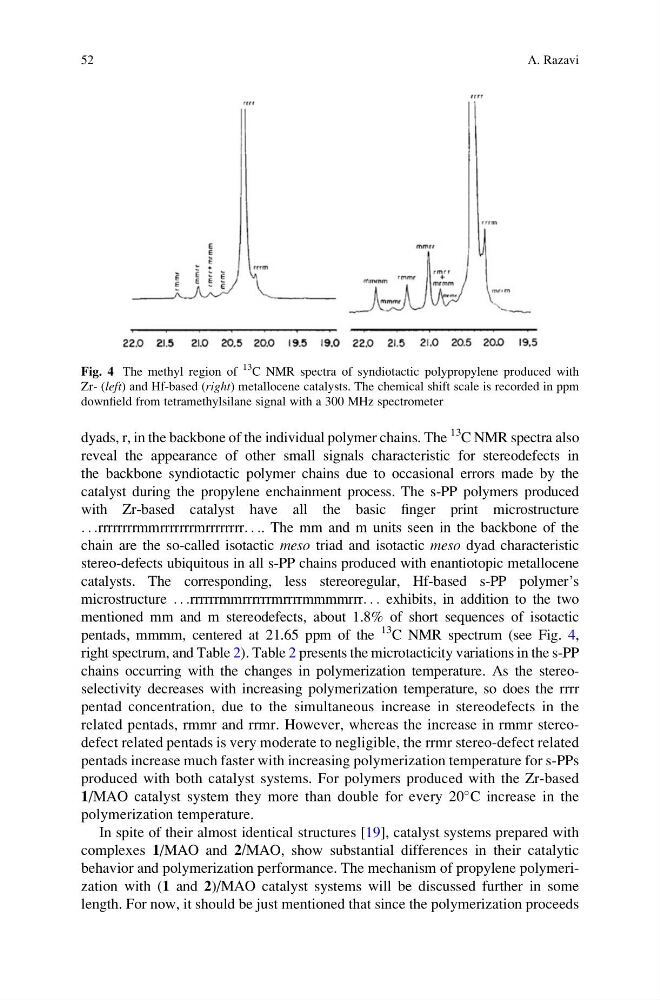
catalyst during the propylene enchainment process. The s-PP polymers produced
with Zr-based catalyst have all the basic finger print microstructure
. . .rrrrrrrrmmrrrrrrrmrrrrrrrr. . .. The mm and m units seen in the backbone of the
chain are the so-called isotactic meso triad and isotactic meso dyad characteristic
stereo-defects ubiquitous in all s-PP chains produced with enantiotopic metallocene
catalysts. The corresponding, less stereoregular, Hf-based s-PP polymer’s
microstructure . . .rrrrrrmmrrrrrrmrrrrmmmmrrr. . . exhibits, in addition to the two
mentioned mm and m stereodefects, about 1.8% of short sequences of isotactic
pentads, mmmm, centered at 21.65 ppm of the
13
C NMR spectrum (see Fig. 4,
right spectrum, and Table 2). Table 2 presents the microtacticity variations in the s-PP
chains occurring with the changes in polymerization temperature. As the stereoselectivity decreases with increasing polymerization temperature, so does the rrrr
pentad concentration, due to the simultaneous increase in stereodefects in the
related pentads, rmmr and rrmr. However, whereas the increase in rmmr stereodefect related pentads is very moderate to negligible, the rrmr stereo-defect related
pentads increase much faster with increasing polymerization temperature for s-PPs
produced with both catalyst systems. For polymers produced with the Zr-based
1/MAO catalyst system they more than double for every 20
C increase in the
polymerization temperature.
In spite of their almost identical structures [19], catalyst systems prepared with
complexes 1/MAO and 2/MAO, show substantial differences in their catalytic
behavior and polymerization performance. The mechanism of propylene polymerization with (1 and 2)/MAO catalyst systems will be discussed further in some
length. For now, it should be just mentioned that since the polymerization proceeds
Fig. 4 The methyl region of
13
C NMR spectra of syndiotactic polypropylene produced with
Zr- (left) and Hf-based (right) metallocene catalysts. The chemical shift scale is recorded in ppm
downfield from tetramethylsilane signal with a 300 MHz spectrometer
52
A. Razavi
13
C NMR spectra also
reveal the appearance of other small signals characteristic for stereodefects in
the backbone syndiotactic polymer chains due to occasional errors made by the
catalyst during the propylene enchainment process. The s-PP polymers produced
with Zr-based catalyst have all the basic finger print microstructure
. . .rrrrrrrrmmrrrrrrrmrrrrrrrr. . .. The mm and m units seen in the backbone of the
chain are the so-called isotactic meso triad and isotactic meso dyad characteristic
stereo-defects ubiquitous in all s-PP chains produced with enantiotopic metallocene
catalysts. The corresponding, less stereoregular, Hf-based s-PP polymer’s
microstructure . . .rrrrrrmmrrrrrrmrrrrmmmmrrr. . . exhibits, in addition to the two
mentioned mm and m stereodefects, about 1.8% of short sequences of isotactic
pentads, mmmm, centered at 21.65 ppm of the
13
C NMR spectrum (see Fig. 4,
right spectrum, and Table 2). Table 2 presents the microtacticity variations in the s-PP
chains occurring with the changes in polymerization temperature. As the stereoselectivity decreases with increasing polymerization temperature, so does the rrrr
pentad concentration, due to the simultaneous increase in stereodefects in the
related pentads, rmmr and rrmr. However, whereas the increase in rmmr stereodefect related pentads is very moderate to negligible, the rrmr stereo-defect related
pentads increase much faster with increasing polymerization temperature for s-PPs
produced with both catalyst systems. For polymers produced with the Zr-based
1/MAO catalyst system they more than double for every 20
C increase in the
polymerization temperature.
In spite of their almost identical structures [19], catalyst systems prepared with
complexes 1/MAO and 2/MAO, show substantial differences in their catalytic
behavior and polymerization performance. The mechanism of propylene polymerization with (1 and 2)/MAO catalyst systems will be discussed further in some
length. For now, it should be just mentioned that since the polymerization proceeds
Fig. 4 The methyl region of
13
C NMR spectra of syndiotactic polypropylene produced with
Zr- (left) and Hf-based (right) metallocene catalysts. The chemical shift scale is recorded in ppm
downfield from tetramethylsilane signal with a 300 MHz spectrometer
52
A. Razavi