

As expected, complex 3 is very active for catalytic polymerization of propylene to
s-PP, and the microstructures and molecular weights of the s-PP polymers it produces
are very close to the properties of syndiotactic polymers obtained with the complex 1/
MAO catalyst system, prepared under the same polymerization condition. All
attempts to isolate the polymerization active cationic reaction intermediate, [(η
5
-
C 5 H 4 -μ-CMe 2 -η
5
-C 13 H 8 )Zr
+
Me][B(C 6 F 5 ) 4 ], in crystalline form for X-ray structure
determination failed. However, it could be isolated, in its stabilized form, after the
addition of one equivalent of the reagent tri-methyl-phosphine, PMe 3 , to a solution of
the catalytically active complex 3 in toluene. The resulting dark purple reaction
product, complex 4, [(η
5
-C 5 H 4 -μ-CMe 2 -η
5
-C 13 H 8 )Zr
+
Me(PMe 3 )][
À
B(C 6 F 5 ) 4 ] could
be crystallized out of the solution and was isolated in pure form and identified by its
1
H
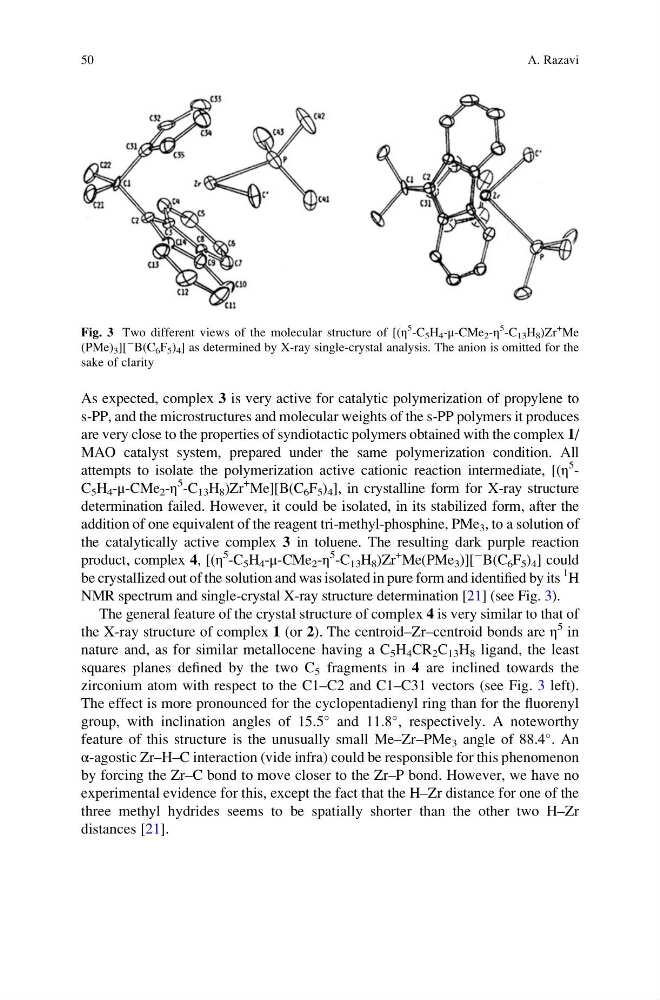
NMR spectrum and single-crystal X-ray structure determination [21] (see Fig. 3).
The general feature of the crystal structure of complex 4 is very similar to that of
the X-ray structure of complex 1 (or 2). The centroid–Zr–centroid bonds are η
5 in
nature and, as for similar metallocene having a C 5 H 4 CR 2 C 13 H 8 ligand, the least
squares planes defined by the two C 5 fragments in 4 are inclined towards the
zirconium atom with respect to the C1–C2 and C1–C31 vectors (see Fig. 3 left).
The effect is more pronounced for the cyclopentadienyl ring than for the fluorenyl
group, with inclination angles of 15.5
and 11.8
, respectively. A noteworthy
feature of this structure is the unusually small Me–Zr–PMe 3 angle of 88.4
. An
α-agostic Zr–H–C interaction (vide infra) could be responsible for this phenomenon
by forcing the Zr–C bond to move closer to the Zr–P bond. However, we have no
experimental evidence for this, except the fact that the H–Zr distance for one of the
three methyl hydrides seems to be spatially shorter than the other two H–Zr
distances [21].
Fig. 3 Two different views of the molecular structure of [(η
5
-C 5 H 4 -μ-CMe 2 -η
5
-C 13 H 8 )Zr
+ Me
(PMe) 3 ][
À
B(C 6 F 5 ) 4 ] as determined by X-ray single-crystal analysis. The anion is omitted for the
sake of clarity
50
A. Razavi
s-PP, and the microstructures and molecular weights of the s-PP polymers it produces
are very close to the properties of syndiotactic polymers obtained with the complex 1/
MAO catalyst system, prepared under the same polymerization condition. All
attempts to isolate the polymerization active cationic reaction intermediate, [(η
5
-
C 5 H 4 -μ-CMe 2 -η
5
-C 13 H 8 )Zr
+
Me][B(C 6 F 5 ) 4 ], in crystalline form for X-ray structure
determination failed. However, it could be isolated, in its stabilized form, after the
addition of one equivalent of the reagent tri-methyl-phosphine, PMe 3 , to a solution of
the catalytically active complex 3 in toluene. The resulting dark purple reaction
product, complex 4, [(η
5
-C 5 H 4 -μ-CMe 2 -η
5
-C 13 H 8 )Zr
+
Me(PMe 3 )][
À
B(C 6 F 5 ) 4 ] could
be crystallized out of the solution and was isolated in pure form and identified by its
1
H
NMR spectrum and single-crystal X-ray structure determination [21] (see Fig. 3).
The general feature of the crystal structure of complex 4 is very similar to that of
the X-ray structure of complex 1 (or 2). The centroid–Zr–centroid bonds are η
5 in
nature and, as for similar metallocene having a C 5 H 4 CR 2 C 13 H 8 ligand, the least
squares planes defined by the two C 5 fragments in 4 are inclined towards the
zirconium atom with respect to the C1–C2 and C1–C31 vectors (see Fig. 3 left).
The effect is more pronounced for the cyclopentadienyl ring than for the fluorenyl
group, with inclination angles of 15.5
and 11.8
, respectively. A noteworthy
feature of this structure is the unusually small Me–Zr–PMe 3 angle of 88.4
. An
α-agostic Zr–H–C interaction (vide infra) could be responsible for this phenomenon
by forcing the Zr–C bond to move closer to the Zr–P bond. However, we have no
experimental evidence for this, except the fact that the H–Zr distance for one of the
three methyl hydrides seems to be spatially shorter than the other two H–Zr
distances [21].
Fig. 3 Two different views of the molecular structure of [(η
5
-C 5 H 4 -μ-CMe 2 -η
5
-C 13 H 8 )Zr
+ Me
(PMe) 3 ][
À
B(C 6 F 5 ) 4 ] as determined by X-ray single-crystal analysis. The anion is omitted for the
sake of clarity
50
A. Razavi