

Highly active and more well-defined catalyst systems have become accessible
by reaction of a zirconocene alkyl precursor with one of several “cationization”
reagents that contain a trityl or dimethylanilinum cation capable of abstracting an
alkyl anion from this precursor. An inert tetra(perfluorophenyl) borate or related
anion coordinates only weakly to the resulting alkyl zirconocenium cation in an
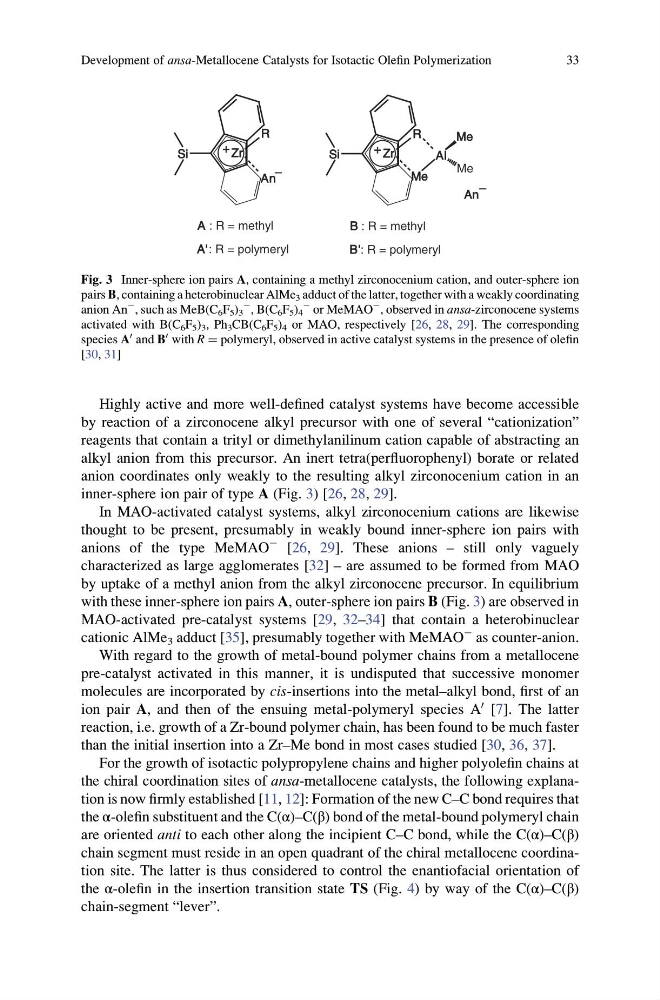
inner-sphere ion pair of type A (Fig. 3) [26, 28, 29].
In MAO-activated catalyst systems, alkyl zirconocenium cations are likewise
thought to be present, presumably in weakly bound inner-sphere ion pairs with
anions of the type MeMAO
À [26, 29]. These anions – still only vaguely
characterized as large agglomerates [32] – are assumed to be formed from MAO
by uptake of a methyl anion from the alkyl zirconocene precursor. In equilibrium
with these inner-sphere ion pairs A, outer-sphere ion pairs B (Fig. 3) are observed in
MAO-activated pre-catalyst systems [29, 32–34] that contain a heterobinuclear
cationic AlMe 3 adduct [35], presumably together with MeMAO
À as counter-anion.
With regard to the growth of metal-bound polymer chains from a metallocene
pre-catalyst activated in this manner, it is undisputed that successive monomer
molecules are incorporated by cis-insertions into the metal–alkyl bond, first of an
ion pair A, and then of the ensuing metal-polymeryl species A
0 [7]. The latter
reaction, i.e. growth of a Zr-bound polymer chain, has been found to be much faster
than the initial insertion into a Zr–Me bond in most cases studied [30, 36, 37].
For the growth of isotactic polypropylene chains and higher polyolefin chains at
the chiral coordination sites of ansa-metallocene catalysts, the following explanation is now firmly established [11, 12]: Formation of the new C–C bond requires that
the α-olefin substituent and the C(α)–C(β) bond of the metal-bound polymeryl chain
are oriented anti to each other along the incipient C–C bond, while the C(α)–C(β)
chain segment must reside in an open quadrant of the chiral metallocene coordination site. The latter is thus considered to control the enantiofacial orientation of
the α-olefin in the insertion transition state TS (Fig. 4) by way of the C(α)–C(β)
chain-segment “lever”.
Si
Zr
R
An
Si
Zr
R
Me
Al
Me Me
Me
An An
_
_
A : R = methyl
A': R = polymeryl
B : R = methyl
B': R = polymeryl
+
+
Fig. 3 Inner-sphere ion pairs A, containing a methyl zirconocenium cation, and outer-sphere ion
pairs B, containing a heterobinuclear AlMe 3 adduct of the latter, together with a weakly coordinating
anion An
À , such as MeB(C 6 F 5 ) 3
À
, B(C 6 F 5 ) 4
À or MeMAO
À , observed in ansa-zirconocene systems
activated with B(C 6 F 5 ) 3 , Ph 3 CB(C 6 F 5 ) 4 or MAO, respectively [26, 28, 29]. The corresponding
species A
0 and B
0 with R ¼ polymeryl, observed in active catalyst systems in the presence of olefin
[30, 31]
Development of ansa-Metallocene Catalysts for Isotactic Olefin Polymerization
33
by reaction of a zirconocene alkyl precursor with one of several “cationization”
reagents that contain a trityl or dimethylanilinum cation capable of abstracting an
alkyl anion from this precursor. An inert tetra(perfluorophenyl) borate or related
anion coordinates only weakly to the resulting alkyl zirconocenium cation in an
inner-sphere ion pair of type A (Fig. 3) [26, 28, 29].
In MAO-activated catalyst systems, alkyl zirconocenium cations are likewise
thought to be present, presumably in weakly bound inner-sphere ion pairs with
anions of the type MeMAO
À [26, 29]. These anions – still only vaguely
characterized as large agglomerates [32] – are assumed to be formed from MAO
by uptake of a methyl anion from the alkyl zirconocene precursor. In equilibrium
with these inner-sphere ion pairs A, outer-sphere ion pairs B (Fig. 3) are observed in
MAO-activated pre-catalyst systems [29, 32–34] that contain a heterobinuclear
cationic AlMe 3 adduct [35], presumably together with MeMAO
À as counter-anion.
With regard to the growth of metal-bound polymer chains from a metallocene
pre-catalyst activated in this manner, it is undisputed that successive monomer
molecules are incorporated by cis-insertions into the metal–alkyl bond, first of an
ion pair A, and then of the ensuing metal-polymeryl species A
0 [7]. The latter
reaction, i.e. growth of a Zr-bound polymer chain, has been found to be much faster
than the initial insertion into a Zr–Me bond in most cases studied [30, 36, 37].
For the growth of isotactic polypropylene chains and higher polyolefin chains at
the chiral coordination sites of ansa-metallocene catalysts, the following explanation is now firmly established [11, 12]: Formation of the new C–C bond requires that
the α-olefin substituent and the C(α)–C(β) bond of the metal-bound polymeryl chain
are oriented anti to each other along the incipient C–C bond, while the C(α)–C(β)
chain segment must reside in an open quadrant of the chiral metallocene coordination site. The latter is thus considered to control the enantiofacial orientation of
the α-olefin in the insertion transition state TS (Fig. 4) by way of the C(α)–C(β)
chain-segment “lever”.
Si
Zr
R
An
Si
Zr
R
Me
Al
Me Me
Me
An An
_
_
A : R = methyl
A': R = polymeryl
B : R = methyl
B': R = polymeryl
+
+
Fig. 3 Inner-sphere ion pairs A, containing a methyl zirconocenium cation, and outer-sphere ion
pairs B, containing a heterobinuclear AlMe 3 adduct of the latter, together with a weakly coordinating
anion An
À , such as MeB(C 6 F 5 ) 3
À
, B(C 6 F 5 ) 4
À or MeMAO
À , observed in ansa-zirconocene systems
activated with B(C 6 F 5 ) 3 , Ph 3 CB(C 6 F 5 ) 4 or MAO, respectively [26, 28, 29]. The corresponding
species A
0 and B
0 with R ¼ polymeryl, observed in active catalyst systems in the presence of olefin
[30, 31]
Development of ansa-Metallocene Catalysts for Isotactic Olefin Polymerization
33