

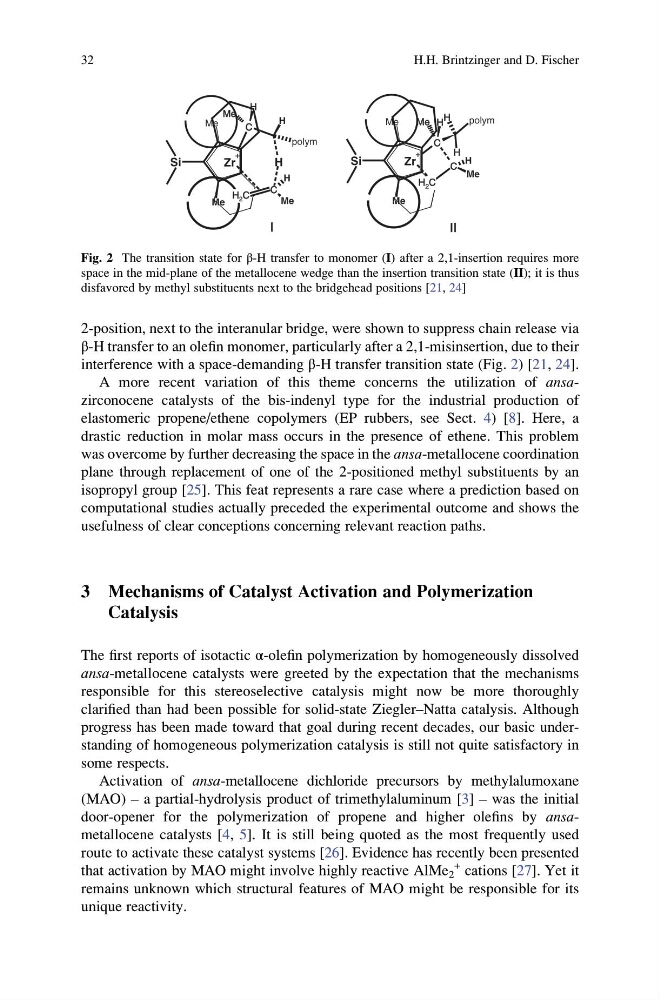
2-position, next to the interanular bridge, were shown to suppress chain release via
β-H transfer to an olefin monomer, particularly after a 2,1-misinsertion, due to their
interference with a space-demanding β-H transfer transition state (Fig. 2) [21, 24].
A more recent variation of this theme concerns the utilization of ansazirconocene catalysts of the bis-indenyl type for the industrial production of
elastomeric propene/ethene copolymers (EP rubbers, see Sect. 4) [8]. Here, a
drastic reduction in molar mass occurs in the presence of ethene. This problem
was overcome by further decreasing the space in the ansa-metallocene coordination
plane through replacement of one of the 2-positioned methyl substituents by an
isopropyl group [25]. This feat represents a rare case where a prediction based on
computational studies actually preceded the experimental outcome and shows the
usefulness of clear conceptions concerning relevant reaction paths.
3 Mechanisms of Catalyst Activation and Polymerization
Catalysis
The first reports of isotactic α-olefin polymerization by homogeneously dissolved
ansa-metallocene catalysts were greeted by the expectation that the mechanisms
responsible for this stereoselective catalysis might now be more thoroughly
clarified than had been possible for solid-state Ziegler–Natta catalysis. Although
progress has been made toward that goal during recent decades, our basic understanding of homogeneous polymerization catalysis is still not quite satisfactory in
some respects.
Activation of ansa-metallocene dichloride precursors by methylalumoxane
(MAO) – a partial-hydrolysis product of trimethylaluminum [3] – was the initial
door-opener for the polymerization of propene and higher olefins by ansametallocene catalysts [4, 5]. It is still being quoted as the most frequently used
route to activate these catalyst systems [26]. Evidence has recently been presented
that activation by MAO might involve highly reactive AlMe 2
+ cations [27]. Yet it
remains unknown which structural features of MAO might be responsible for its
unique reactivity.
Me
Si
Me
H
H
Zr
+
C
H
Me
C
H
Me
Si
Me
Me
Zr
+
C
polym
H
H
H
Me
C
Me
H
polym
H 2 C
H 2 C
I
II
Fig. 2 The transition state for β-H transfer to monomer (I) after a 2,1-insertion requires more
space in the mid-plane of the metallocene wedge than the insertion transition state (II); it is thus
disfavored by methyl substituents next to the bridgehead positions [21, 24]
32
H.H. Brintzinger and D. Fischer
β-H transfer to an olefin monomer, particularly after a 2,1-misinsertion, due to their
interference with a space-demanding β-H transfer transition state (Fig. 2) [21, 24].
A more recent variation of this theme concerns the utilization of ansazirconocene catalysts of the bis-indenyl type for the industrial production of
elastomeric propene/ethene copolymers (EP rubbers, see Sect. 4) [8]. Here, a
drastic reduction in molar mass occurs in the presence of ethene. This problem
was overcome by further decreasing the space in the ansa-metallocene coordination
plane through replacement of one of the 2-positioned methyl substituents by an
isopropyl group [25]. This feat represents a rare case where a prediction based on
computational studies actually preceded the experimental outcome and shows the
usefulness of clear conceptions concerning relevant reaction paths.
3 Mechanisms of Catalyst Activation and Polymerization
Catalysis
The first reports of isotactic α-olefin polymerization by homogeneously dissolved
ansa-metallocene catalysts were greeted by the expectation that the mechanisms
responsible for this stereoselective catalysis might now be more thoroughly
clarified than had been possible for solid-state Ziegler–Natta catalysis. Although
progress has been made toward that goal during recent decades, our basic understanding of homogeneous polymerization catalysis is still not quite satisfactory in
some respects.
Activation of ansa-metallocene dichloride precursors by methylalumoxane
(MAO) – a partial-hydrolysis product of trimethylaluminum [3] – was the initial
door-opener for the polymerization of propene and higher olefins by ansametallocene catalysts [4, 5]. It is still being quoted as the most frequently used
route to activate these catalyst systems [26]. Evidence has recently been presented
that activation by MAO might involve highly reactive AlMe 2
+ cations [27]. Yet it
remains unknown which structural features of MAO might be responsible for its
unique reactivity.
Me
Si
Me
H
H
Zr
+
C
H
Me
C
H
Me
Si
Me
Me
Zr
+
C
polym
H
H
H
Me
C
Me
H
polym
H 2 C
H 2 C
I
II
Fig. 2 The transition state for β-H transfer to monomer (I) after a 2,1-insertion requires more
space in the mid-plane of the metallocene wedge than the insertion transition state (II); it is thus
disfavored by methyl substituents next to the bridgehead positions [21, 24]
32
H.H. Brintzinger and D. Fischer