

Ansa-metallocene catalysts with ring ligands connected by a semi-labile electron
donor–acceptor bond have been shown to produce polypropylene with interesting
elasticity properties [18]. Similar observations had also previously been made with
unbridged zirconocene catalysts, the indenyl ligands of which are hindered in their
mutual rotation by phenyl substituents in their 2-position [19]. In both cases, an
interchange between alternative ring ligand rotamers appears to occur on a time
scale that is comparable to that required to complete a polyolefin chain. Whether this
gives rise to polymer chains containing alternating blocks of preponderantly isotactic and atactic sequences as a cause of elastomeric properties, or to reactor blends of
mainly isotactic and mainly atactic chains (or both), is still under debate [8].
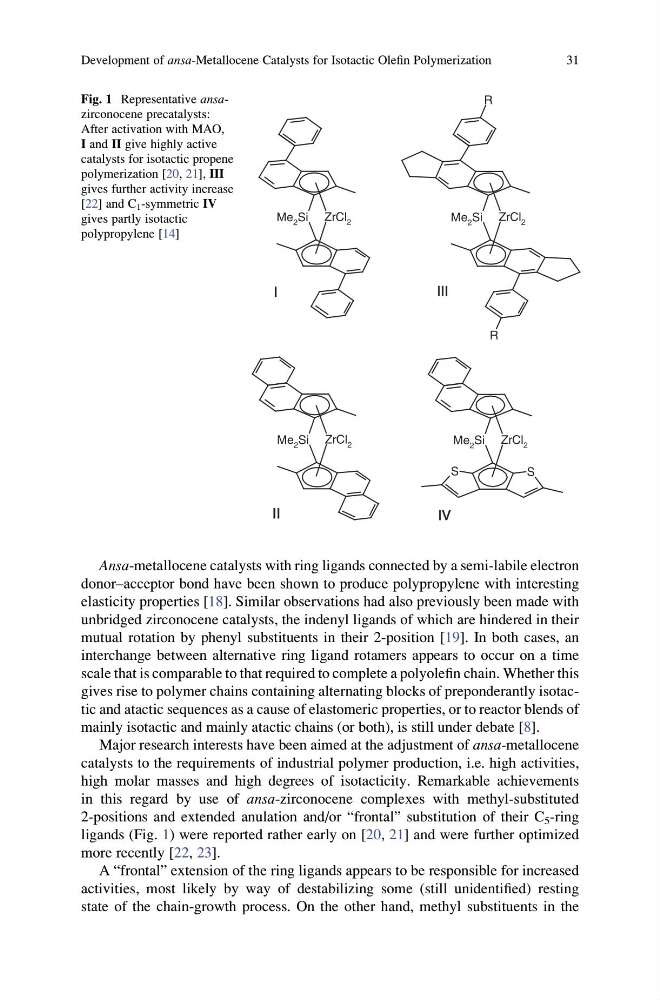
Major research interests have been aimed at the adjustment of ansa-metallocene
catalysts to the requirements of industrial polymer production, i.e. high activities,
high molar masses and high degrees of isotacticity. Remarkable achievements
in this regard by use of ansa-zirconocene complexes with methyl-substituted
2-positions and extended anulation and/or “frontal” substitution of their C 5 -ring
ligands (Fig. 1) were reported rather early on [20, 21] and were further optimized
more recently [22, 23].
A “frontal” extension of the ring ligands appears to be responsible for increased
activities, most likely by way of destabilizing some (still unidentified) resting
state of the chain-growth process. On the other hand, methyl substituents in the
ZrCl 2
Me 2 Si
ZrCl 2
R
Me 2 Si
R
ZrCl 2
Me 2 Si
S
S
ZrCl 2
Me 2 Si
I
III
II
IV
Fig. 1 Representative ansazirconocene precatalysts:
After activation with MAO,
I and II give highly active
catalysts for isotactic propene
polymerization [20, 21], III
gives further activity increase
[22] and C 1 -symmetric IV
gives partly isotactic
polypropylene [14]
Development of ansa-Metallocene Catalysts for Isotactic Olefin Polymerization
31
donor–acceptor bond have been shown to produce polypropylene with interesting
elasticity properties [18]. Similar observations had also previously been made with
unbridged zirconocene catalysts, the indenyl ligands of which are hindered in their
mutual rotation by phenyl substituents in their 2-position [19]. In both cases, an
interchange between alternative ring ligand rotamers appears to occur on a time
scale that is comparable to that required to complete a polyolefin chain. Whether this
gives rise to polymer chains containing alternating blocks of preponderantly isotactic and atactic sequences as a cause of elastomeric properties, or to reactor blends of
mainly isotactic and mainly atactic chains (or both), is still under debate [8].
Major research interests have been aimed at the adjustment of ansa-metallocene
catalysts to the requirements of industrial polymer production, i.e. high activities,
high molar masses and high degrees of isotacticity. Remarkable achievements
in this regard by use of ansa-zirconocene complexes with methyl-substituted
2-positions and extended anulation and/or “frontal” substitution of their C 5 -ring
ligands (Fig. 1) were reported rather early on [20, 21] and were further optimized
more recently [22, 23].
A “frontal” extension of the ring ligands appears to be responsible for increased
activities, most likely by way of destabilizing some (still unidentified) resting
state of the chain-growth process. On the other hand, methyl substituents in the
ZrCl 2
Me 2 Si
ZrCl 2
R
Me 2 Si
R
ZrCl 2
Me 2 Si
S
S
ZrCl 2
Me 2 Si
I
III
II
IV
Fig. 1 Representative ansazirconocene precatalysts:
After activation with MAO,
I and II give highly active
catalysts for isotactic propene
polymerization [20, 21], III
gives further activity increase
[22] and C 1 -symmetric IV
gives partly isotactic
polypropylene [14]
Development of ansa-Metallocene Catalysts for Isotactic Olefin Polymerization
31