

This model of chain-segment mediated enantiomorphic site control for isotactic
polyolefin formation by C 2 -symmetric ansa-metallocene catalysts has received
experimental support from several lines of stereochemical evidence [38, 39]. It
has also provided convincing explanations for the generation of syndiotactic polypropylene at the enantiotopic coordination sites of C S -symmetric ansa-metallocene
catalysts [10] and for the variable stereoregularities of polymers obtained with
C 1 -symmetric catalysts cf. Sect. 2) [7, 13].
Useful insights regarding the transition states of side reactions, which occur in
competition to olefin insertion, such as chain release by β-H transfer and chainend isomerizations, have also been derived from experimental data on kinetics
[21, 40, 41], kinetic isotope effects and isotope label redistributions [39, 42].
Little experimental evidence is available, on the other hand, with regard to a
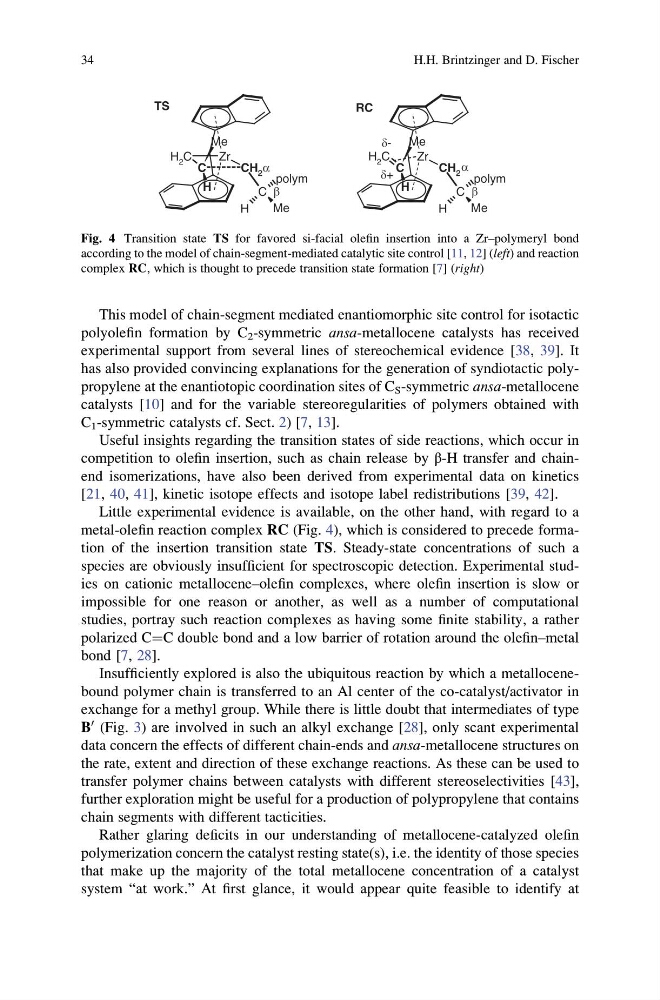
metal-olefin reaction complex RC (Fig. 4), which is considered to precede formation of the insertion transition state TS. Steady-state concentrations of such a
species are obviously insufficient for spectroscopic detection. Experimental studies on cationic metallocene–olefin complexes, where olefin insertion is slow or
impossible for one reason or another, as well as a number of computational
studies, portray such reaction complexes as having some finite stability, a rather
polarized C¼C double bond and a low barrier of rotation around the olefin–metal
bond [7, 28].
Insufficiently explored is also the ubiquitous reaction by which a metallocenebound polymer chain is transferred to an Al center of the co-catalyst/activator in
exchange for a methyl group. While there is little doubt that intermediates of type
B
0 (Fig. 3) are involved in such an alkyl exchange [28], only scant experimental
data concern the effects of different chain-ends and ansa-metallocene structures on
the rate, extent and direction of these exchange reactions. As these can be used to
transfer polymer chains between catalysts with different stereoselectivities [43],
further exploration might be useful for a production of polypropylene that contains
chain segments with different tacticities.
Rather glaring deficits in our understanding of metallocene-catalyzed olefin
polymerization concern the catalyst resting state(s), i.e. the identity of those species
that make up the majority of the total metallocene concentration of a catalyst
system “at work.” At first glance, it would appear quite feasible to identify at
CH 2 2
Zr
C
H
Me
C
C
H 2
Me
H
CH 2
Zr
C
H
Me
C
C
H 2
Me
H
α
α
β
δ+
δTS
RC
polym
β
polym
Fig. 4 Transition state TS for favored si-facial olefin insertion into a Zr–polymeryl bond
according to the model of chain-segment-mediated catalytic site control [11, 12] (left) and reaction
complex RC, which is thought to precede transition state formation [7] (right)
34
H.H. Brintzinger and D. Fischer
polyolefin formation by C 2 -symmetric ansa-metallocene catalysts has received
experimental support from several lines of stereochemical evidence [38, 39]. It
has also provided convincing explanations for the generation of syndiotactic polypropylene at the enantiotopic coordination sites of C S -symmetric ansa-metallocene
catalysts [10] and for the variable stereoregularities of polymers obtained with
C 1 -symmetric catalysts cf. Sect. 2) [7, 13].
Useful insights regarding the transition states of side reactions, which occur in
competition to olefin insertion, such as chain release by β-H transfer and chainend isomerizations, have also been derived from experimental data on kinetics
[21, 40, 41], kinetic isotope effects and isotope label redistributions [39, 42].
Little experimental evidence is available, on the other hand, with regard to a
metal-olefin reaction complex RC (Fig. 4), which is considered to precede formation of the insertion transition state TS. Steady-state concentrations of such a
species are obviously insufficient for spectroscopic detection. Experimental studies on cationic metallocene–olefin complexes, where olefin insertion is slow or
impossible for one reason or another, as well as a number of computational
studies, portray such reaction complexes as having some finite stability, a rather
polarized C¼C double bond and a low barrier of rotation around the olefin–metal
bond [7, 28].
Insufficiently explored is also the ubiquitous reaction by which a metallocenebound polymer chain is transferred to an Al center of the co-catalyst/activator in
exchange for a methyl group. While there is little doubt that intermediates of type
B
0 (Fig. 3) are involved in such an alkyl exchange [28], only scant experimental
data concern the effects of different chain-ends and ansa-metallocene structures on
the rate, extent and direction of these exchange reactions. As these can be used to
transfer polymer chains between catalysts with different stereoselectivities [43],
further exploration might be useful for a production of polypropylene that contains
chain segments with different tacticities.
Rather glaring deficits in our understanding of metallocene-catalyzed olefin
polymerization concern the catalyst resting state(s), i.e. the identity of those species
that make up the majority of the total metallocene concentration of a catalyst
system “at work.” At first glance, it would appear quite feasible to identify at
CH 2 2
Zr
C
H
Me
C
C
H 2
Me
H
CH 2
Zr
C
H
Me
C
C
H 2
Me
H
α
α
β
δ+
δTS
RC
polym
β
polym
Fig. 4 Transition state TS for favored si-facial olefin insertion into a Zr–polymeryl bond
according to the model of chain-segment-mediated catalytic site control [11, 12] (left) and reaction
complex RC, which is thought to precede transition state formation [7] (right)
34
H.H. Brintzinger and D. Fischer