

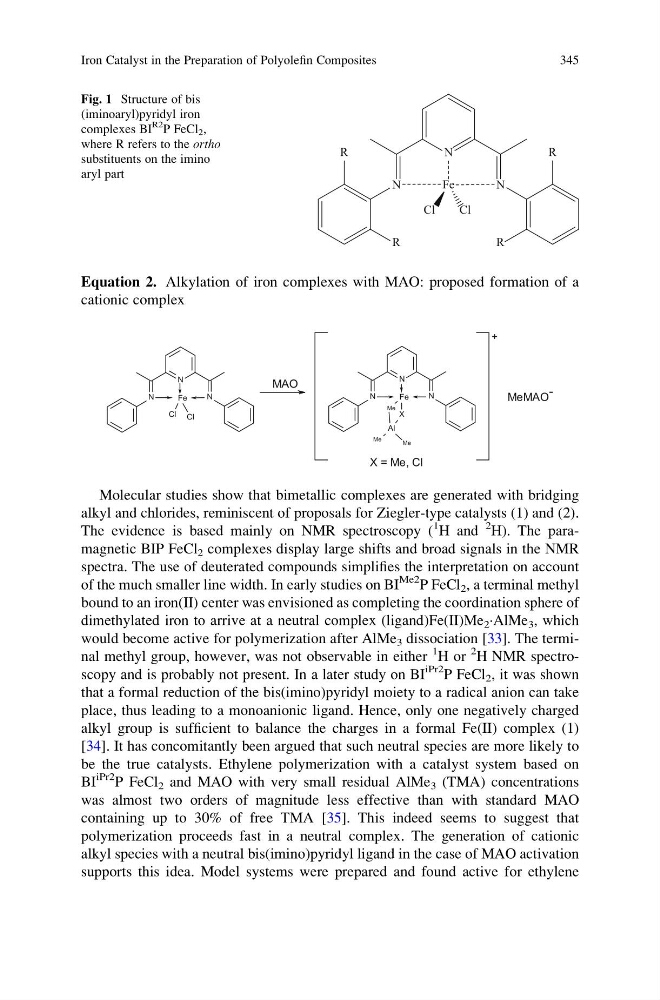
Equation 2. Alkylation of iron complexes with MAO: proposed formation of a
cationic complex
MAO
MeMAO -
X = Me, Cl
N
N
N
Cl
Fe
Cl
N
N
N
X
Al
Fe
Me
Me
Me
+
Molecular studies show that bimetallic complexes are generated with bridging
alkyl and chlorides, reminiscent of proposals for Ziegler-type catalysts (1) and (2).
The evidence is based mainly on NMR spectroscopy (
1 H and
2 H). The paramagnetic BIP FeCl 2 complexes display large shifts and broad signals in the NMR
spectra. The use of deuterated compounds simplifies the interpretation on account
of the much smaller line width. In early studies on BI
Me2 P FeCl 2 , a terminal methyl
bound to an iron(II) center was envisioned as completing the coordination sphere of
dimethylated iron to arrive at a neutral complex (ligand)Fe(II)Me 2 ·AlMe 3 , which
would become active for polymerization after AlMe 3 dissociation [33]. The terminal methyl group, however, was not observable in either
1 H or
2 H NMR spectroscopy and is probably not present. In a later study on BI
iPr2 P FeCl 2 , it was shown
that a formal reduction of the bis(imino)pyridyl moiety to a radical anion can take
place, thus leading to a monoanionic ligand. Hence, only one negatively charged
alkyl group is sufficient to balance the charges in a formal Fe(II) complex (1)
[34]. It has concomitantly been argued that such neutral species are more likely to
be the true catalysts. Ethylene polymerization with a catalyst system based on
BI
iPr2 P FeCl 2 and MAO with very small residual AlMe 3 (TMA) concentrations
was almost two orders of magnitude less effective than with standard MAO
containing up to 30% of free TMA [35]. This indeed seems to suggest that
polymerization proceeds fast in a neutral complex. The generation of cationic
alkyl species with a neutral bis(imino)pyridyl ligand in the case of MAO activation
supports this idea. Model systems were prepared and found active for ethylene
N
N
N
Fe
Cl
Cl
R
R
R
R
Fig. 1 Structure of bis
(iminoaryl)pyridyl iron
complexes BI
R2 P FeCl 2 ,
where R refers to the ortho
substituents on the imino
aryl part
Iron Catalyst in the Preparation of Polyolefin Composites
345
cationic complex
MAO
MeMAO -
X = Me, Cl
N
N
N
Cl
Fe
Cl
N
N
N
X
Al
Fe
Me
Me
Me
+
Molecular studies show that bimetallic complexes are generated with bridging
alkyl and chlorides, reminiscent of proposals for Ziegler-type catalysts (1) and (2).
The evidence is based mainly on NMR spectroscopy (
1 H and
2 H). The paramagnetic BIP FeCl 2 complexes display large shifts and broad signals in the NMR
spectra. The use of deuterated compounds simplifies the interpretation on account
of the much smaller line width. In early studies on BI
Me2 P FeCl 2 , a terminal methyl
bound to an iron(II) center was envisioned as completing the coordination sphere of
dimethylated iron to arrive at a neutral complex (ligand)Fe(II)Me 2 ·AlMe 3 , which
would become active for polymerization after AlMe 3 dissociation [33]. The terminal methyl group, however, was not observable in either
1 H or
2 H NMR spectroscopy and is probably not present. In a later study on BI
iPr2 P FeCl 2 , it was shown
that a formal reduction of the bis(imino)pyridyl moiety to a radical anion can take
place, thus leading to a monoanionic ligand. Hence, only one negatively charged
alkyl group is sufficient to balance the charges in a formal Fe(II) complex (1)
[34]. It has concomitantly been argued that such neutral species are more likely to
be the true catalysts. Ethylene polymerization with a catalyst system based on
BI
iPr2 P FeCl 2 and MAO with very small residual AlMe 3 (TMA) concentrations
was almost two orders of magnitude less effective than with standard MAO
containing up to 30% of free TMA [35]. This indeed seems to suggest that
polymerization proceeds fast in a neutral complex. The generation of cationic
alkyl species with a neutral bis(imino)pyridyl ligand in the case of MAO activation
supports this idea. Model systems were prepared and found active for ethylene
N
N
N
Fe
Cl
Cl
R
R
R
R
Fig. 1 Structure of bis
(iminoaryl)pyridyl iron
complexes BI
R2 P FeCl 2 ,
where R refers to the ortho
substituents on the imino
aryl part
Iron Catalyst in the Preparation of Polyolefin Composites
345