

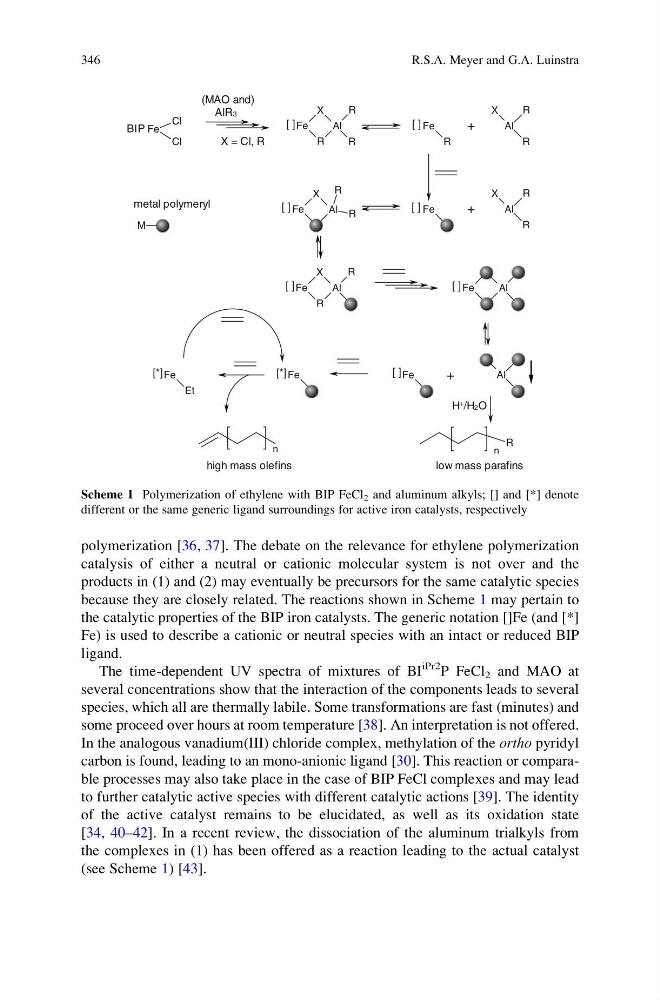
polymerization [36, 37]. The debate on the relevance for ethylene polymerization
catalysis of either a neutral or cationic molecular system is not over and the
products in (1) and (2) may eventually be precursors for the same catalytic species
because they are closely related. The reactions shown in Scheme 1 may pertain to
the catalytic properties of the BIP iron catalysts. The generic notation []Fe (and [*]
Fe) is used to describe a cationic or neutral species with an intact or reduced BIP
ligand.
The time-dependent UV spectra of mixtures of BI
iPr2 P FeCl 2 and MAO at
several concentrations show that the interaction of the components leads to several
species, which all are thermally labile. Some transformations are fast (minutes) and
some proceed over hours at room temperature [38]. An interpretation is not offered.
In the analogous vanadium(III) chloride complex, methylation of the ortho pyridyl
carbon is found, leading to an mono-anionic ligand [30]. This reaction or comparable processes may also take place in the case of BIP FeCl complexes and may lead
to further catalytic active species with different catalytic actions [39]. The identity
of the active catalyst remains to be elucidated, as well as its oxidation state
[34, 40–42]. In a recent review, the dissociation of the aluminum trialkyls from
the complexes in (1) has been offered as a reaction leading to the actual catalyst
(see Scheme 1) [43].
[ ]
s
n
i
f
a
r
a
p
s
s
a
m
w
o
l
s
n
i
f
e
l
o
s
s
a
m
h
g
i
h
[ ]
[ ]
[*]
[ ]
[*]
[ ]
AlR3
X = Cl, R
(MAO and)
BIP
[ ]
metal polymeryl
H
+ /H2O
[ ]
R
l
A
e
F
e
F
e
F
Fe
Al
X
Fe
R
Al
R
X
R
Al
R
Fe
X R
Al R
Fe
R
Fe
X
R
Al
R
R
R
Fe
X
Al
R
Cl
Cl
Fe
n
n
Et
M
+
+
+
Scheme 1 Polymerization of ethylene with BIP FeCl 2 and aluminum alkyls; [] and [*] denote
different or the same generic ligand surroundings for active iron catalysts, respectively
346
R.S.A. Meyer and G.A. Luinstra
catalysis of either a neutral or cationic molecular system is not over and the
products in (1) and (2) may eventually be precursors for the same catalytic species
because they are closely related. The reactions shown in Scheme 1 may pertain to
the catalytic properties of the BIP iron catalysts. The generic notation []Fe (and [*]
Fe) is used to describe a cationic or neutral species with an intact or reduced BIP
ligand.
The time-dependent UV spectra of mixtures of BI
iPr2 P FeCl 2 and MAO at
several concentrations show that the interaction of the components leads to several
species, which all are thermally labile. Some transformations are fast (minutes) and
some proceed over hours at room temperature [38]. An interpretation is not offered.
In the analogous vanadium(III) chloride complex, methylation of the ortho pyridyl
carbon is found, leading to an mono-anionic ligand [30]. This reaction or comparable processes may also take place in the case of BIP FeCl complexes and may lead
to further catalytic active species with different catalytic actions [39]. The identity
of the active catalyst remains to be elucidated, as well as its oxidation state
[34, 40–42]. In a recent review, the dissociation of the aluminum trialkyls from
the complexes in (1) has been offered as a reaction leading to the actual catalyst
(see Scheme 1) [43].
[ ]
s
n
i
f
a
r
a
p
s
s
a
m
w
o
l
s
n
i
f
e
l
o
s
s
a
m
h
g
i
h
[ ]
[ ]
[*]
[ ]
[*]
[ ]
AlR3
X = Cl, R
(MAO and)
BIP
[ ]
metal polymeryl
H
+ /H2O
[ ]
R
l
A
e
F
e
F
e
F
Fe
Al
X
Fe
R
Al
R
X
R
Al
R
Fe
X R
Al R
Fe
R
Fe
X
R
Al
R
R
R
Fe
X
Al
R
Cl
Cl
Fe
n
n
Et
M
+
+
+
Scheme 1 Polymerization of ethylene with BIP FeCl 2 and aluminum alkyls; [] and [*] denote
different or the same generic ligand surroundings for active iron catalysts, respectively
346
R.S.A. Meyer and G.A. Luinstra