

faster industrial implementation. The discovery of tridentate bis(iminoaryl)pyridyl
complexes of iron [28, 29] (and cobalt, and later also vanadium [30] and other
metals [31]) with an extremely high activity for ethylene polymerization has been a
milestone in that sense.
The primary products from iron catalysts are linear polyethylenes and aluminum
polymeryls. The iron complexes can be prepared in a few simple steps and are not
particularly sensitive to air, contrasting with many metallocenes of group III and IV
or rare earth complexes. A body of literature on ethylene polymerization studies
with these complexes allows a picture to be created of the catalytic action
[31]. Here, a summary is given on the catalytic activity of these complexes, also
in combination with solid supports, and an outlook towards the preparation of
composites.
2 Ethylene Polymerization with Iron Catalysts
2.1 Combination of Aluminum Alkyls and Bis(iminoaryl)pyridyl Iron Dichloride
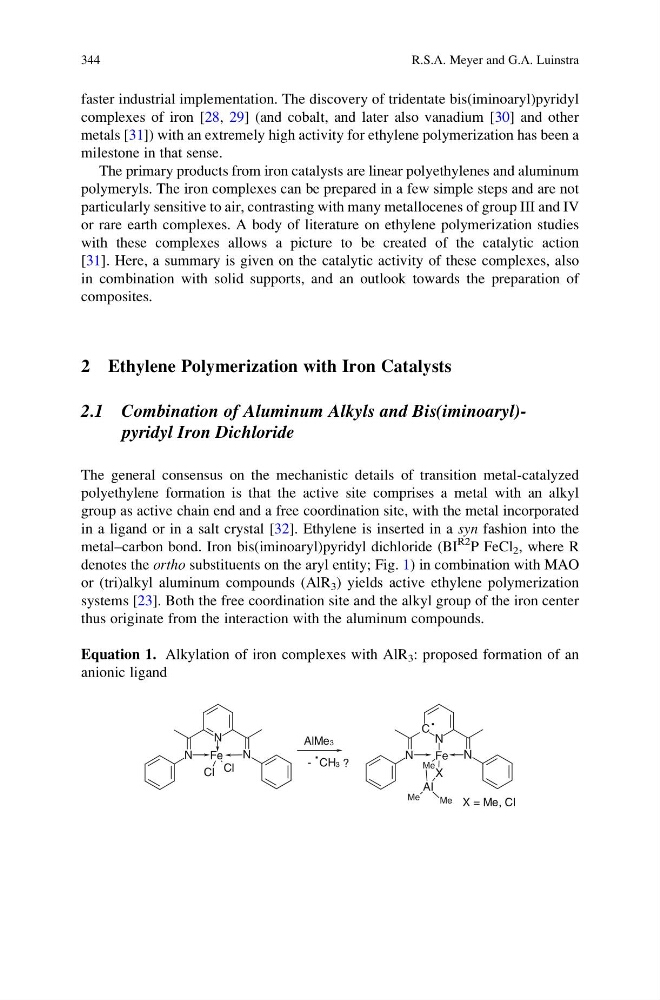
The general consensus on the mechanistic details of transition metal-catalyzed
polyethylene formation is that the active site comprises a metal with an alkyl
group as active chain end and a free coordination site, with the metal incorporated
in a ligand or in a salt crystal [32]. Ethylene is inserted in a syn fashion into the
metal–carbon bond. Iron bis(iminoaryl)pyridyl dichloride (BI
R2 P FeCl 2 , where R
denotes the ortho substituents on the aryl entity; Fig. 1) in combination with MAO
or (tri)alkyl aluminum compounds (AlR 3 ) yields active ethylene polymerization
systems [23]. Both the free coordination site and the alkyl group of the iron center
thus originate from the interaction with the aluminum compounds.
Equation 1. Alkylation of iron complexes with AlR 3 : proposed formation of an
anionic ligand
-
.
.
CH3 ?
X = Me, Cl
AlMe
Fe
Fe
Cl
C
Cl
N
Me
Me
Me
N
N
X
AI
N
N
N
3
344
R.S.A. Meyer and G.A. Luinstra
complexes of iron [28, 29] (and cobalt, and later also vanadium [30] and other
metals [31]) with an extremely high activity for ethylene polymerization has been a
milestone in that sense.
The primary products from iron catalysts are linear polyethylenes and aluminum
polymeryls. The iron complexes can be prepared in a few simple steps and are not
particularly sensitive to air, contrasting with many metallocenes of group III and IV
or rare earth complexes. A body of literature on ethylene polymerization studies
with these complexes allows a picture to be created of the catalytic action
[31]. Here, a summary is given on the catalytic activity of these complexes, also
in combination with solid supports, and an outlook towards the preparation of
composites.
2 Ethylene Polymerization with Iron Catalysts
2.1 Combination of Aluminum Alkyls and Bis(iminoaryl)pyridyl Iron Dichloride
The general consensus on the mechanistic details of transition metal-catalyzed
polyethylene formation is that the active site comprises a metal with an alkyl
group as active chain end and a free coordination site, with the metal incorporated
in a ligand or in a salt crystal [32]. Ethylene is inserted in a syn fashion into the
metal–carbon bond. Iron bis(iminoaryl)pyridyl dichloride (BI
R2 P FeCl 2 , where R
denotes the ortho substituents on the aryl entity; Fig. 1) in combination with MAO
or (tri)alkyl aluminum compounds (AlR 3 ) yields active ethylene polymerization
systems [23]. Both the free coordination site and the alkyl group of the iron center
thus originate from the interaction with the aluminum compounds.
Equation 1. Alkylation of iron complexes with AlR 3 : proposed formation of an
anionic ligand
-
.
.
CH3 ?
X = Me, Cl
AlMe
Fe
Fe
Cl
C
Cl
N
Me
Me
Me
N
N
X
AI
N
N
N
3
344
R.S.A. Meyer and G.A. Luinstra