

MAO and then the cationic metallocene catalyst {Zr[η-C 6 H 5 Me(thf)]}
+ was
intercalated in two clays (a synthetic fluorinated mica-type silicate and the modified
synthetic hectorite) by ion-exchange reaction with the interlamellar cations of the
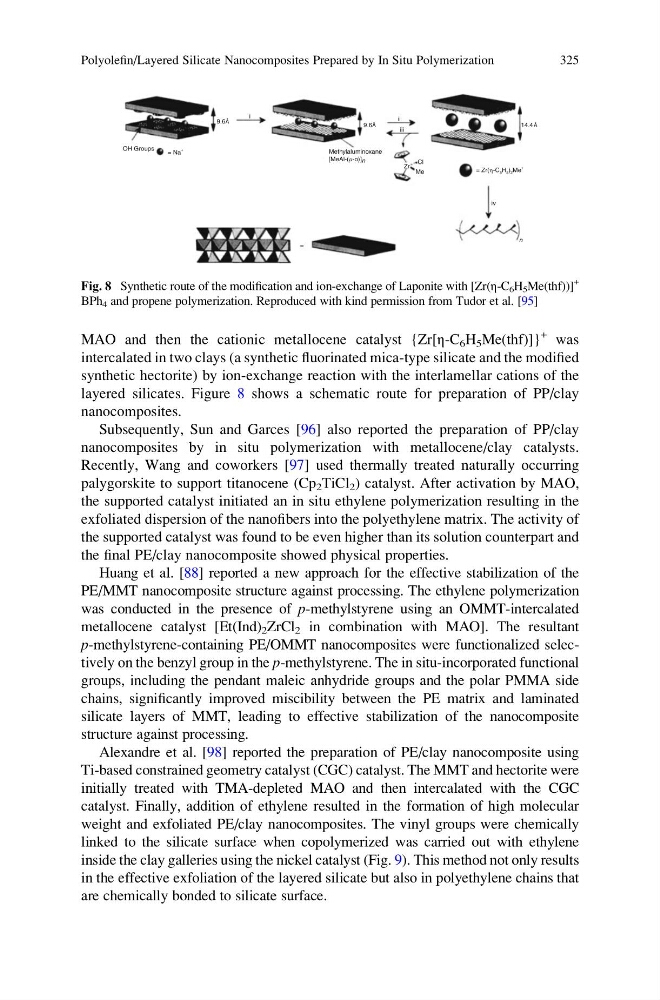
layered silicates. Figure 8 shows a schematic route for preparation of PP/clay
nanocomposites.
Subsequently, Sun and Garces [96] also reported the preparation of PP/clay
nanocomposites by in situ polymerization with metallocene/clay catalysts.
Recently, Wang and coworkers [97] used thermally treated naturally occurring
palygorskite to support titanocene (Cp 2 TiCl 2 ) catalyst. After activation by MAO,
the supported catalyst initiated an in situ ethylene polymerization resulting in the
exfoliated dispersion of the nanofibers into the polyethylene matrix. The activity of
the supported catalyst was found to be even higher than its solution counterpart and
the final PE/clay nanocomposite showed physical properties.
Huang et al. [88] reported a new approach for the effective stabilization of the
PE/MMT nanocomposite structure against processing. The ethylene polymerization
was conducted in the presence of p-methylstyrene using an OMMT-intercalated
metallocene catalyst [Et(Ind) 2 ZrCl 2 in combination with MAO]. The resultant
p-methylstyrene-containing PE/OMMT nanocomposites were functionalized selectively on the benzyl group in the p-methylstyrene. The in situ-incorporated functional
groups, including the pendant maleic anhydride groups and the polar PMMA side
chains, significantly improved miscibility between the PE matrix and laminated
silicate layers of MMT, leading to effective stabilization of the nanocomposite
structure against processing.
Alexandre et al. [98] reported the preparation of PE/clay nanocomposite using
Ti-based constrained geometry catalyst (CGC) catalyst. The MMT and hectorite were
initially treated with TMA-depleted MAO and then intercalated with the CGC
catalyst. Finally, addition of ethylene resulted in the formation of high molecular
weight and exfoliated PE/clay nanocomposites. The vinyl groups were chemically
linked to the silicate surface when copolymerized was carried out with ethylene
inside the clay galleries using the nickel catalyst (Fig. 9). This method not only results
in the effective exfoliation of the layered silicate but also in polyethylene chains that
are chemically bonded to silicate surface.
Methylaluminoxane
[MeAl-(m-o)] n
i
ii
iv
iii
9.6Å
9.6Å
14.4Å
OH Groups
= Na +
Zr
Cl
Me
= Zr(η-C 5 H 5 ) 2 Me +
n
=
Fig. 8 Synthetic route of the modification and ion-exchange of Laponite with [Zr(η-C 6 H 5 Me(thf))]
+
BPh 4 and propene polymerization. Reproduced with kind permission from Tudor et al. [95]
Polyolefin/Layered Silicate Nanocomposites Prepared by In Situ Polymerization
325
+ was
intercalated in two clays (a synthetic fluorinated mica-type silicate and the modified
synthetic hectorite) by ion-exchange reaction with the interlamellar cations of the
layered silicates. Figure 8 shows a schematic route for preparation of PP/clay
nanocomposites.
Subsequently, Sun and Garces [96] also reported the preparation of PP/clay
nanocomposites by in situ polymerization with metallocene/clay catalysts.
Recently, Wang and coworkers [97] used thermally treated naturally occurring
palygorskite to support titanocene (Cp 2 TiCl 2 ) catalyst. After activation by MAO,
the supported catalyst initiated an in situ ethylene polymerization resulting in the
exfoliated dispersion of the nanofibers into the polyethylene matrix. The activity of
the supported catalyst was found to be even higher than its solution counterpart and
the final PE/clay nanocomposite showed physical properties.
Huang et al. [88] reported a new approach for the effective stabilization of the
PE/MMT nanocomposite structure against processing. The ethylene polymerization
was conducted in the presence of p-methylstyrene using an OMMT-intercalated
metallocene catalyst [Et(Ind) 2 ZrCl 2 in combination with MAO]. The resultant
p-methylstyrene-containing PE/OMMT nanocomposites were functionalized selectively on the benzyl group in the p-methylstyrene. The in situ-incorporated functional
groups, including the pendant maleic anhydride groups and the polar PMMA side
chains, significantly improved miscibility between the PE matrix and laminated
silicate layers of MMT, leading to effective stabilization of the nanocomposite
structure against processing.
Alexandre et al. [98] reported the preparation of PE/clay nanocomposite using
Ti-based constrained geometry catalyst (CGC) catalyst. The MMT and hectorite were
initially treated with TMA-depleted MAO and then intercalated with the CGC
catalyst. Finally, addition of ethylene resulted in the formation of high molecular
weight and exfoliated PE/clay nanocomposites. The vinyl groups were chemically
linked to the silicate surface when copolymerized was carried out with ethylene
inside the clay galleries using the nickel catalyst (Fig. 9). This method not only results
in the effective exfoliation of the layered silicate but also in polyethylene chains that
are chemically bonded to silicate surface.
Methylaluminoxane
[MeAl-(m-o)] n
i
ii
iv
iii
9.6Å
9.6Å
14.4Å
OH Groups
= Na +
Zr
Cl
Me
= Zr(η-C 5 H 5 ) 2 Me +
n
=
Fig. 8 Synthetic route of the modification and ion-exchange of Laponite with [Zr(η-C 6 H 5 Me(thf))]
+
BPh 4 and propene polymerization. Reproduced with kind permission from Tudor et al. [95]
Polyolefin/Layered Silicate Nanocomposites Prepared by In Situ Polymerization
325