

6.1.2 Clay as Catalyst or Cocatalyst Support
Kaminsky [92] was the first to report a method in which the filler surfaces were
treated with metallocene-based catalyst for the production of filled polyolefins. In
this method, at first under inert atmosphere, the clay surface is treated with an
alkylaluminum compound to reduce the residual water content. In the second step,
the catalyst or cocatalyst solution is impregnated onto the clay surface followed by
washing with an anhydrous solvent to avoid excess catalyst leaching from the
support during the polymerization. Additional alkylaluminum compounds may be
used during the course of polymerization. This polymerization-filling technique is a
widely used procedure for the synthesis of polymer/clay nanocomposites using
coordination catalysts [60, 93, 94].
In order to show the advantages of catalyst or cocatalyst being supported on clay
over simple addition of clay to the reactor, Kuo et al. [89] performed a comparative
study of these two preparative methods. In method 1, they reacted Et(Ind) 2 ZrCl 2 ,
MAO, and an organoclay in the reactor and started the polymerization by
introducing ethylene. In method 2, they reacted MAO-treated organoclay with the
catalyst solution, and then used the product to polymerize ethylene. It was observed
that in situ polymerization with method 2 led to higher catalyst activities and was
less sensitive to clay loading. In addition, a finer and more homogeneous dispersion
of polymer/clay particles was obtained for method 2. It was also reported that
extending the MAO treatment time from 1.5 to 2.5 h, and the catalyst impregnation
time from 0.5 to 2 h, had no appreciable effect on polymerization activity.
Tudor et al. [95] first used the in situ intercalative polymerization method for the
preparation of PP/clay nanocomposites. They demonstrated the ability of soluble
metallocene catalysts to intercalate inside silicate layers, and to promote the
coordination polymerization of propylene. The silicate layers were modified by
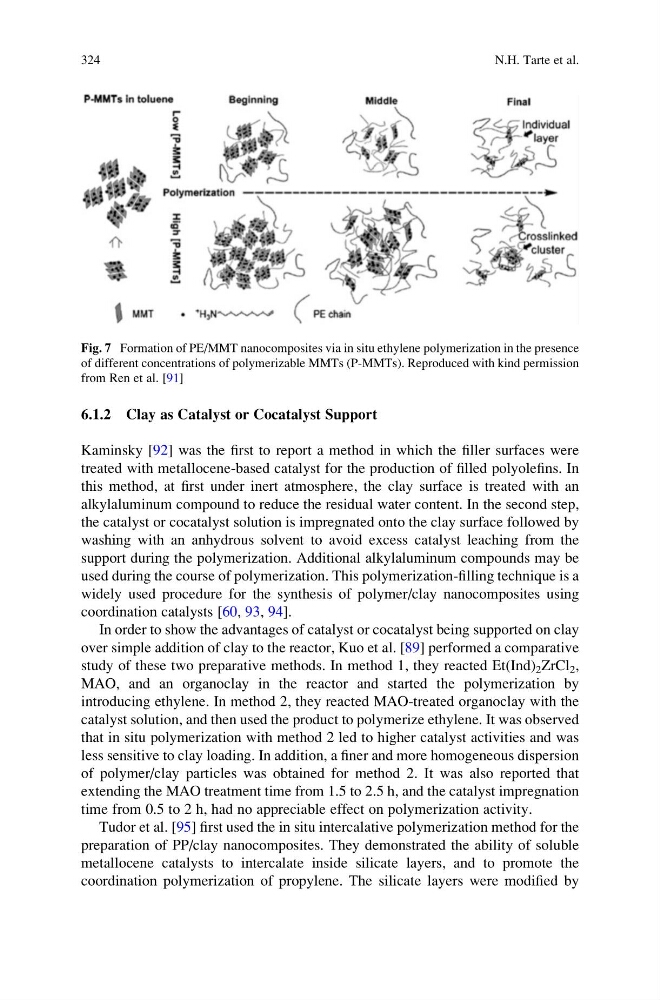
Fig. 7 Formation of PE/MMT nanocomposites via in situ ethylene polymerization in the presence
of different concentrations of polymerizable MMTs (P-MMTs). Reproduced with kind permission
from Ren et al. [91]
324
N.H. Tarte et al.
Kaminsky [92] was the first to report a method in which the filler surfaces were
treated with metallocene-based catalyst for the production of filled polyolefins. In
this method, at first under inert atmosphere, the clay surface is treated with an
alkylaluminum compound to reduce the residual water content. In the second step,
the catalyst or cocatalyst solution is impregnated onto the clay surface followed by
washing with an anhydrous solvent to avoid excess catalyst leaching from the
support during the polymerization. Additional alkylaluminum compounds may be
used during the course of polymerization. This polymerization-filling technique is a
widely used procedure for the synthesis of polymer/clay nanocomposites using
coordination catalysts [60, 93, 94].
In order to show the advantages of catalyst or cocatalyst being supported on clay
over simple addition of clay to the reactor, Kuo et al. [89] performed a comparative
study of these two preparative methods. In method 1, they reacted Et(Ind) 2 ZrCl 2 ,
MAO, and an organoclay in the reactor and started the polymerization by
introducing ethylene. In method 2, they reacted MAO-treated organoclay with the
catalyst solution, and then used the product to polymerize ethylene. It was observed
that in situ polymerization with method 2 led to higher catalyst activities and was
less sensitive to clay loading. In addition, a finer and more homogeneous dispersion
of polymer/clay particles was obtained for method 2. It was also reported that
extending the MAO treatment time from 1.5 to 2.5 h, and the catalyst impregnation
time from 0.5 to 2 h, had no appreciable effect on polymerization activity.
Tudor et al. [95] first used the in situ intercalative polymerization method for the
preparation of PP/clay nanocomposites. They demonstrated the ability of soluble
metallocene catalysts to intercalate inside silicate layers, and to promote the
coordination polymerization of propylene. The silicate layers were modified by
Fig. 7 Formation of PE/MMT nanocomposites via in situ ethylene polymerization in the presence
of different concentrations of polymerizable MMTs (P-MMTs). Reproduced with kind permission
from Ren et al. [91]
324
N.H. Tarte et al.