

Shin and coworkers [99] prepared a hybrid PE/clay nanocomposite using [1,4-bis
(2,6-diisopropylphenyl)-acenaphthenediimine]-dichloronickel catalyst. The chemical
modification and intercalation of MMT were carried out with alkylaluminum and
vinyl alcohol.
Ray et al. [93] treated organically modified MMT (OMMT) with a MAO
solution after vacuum-drying at 100
C. The resulting MAO-treated clay was
subsequently used for ethylene polymerization in the presence of 2,6-bis
[1-(2,6-diisopropylphenylimino)ethyl]pyridine iron(II) dichloride with additional
MAO in a glass reactor. In addition, they compared the methods of nanocomposite
preparation and observed that the nanocomposite produced by catalyst supported on
MAO-pretreated OMMT was more efficiently exfoliated than the nanocomposite
produced when only a mixture of catalyst and clay was used. This result led them to
conclude that at least some of the active centers resided within the clay galleries.
Similarly, Guo et al. [100] in a separate studies successfully used pyridine diiminebased iron(II) catalysts for preparation of exfoliated PE/clay nanocomposites.
Bergman et al. [101] used Brookhart’s single component palladium-based complex and the 1-tetradecylammonium cationically modified synthetic fluorohectorite
for preparation of polyethylene nanocomposites. They first intercalated palladium
catalyst into the galleries of modified fluorohectorite and exposed the dry powder to
ethylene gas. Over a period of 2 h, they observed monomer consumption and a
dramatic increase in the size of the silicate–catalyst composite. After 12 h, the
orange colored palladium complex was unrecognizable; in its place was a large
mass of colorless, rubbery polymer. The complete absence of diffraction peaks in
the XRD patterns strongly suggested the formation of an exfoliated nanocomposite.
It is noteworthy that this nanocomposite is formed without the use of MAO either
for pretreatment of the silicate material or during polymerization. A schematic
representation of nanocomposite formation by this method is given in Fig. 10.
Jin et al. [102] used organic salts with hydroxyl groups for the modification of
MMT to produce MMT–OH. Because the hydroxyl groups in intercalation agents
offer facile reactive sites for anchoring catalysts between silicate layers, they
successfully anchored a Ti-based Ziegler–Natta catalyst at the inner surface of
MMT for in situ production of exfoliated PENC. Figure 11 shows the TiCl 4 fixation
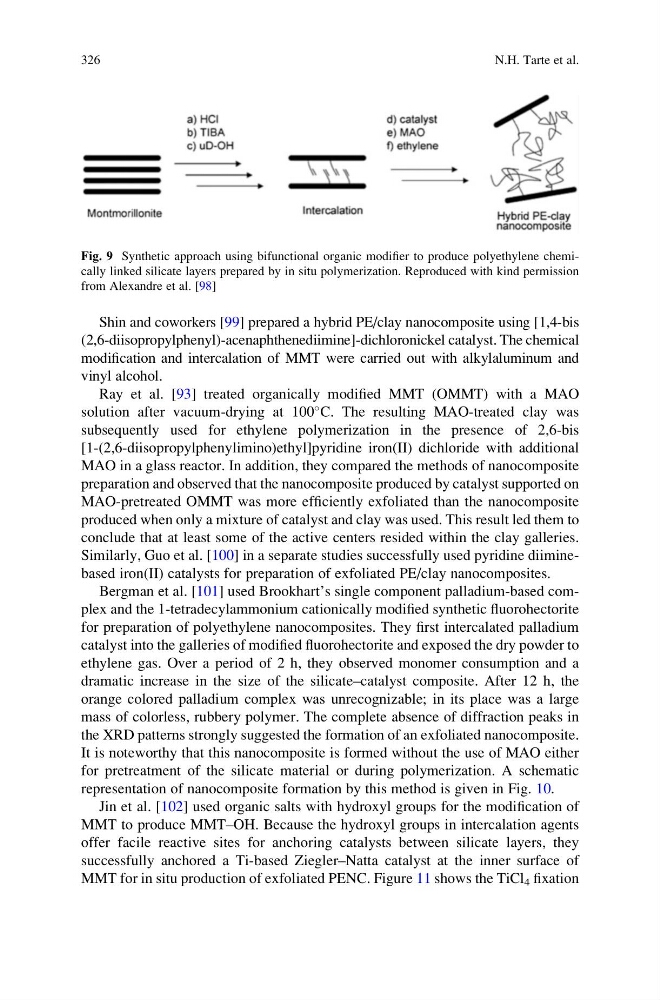
Fig. 9 Synthetic approach using bifunctional organic modifier to produce polyethylene chemically linked silicate layers prepared by in situ polymerization. Reproduced with kind permission
from Alexandre et al. [98]
326
N.H. Tarte et al.
(2,6-diisopropylphenyl)-acenaphthenediimine]-dichloronickel catalyst. The chemical
modification and intercalation of MMT were carried out with alkylaluminum and
vinyl alcohol.
Ray et al. [93] treated organically modified MMT (OMMT) with a MAO
solution after vacuum-drying at 100
C. The resulting MAO-treated clay was
subsequently used for ethylene polymerization in the presence of 2,6-bis
[1-(2,6-diisopropylphenylimino)ethyl]pyridine iron(II) dichloride with additional
MAO in a glass reactor. In addition, they compared the methods of nanocomposite
preparation and observed that the nanocomposite produced by catalyst supported on
MAO-pretreated OMMT was more efficiently exfoliated than the nanocomposite
produced when only a mixture of catalyst and clay was used. This result led them to
conclude that at least some of the active centers resided within the clay galleries.
Similarly, Guo et al. [100] in a separate studies successfully used pyridine diiminebased iron(II) catalysts for preparation of exfoliated PE/clay nanocomposites.
Bergman et al. [101] used Brookhart’s single component palladium-based complex and the 1-tetradecylammonium cationically modified synthetic fluorohectorite
for preparation of polyethylene nanocomposites. They first intercalated palladium
catalyst into the galleries of modified fluorohectorite and exposed the dry powder to
ethylene gas. Over a period of 2 h, they observed monomer consumption and a
dramatic increase in the size of the silicate–catalyst composite. After 12 h, the
orange colored palladium complex was unrecognizable; in its place was a large
mass of colorless, rubbery polymer. The complete absence of diffraction peaks in
the XRD patterns strongly suggested the formation of an exfoliated nanocomposite.
It is noteworthy that this nanocomposite is formed without the use of MAO either
for pretreatment of the silicate material or during polymerization. A schematic
representation of nanocomposite formation by this method is given in Fig. 10.
Jin et al. [102] used organic salts with hydroxyl groups for the modification of
MMT to produce MMT–OH. Because the hydroxyl groups in intercalation agents
offer facile reactive sites for anchoring catalysts between silicate layers, they
successfully anchored a Ti-based Ziegler–Natta catalyst at the inner surface of
MMT for in situ production of exfoliated PENC. Figure 11 shows the TiCl 4 fixation
Fig. 9 Synthetic approach using bifunctional organic modifier to produce polyethylene chemically linked silicate layers prepared by in situ polymerization. Reproduced with kind permission
from Alexandre et al. [98]
326
N.H. Tarte et al.