

than with octahedrally substituted material. Layer rigidity is an essential requirement
for the pillaring of any lamellar solid. In the absence of such rigidity, attractive
interactions between layers would result in distortion in the region between pillars,
and such layer distortions would lead to collapse of the gallery pores.
3 Clay Surface Modifications
For all their advantages, including a large interlayer surface area (~700 m
2 /g), high
cation exchange capacity (~100 mol/kg), expansibility in water, and propensity for
intercalating organic molecules, the MMTs and related phyllosilicates are naturally
hydrophilic because of the presence of hydrated inorganic counterions such as Na
+
and Ca
2+ in the interlayer space [27]. Obviously, in this pristine state, layered
silicates are only miscible with hydrophilic polymers. Hence, the use of silicates as
such greatly limits the class of miscible polymers. Treatment steps for use of
coordination catalysts are required mainly to control the population of hydroxyl
groups and surface acidity, and to scavenge impurities from the support surface
before introduction of the catalyst precursor. Clay surface modifications are mainly
achieved by organic modification of the clay, thermal treatment of the clay, and
treatment of clay with alkylaluminum compounds.
3.1 Organic Modification of the Clay
One of the ways of overcoming the chemical incompatibility between mineral and
polymer is to graft polar functional groups to either the mineral surface [28, 29] or
the polymer chain [30–32]. The purpose of this treatment is to reduce the surface
energy of MMT, increase the interlayer spacing of MMT, and create anchoring
points for catalyst incorporation. This may be achieved by either intercalation of
organic cations or grafting of organosilanes or suitable polymeric species to the
silicate surface [29].
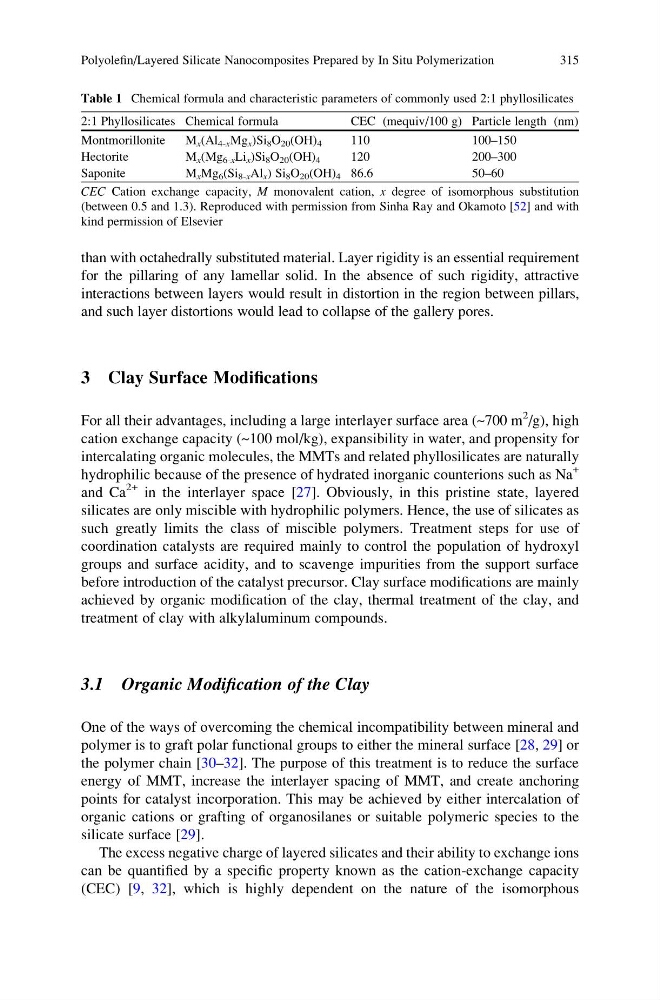
The excess negative charge of layered silicates and their ability to exchange ions
can be quantified by a specific property known as the cation-exchange capacity
(CEC) [9, 32], which is highly dependent on the nature of the isomorphous
Table 1 Chemical formula and characteristic parameters of commonly used 2:1 phyllosilicates
2:1 Phyllosilicates Chemical formula
CEC (mequiv/100 g) Particle length (nm)
Montmorillonite
M x (Al 4-x Mg x )Si 8 O 20 (OH) 4
110
100–150
Hectorite
M x (Mg 6-x Li x )Si 8 O 20 (OH) 4
120
200–300
Saponite
M x Mg 6 (Si 8-x Al x ) Si 8 O 20 (OH) 4 86.6
50–60
CEC Cation exchange capacity, M monovalent cation, x degree of isomorphous substitution
(between 0.5 and 1.3). Reproduced with permission from Sinha Ray and Okamoto [52] and with
kind permission of Elsevier
Polyolefin/Layered Silicate Nanocomposites Prepared by In Situ Polymerization
315
for the pillaring of any lamellar solid. In the absence of such rigidity, attractive
interactions between layers would result in distortion in the region between pillars,
and such layer distortions would lead to collapse of the gallery pores.
3 Clay Surface Modifications
For all their advantages, including a large interlayer surface area (~700 m
2 /g), high
cation exchange capacity (~100 mol/kg), expansibility in water, and propensity for
intercalating organic molecules, the MMTs and related phyllosilicates are naturally
hydrophilic because of the presence of hydrated inorganic counterions such as Na
+
and Ca
2+ in the interlayer space [27]. Obviously, in this pristine state, layered
silicates are only miscible with hydrophilic polymers. Hence, the use of silicates as
such greatly limits the class of miscible polymers. Treatment steps for use of
coordination catalysts are required mainly to control the population of hydroxyl
groups and surface acidity, and to scavenge impurities from the support surface
before introduction of the catalyst precursor. Clay surface modifications are mainly
achieved by organic modification of the clay, thermal treatment of the clay, and
treatment of clay with alkylaluminum compounds.
3.1 Organic Modification of the Clay
One of the ways of overcoming the chemical incompatibility between mineral and
polymer is to graft polar functional groups to either the mineral surface [28, 29] or
the polymer chain [30–32]. The purpose of this treatment is to reduce the surface
energy of MMT, increase the interlayer spacing of MMT, and create anchoring
points for catalyst incorporation. This may be achieved by either intercalation of
organic cations or grafting of organosilanes or suitable polymeric species to the
silicate surface [29].
The excess negative charge of layered silicates and their ability to exchange ions
can be quantified by a specific property known as the cation-exchange capacity
(CEC) [9, 32], which is highly dependent on the nature of the isomorphous
Table 1 Chemical formula and characteristic parameters of commonly used 2:1 phyllosilicates
2:1 Phyllosilicates Chemical formula
CEC (mequiv/100 g) Particle length (nm)
Montmorillonite
M x (Al 4-x Mg x )Si 8 O 20 (OH) 4
110
100–150
Hectorite
M x (Mg 6-x Li x )Si 8 O 20 (OH) 4
120
200–300
Saponite
M x Mg 6 (Si 8-x Al x ) Si 8 O 20 (OH) 4 86.6
50–60
CEC Cation exchange capacity, M monovalent cation, x degree of isomorphous substitution
(between 0.5 and 1.3). Reproduced with permission from Sinha Ray and Okamoto [52] and with
kind permission of Elsevier
Polyolefin/Layered Silicate Nanocomposites Prepared by In Situ Polymerization
315