

substitutions in the tetrahedral and octahedral layers. The ability of MMT for cation
exchange has been known for nearly a century [33] and it shows different CEC,
ranging from approximately 0.9 to 1.2 mequiv/g [32, 34]. Hence, on the basis of the
CEC of the clay, the content of the surfactant is usually about 35–45 wt%. Two
types of organic cation-exchanged smectites may be distinguished. The first type of
organically modified smectites is often referred to as “adsorptive clays” [35], which
are formed by replacing the inorganic counterions in smectites with short-chain,
compact cationic species, such as tetramethylammonium, tetraethylammonium,
and trimethylphenylammonium [36]. The second type of organically modified
smectites is obtained by intercalation of long chain alkyl ammonium ([H 3 N]R þ )
or quaternary ammonium ([CH 3 ] 3 NR þ ) ions, where R represents an alkyl chain
(e.g., hexadecyl); these are called “organoclays” [37] or clay–organic complexes
[38]. Natural clays, which may contain divalent cations such as calcium, are
required to exchange these divalent cations with sodium prior to further treatment
with organic cationic surfactant [39].
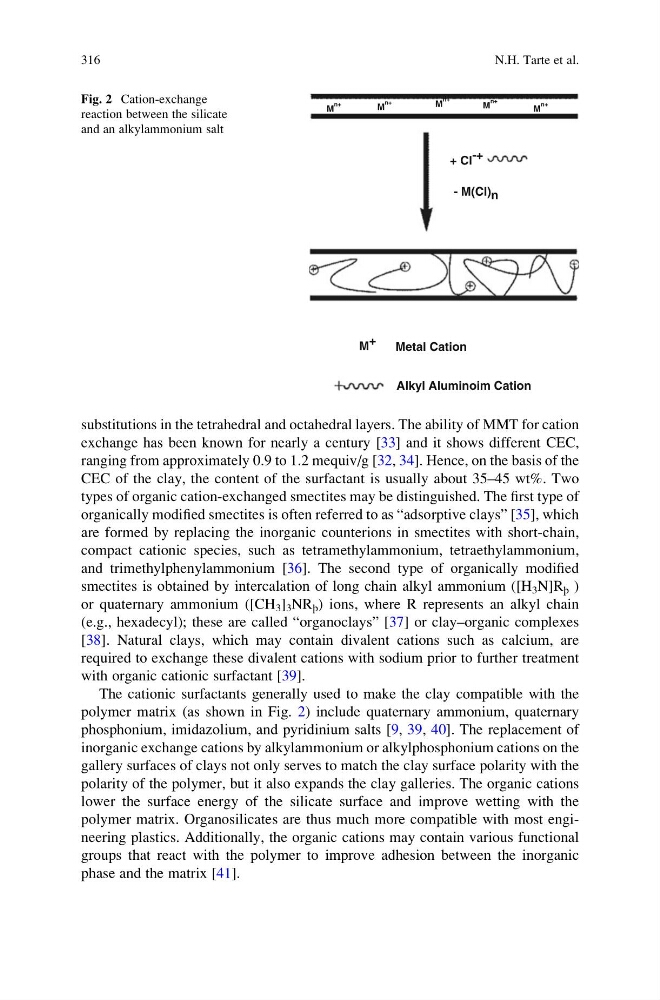
The cationic surfactants generally used to make the clay compatible with the
polymer matrix (as shown in Fig. 2) include quaternary ammonium, quaternary
phosphonium, imidazolium, and pyridinium salts [9, 39, 40]. The replacement of
inorganic exchange cations by alkylammonium or alkylphosphonium cations on the
gallery surfaces of clays not only serves to match the clay surface polarity with the
polarity of the polymer, but it also expands the clay galleries. The organic cations
lower the surface energy of the silicate surface and improve wetting with the
polymer matrix. Organosilicates are thus much more compatible with most engineering plastics. Additionally, the organic cations may contain various functional
groups that react with the polymer to improve adhesion between the inorganic
phase and the matrix [41].
Alkyl Aluminoim Cation
M +
Metal Cation
- M(Cl) n
+ Cl -+
M
n+
M
n+
M
n+
M
n+
M
n+
Fig. 2 Cation-exchange
reaction between the silicate
and an alkylammonium salt
316
N.H. Tarte et al.
exchange has been known for nearly a century [33] and it shows different CEC,
ranging from approximately 0.9 to 1.2 mequiv/g [32, 34]. Hence, on the basis of the
CEC of the clay, the content of the surfactant is usually about 35–45 wt%. Two
types of organic cation-exchanged smectites may be distinguished. The first type of
organically modified smectites is often referred to as “adsorptive clays” [35], which
are formed by replacing the inorganic counterions in smectites with short-chain,
compact cationic species, such as tetramethylammonium, tetraethylammonium,
and trimethylphenylammonium [36]. The second type of organically modified
smectites is obtained by intercalation of long chain alkyl ammonium ([H 3 N]R þ )
or quaternary ammonium ([CH 3 ] 3 NR þ ) ions, where R represents an alkyl chain
(e.g., hexadecyl); these are called “organoclays” [37] or clay–organic complexes
[38]. Natural clays, which may contain divalent cations such as calcium, are
required to exchange these divalent cations with sodium prior to further treatment
with organic cationic surfactant [39].
The cationic surfactants generally used to make the clay compatible with the
polymer matrix (as shown in Fig. 2) include quaternary ammonium, quaternary
phosphonium, imidazolium, and pyridinium salts [9, 39, 40]. The replacement of
inorganic exchange cations by alkylammonium or alkylphosphonium cations on the
gallery surfaces of clays not only serves to match the clay surface polarity with the
polarity of the polymer, but it also expands the clay galleries. The organic cations
lower the surface energy of the silicate surface and improve wetting with the
polymer matrix. Organosilicates are thus much more compatible with most engineering plastics. Additionally, the organic cations may contain various functional
groups that react with the polymer to improve adhesion between the inorganic
phase and the matrix [41].
Alkyl Aluminoim Cation
M +
Metal Cation
- M(Cl) n
+ Cl -+
M
n+
M
n+
M
n+
M
n+
M
n+
Fig. 2 Cation-exchange
reaction between the silicate
and an alkylammonium salt
316
N.H. Tarte et al.