

2 Structure and Properties of Layered Silicates
PLS nanocomposites are a hybrid between an organic phase (the polymer) and an
inorganic phase (the silicate). The choice of the silicate determines the nanoscopic
dispersion typical of nanocomposites. The silicates employed belong to the family
of layered silicates also known as phyllosilicates, such as mica, talc, MMT,
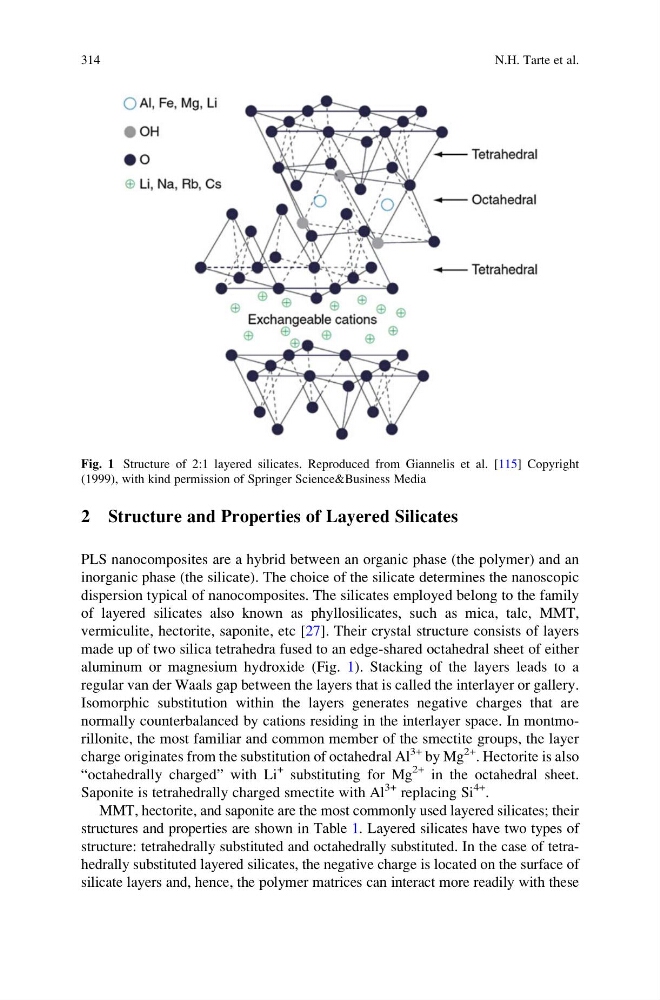
vermiculite, hectorite, saponite, etc [27]. Their crystal structure consists of layers
made up of two silica tetrahedra fused to an edge-shared octahedral sheet of either
aluminum or magnesium hydroxide (Fig. 1). Stacking of the layers leads to a
regular van der Waals gap between the layers that is called the interlayer or gallery.
Isomorphic substitution within the layers generates negative charges that are
normally counterbalanced by cations residing in the interlayer space. In montmorillonite, the most familiar and common member of the smectite groups, the layer
charge originates from the substitution of octahedral Al
3+ by Mg
2+ . Hectorite is also
“octahedrally charged” with Li
+ substituting for Mg
2+ in the octahedral sheet.
Saponite is tetrahedrally charged smectite with Al
3+ replacing Si
4+ .
MMT, hectorite, and saponite are the most commonly used layered silicates; their
structures and properties are shown in Table 1. Layered silicates have two types of
structure: tetrahedrally substituted and octahedrally substituted. In the case of tetrahedrally substituted layered silicates, the negative charge is located on the surface of
silicate layers and, hence, the polymer matrices can interact more readily with these
Fig. 1 Structure of 2:1 layered silicates. Reproduced from Giannelis et al. [115] Copyright
(1999), with kind permission of Springer Science&Business Media
314
N.H. Tarte et al.
PLS nanocomposites are a hybrid between an organic phase (the polymer) and an
inorganic phase (the silicate). The choice of the silicate determines the nanoscopic
dispersion typical of nanocomposites. The silicates employed belong to the family
of layered silicates also known as phyllosilicates, such as mica, talc, MMT,
vermiculite, hectorite, saponite, etc [27]. Their crystal structure consists of layers
made up of two silica tetrahedra fused to an edge-shared octahedral sheet of either
aluminum or magnesium hydroxide (Fig. 1). Stacking of the layers leads to a
regular van der Waals gap between the layers that is called the interlayer or gallery.
Isomorphic substitution within the layers generates negative charges that are
normally counterbalanced by cations residing in the interlayer space. In montmorillonite, the most familiar and common member of the smectite groups, the layer
charge originates from the substitution of octahedral Al
3+ by Mg
2+ . Hectorite is also
“octahedrally charged” with Li
+ substituting for Mg
2+ in the octahedral sheet.
Saponite is tetrahedrally charged smectite with Al
3+ replacing Si
4+ .
MMT, hectorite, and saponite are the most commonly used layered silicates; their
structures and properties are shown in Table 1. Layered silicates have two types of
structure: tetrahedrally substituted and octahedrally substituted. In the case of tetrahedrally substituted layered silicates, the negative charge is located on the surface of
silicate layers and, hence, the polymer matrices can interact more readily with these
Fig. 1 Structure of 2:1 layered silicates. Reproduced from Giannelis et al. [115] Copyright
(1999), with kind permission of Springer Science&Business Media
314
N.H. Tarte et al.