

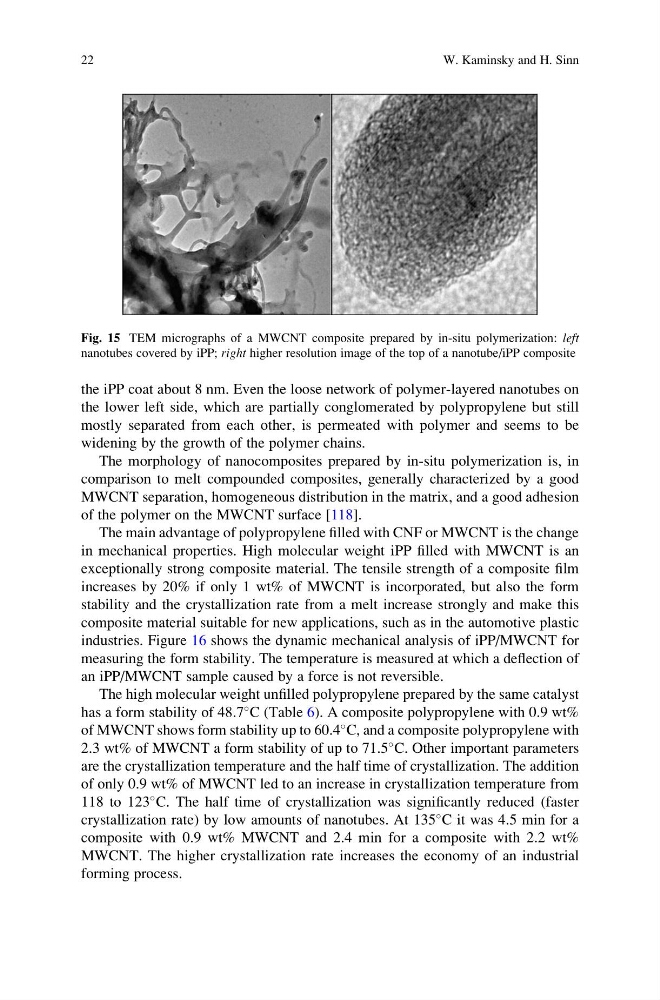
the iPP coat about 8 nm. Even the loose network of polymer-layered nanotubes on
the lower left side, which are partially conglomerated by polypropylene but still
mostly separated from each other, is permeated with polymer and seems to be
widening by the growth of the polymer chains.
The morphology of nanocomposites prepared by in-situ polymerization is, in
comparison to melt compounded composites, generally characterized by a good
MWCNT separation, homogeneous distribution in the matrix, and a good adhesion
of the polymer on the MWCNT surface [118].
The main advantage of polypropylene filled with CNF or MWCNT is the change
in mechanical properties. High molecular weight iPP filled with MWCNT is an
exceptionally strong composite material. The tensile strength of a composite film
increases by 20% if only 1 wt% of MWCNT is incorporated, but also the form
stability and the crystallization rate from a melt increase strongly and make this
composite material suitable for new applications, such as in the automotive plastic
industries. Figure 16 shows the dynamic mechanical analysis of iPP/MWCNT for
measuring the form stability. The temperature is measured at which a deflection of
an iPP/MWCNT sample caused by a force is not reversible.
The high molecular weight unfilled polypropylene prepared by the same catalyst
has a form stability of 48.7
C (Table 6). A composite polypropylene with 0.9 wt%
of MWCNT shows form stability up to 60.4
C, and a composite polypropylene with
2.3 wt% of MWCNT a form stability of up to 71.5
C. Other important parameters
are the crystallization temperature and the half time of crystallization. The addition
of only 0.9 wt% of MWCNT led to an increase in crystallization temperature from
118 to 123
C. The half time of crystallization was significantly reduced (faster
crystallization rate) by low amounts of nanotubes. At 135
C it was 4.5 min for a
composite with 0.9 wt% MWCNT and 2.4 min for a composite with 2.2 wt%
MWCNT. The higher crystallization rate increases the economy of an industrial
forming process.
Fig. 15 TEM micrographs of a MWCNT composite prepared by in-situ polymerization: left
nanotubes covered by iPP; right higher resolution image of the top of a nanotube/iPP composite
22
W. Kaminsky and H. Sinn
the lower left side, which are partially conglomerated by polypropylene but still
mostly separated from each other, is permeated with polymer and seems to be
widening by the growth of the polymer chains.
The morphology of nanocomposites prepared by in-situ polymerization is, in
comparison to melt compounded composites, generally characterized by a good
MWCNT separation, homogeneous distribution in the matrix, and a good adhesion
of the polymer on the MWCNT surface [118].
The main advantage of polypropylene filled with CNF or MWCNT is the change
in mechanical properties. High molecular weight iPP filled with MWCNT is an
exceptionally strong composite material. The tensile strength of a composite film
increases by 20% if only 1 wt% of MWCNT is incorporated, but also the form
stability and the crystallization rate from a melt increase strongly and make this
composite material suitable for new applications, such as in the automotive plastic
industries. Figure 16 shows the dynamic mechanical analysis of iPP/MWCNT for
measuring the form stability. The temperature is measured at which a deflection of
an iPP/MWCNT sample caused by a force is not reversible.
The high molecular weight unfilled polypropylene prepared by the same catalyst
has a form stability of 48.7
C (Table 6). A composite polypropylene with 0.9 wt%
of MWCNT shows form stability up to 60.4
C, and a composite polypropylene with
2.3 wt% of MWCNT a form stability of up to 71.5
C. Other important parameters
are the crystallization temperature and the half time of crystallization. The addition
of only 0.9 wt% of MWCNT led to an increase in crystallization temperature from
118 to 123
C. The half time of crystallization was significantly reduced (faster
crystallization rate) by low amounts of nanotubes. At 135
C it was 4.5 min for a
composite with 0.9 wt% MWCNT and 2.4 min for a composite with 2.2 wt%
MWCNT. The higher crystallization rate increases the economy of an industrial
forming process.
Fig. 15 TEM micrographs of a MWCNT composite prepared by in-situ polymerization: left
nanotubes covered by iPP; right higher resolution image of the top of a nanotube/iPP composite
22
W. Kaminsky and H. Sinn