

4 Outlook
Mechanistic studies of metallocene/MAO catalysts have strongly increased the
knowledge of olefin polymerization catalysis. This knowledge has made it possible
to find new bulky and weakly coordinating cocatalysts such as perfluorophenylborate anions and boranes. The discovery of new transition metal complexes
activated by MAO or other cocatalysts that show special polymerization properties
is still ongoing. It is another task to decrease the amount of MAO needed for the
activation. Supporting the MAO on silica, alumina, or on new organic polymers
[119] is one step towards this.
Metallocene/MAO and other single-site catalysts allow the synthesis of tailored
polyolefin structures in a way that was impossible in previous years. The known
dependence of the kind of metallocene-based polymer on the catalyst structure
allows the modeling of the reaction kinetics and the polymerization process
[120]. Reactor models could be developed using mass and energy balances and
they describe the polymer composition as well as the reactor operating conditions
required for a given polymer architecture. It should be possible to design
polyolefins with tailored molecular weight, comonomer content, long and short
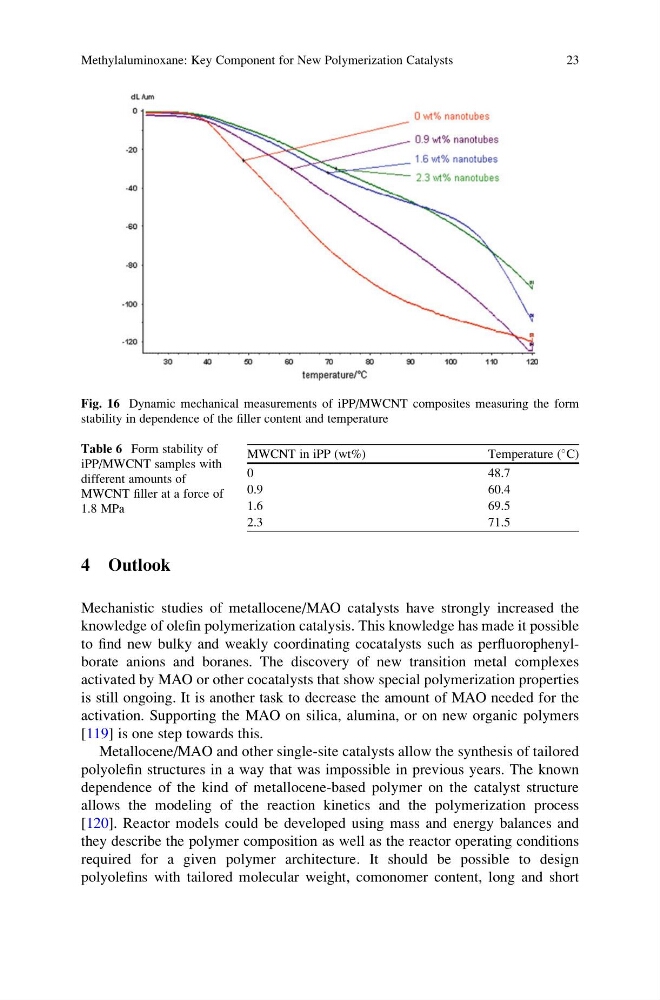
Fig. 16 Dynamic mechanical measurements of iPP/MWCNT composites measuring the form
stability in dependence of the filler content and temperature
Table 6 Form stability of
iPP/MWCNT samples with
different amounts of
MWCNT filler at a force of
1.8 MPa
MWCNT in iPP (wt%)
Temperature (
C)
0
48.7
0.9
60.4
1.6
69.5
2.3
71.5
Methylaluminoxane: Key Component for New Polymerization Catalysts
23
Mechanistic studies of metallocene/MAO catalysts have strongly increased the
knowledge of olefin polymerization catalysis. This knowledge has made it possible
to find new bulky and weakly coordinating cocatalysts such as perfluorophenylborate anions and boranes. The discovery of new transition metal complexes
activated by MAO or other cocatalysts that show special polymerization properties
is still ongoing. It is another task to decrease the amount of MAO needed for the
activation. Supporting the MAO on silica, alumina, or on new organic polymers
[119] is one step towards this.
Metallocene/MAO and other single-site catalysts allow the synthesis of tailored
polyolefin structures in a way that was impossible in previous years. The known
dependence of the kind of metallocene-based polymer on the catalyst structure
allows the modeling of the reaction kinetics and the polymerization process
[120]. Reactor models could be developed using mass and energy balances and
they describe the polymer composition as well as the reactor operating conditions
required for a given polymer architecture. It should be possible to design
polyolefins with tailored molecular weight, comonomer content, long and short
Fig. 16 Dynamic mechanical measurements of iPP/MWCNT composites measuring the form
stability in dependence of the filler content and temperature
Table 6 Form stability of
iPP/MWCNT samples with
different amounts of
MWCNT filler at a force of
1.8 MPa
MWCNT in iPP (wt%)
Temperature (
C)
0
48.7
0.9
60.4
1.6
69.5
2.3
71.5
Methylaluminoxane: Key Component for New Polymerization Catalysts
23