

shear thinning. Using reactor cascades, multizone reactors, and blends of single-site
catalysts (hybrid catalysts), the molar mass distributions and molar mass-dependent
branching are readily varied, thus improving processing, melt strengthening, and
fatigue resistance. Morphology control by reactor granule technology eliminates
the need for pelletizing extrusion and enables the in situ formation of reactor blends
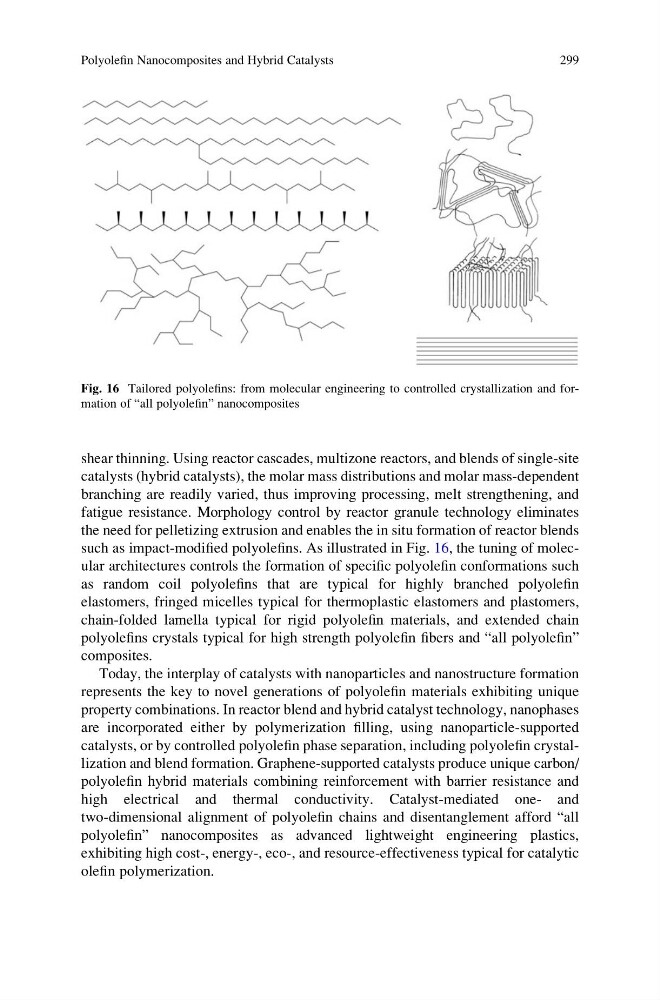
such as impact-modified polyolefins. As illustrated in Fig. 16, the tuning of molecular architectures controls the formation of specific polyolefin conformations such
as random coil polyolefins that are typical for highly branched polyolefin
elastomers, fringed micelles typical for thermoplastic elastomers and plastomers,
chain-folded lamella typical for rigid polyolefin materials, and extended chain
polyolefins crystals typical for high strength polyolefin fibers and “all polyolefin”
composites.
Today, the interplay of catalysts with nanoparticles and nanostructure formation
represents the key to novel generations of polyolefin materials exhibiting unique
property combinations. In reactor blend and hybrid catalyst technology, nanophases
are incorporated either by polymerization filling, using nanoparticle-supported
catalysts, or by controlled polyolefin phase separation, including polyolefin crystallization and blend formation. Graphene-supported catalysts produce unique carbon/
polyolefin hybrid materials combining reinforcement with barrier resistance and
high electrical and thermal conductivity. Catalyst-mediated one- and
two-dimensional alignment of polyolefin chains and disentanglement afford “all
polyolefin” nanocomposites as advanced lightweight engineering plastics,
exhibiting high cost-, energy-, eco-, and resource-effectiveness typical for catalytic
olefin polymerization.
Fig. 16 Tailored polyolefins: from molecular engineering to controlled crystallization and formation of “all polyolefin” nanocomposites
Polyolefin Nanocomposites and Hybrid Catalysts
299
catalysts (hybrid catalysts), the molar mass distributions and molar mass-dependent
branching are readily varied, thus improving processing, melt strengthening, and
fatigue resistance. Morphology control by reactor granule technology eliminates
the need for pelletizing extrusion and enables the in situ formation of reactor blends
such as impact-modified polyolefins. As illustrated in Fig. 16, the tuning of molecular architectures controls the formation of specific polyolefin conformations such
as random coil polyolefins that are typical for highly branched polyolefin
elastomers, fringed micelles typical for thermoplastic elastomers and plastomers,
chain-folded lamella typical for rigid polyolefin materials, and extended chain
polyolefins crystals typical for high strength polyolefin fibers and “all polyolefin”
composites.
Today, the interplay of catalysts with nanoparticles and nanostructure formation
represents the key to novel generations of polyolefin materials exhibiting unique
property combinations. In reactor blend and hybrid catalyst technology, nanophases
are incorporated either by polymerization filling, using nanoparticle-supported
catalysts, or by controlled polyolefin phase separation, including polyolefin crystallization and blend formation. Graphene-supported catalysts produce unique carbon/
polyolefin hybrid materials combining reinforcement with barrier resistance and
high electrical and thermal conductivity. Catalyst-mediated one- and
two-dimensional alignment of polyolefin chains and disentanglement afford “all
polyolefin” nanocomposites as advanced lightweight engineering plastics,
exhibiting high cost-, energy-, eco-, and resource-effectiveness typical for catalytic
olefin polymerization.
Fig. 16 Tailored polyolefins: from molecular engineering to controlled crystallization and formation of “all polyolefin” nanocomposites
Polyolefin Nanocomposites and Hybrid Catalysts
299