

controlled oriented crystallization of extended chain polyolefins. In their pioneering
advances, Smith, Chanzy and Rotzinger reported on a VCl 4 /AlEt 3 catalyst producing disentangled polyethylene on the surface of a glass slide. They succeeded in
producing ultrastrong fibers, films, and tapes drawn directly from disentangled
virgin UHMWPE without using any solvents [194–196].
The advent of metallocene and post-metallocene catalysis has opened new
possibilities for producing “disentangled” UHMWPE, e.g., using the supported FI
catalyst displayed in Fig. 15. For instance, Rastogi and coworkers used phenoxyimine-based catalysts supported on various nanoparticles (e.g., SWCNT, TiO 2 ,
ZrO 2 and hydroxyapatite) to produce disentangled polyethylene at higher
temperatures (25
C; 1 bar ethylene) with respect to the polyethylene produced on
vanadium catalysts. After drawing in the solid state at temperatures between
125 and 145
C, disentangled polyethylene samples containing different nanoparticles
exhibited high crystallinities (>90%) and high moduli at draw ratios >180.
Attributed to the nature of the used supports, polymer–particle interactions influence the modulus and activity of the systems. Furthermore, the catalyst activity was
significantly increased, most likely by scavenging of aluminum trimethyl by adding
small amounts of sterically hindered phenols. It was concluded that modern
metallocene catalysis based upon FI catalysts renders disentangled polyethylene
readily available and prevents reactor fouling [52, 53, 197, 198]. Yet, in another
approach towards disentangled UHMWPE Mecking et al. proposed the catalytic
dispersion polymerization of ethylene in aqueous media [199]. LDPE can be used
as dispersing agent at elevated temperatures (50
C), forming a stable dispersion of
disentangled polyethylene in toluene [200].
3 Summary, Conclusions, and Outlook
The remarkable progress in catalytic olefin polymerization and single-site catalyst
technology offers new opportunities for tailoring advanced highly energy-effective
and sustainable polyolefin materials. As a function of the catalyst architectures, it is
possible to tune polyolefin architectures and properties. Olefin copolymerization
and multibranching homopolymerization afford precise control of short- and longchain branching, thus enabling control of crystallization, density, elasticity, and
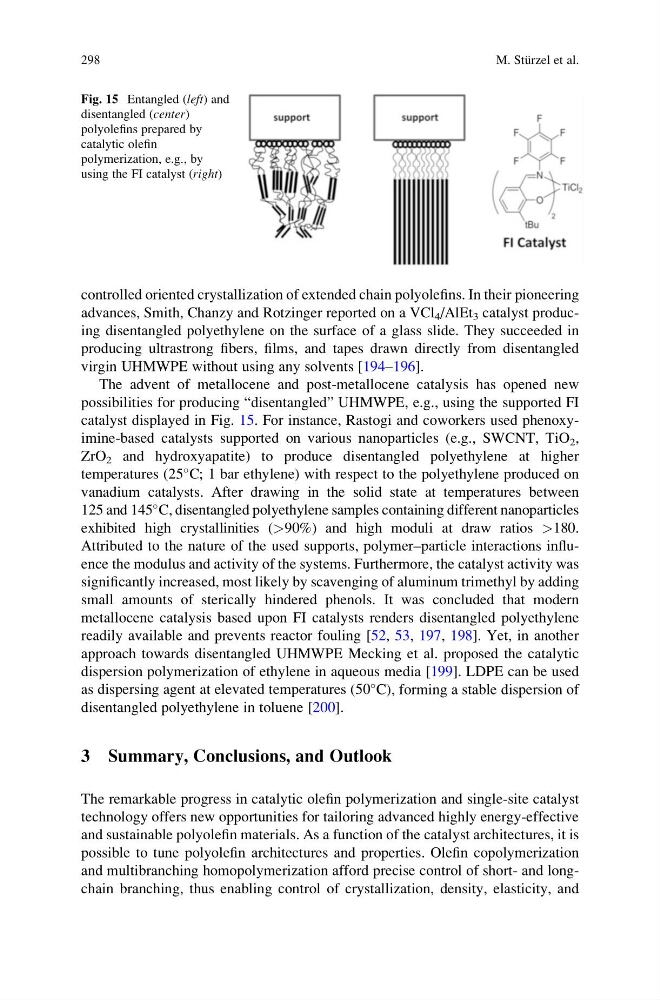
Fig. 15 Entangled (left) and
disentangled (center)
polyolefins prepared by
catalytic olefin
polymerization, e.g., by
using the FI catalyst (right)
298
M. Stu ¨rzel et al.
advances, Smith, Chanzy and Rotzinger reported on a VCl 4 /AlEt 3 catalyst producing disentangled polyethylene on the surface of a glass slide. They succeeded in
producing ultrastrong fibers, films, and tapes drawn directly from disentangled
virgin UHMWPE without using any solvents [194–196].
The advent of metallocene and post-metallocene catalysis has opened new
possibilities for producing “disentangled” UHMWPE, e.g., using the supported FI
catalyst displayed in Fig. 15. For instance, Rastogi and coworkers used phenoxyimine-based catalysts supported on various nanoparticles (e.g., SWCNT, TiO 2 ,
ZrO 2 and hydroxyapatite) to produce disentangled polyethylene at higher
temperatures (25
C; 1 bar ethylene) with respect to the polyethylene produced on
vanadium catalysts. After drawing in the solid state at temperatures between
125 and 145
C, disentangled polyethylene samples containing different nanoparticles
exhibited high crystallinities (>90%) and high moduli at draw ratios >180.
Attributed to the nature of the used supports, polymer–particle interactions influence the modulus and activity of the systems. Furthermore, the catalyst activity was
significantly increased, most likely by scavenging of aluminum trimethyl by adding
small amounts of sterically hindered phenols. It was concluded that modern
metallocene catalysis based upon FI catalysts renders disentangled polyethylene
readily available and prevents reactor fouling [52, 53, 197, 198]. Yet, in another
approach towards disentangled UHMWPE Mecking et al. proposed the catalytic
dispersion polymerization of ethylene in aqueous media [199]. LDPE can be used
as dispersing agent at elevated temperatures (50
C), forming a stable dispersion of
disentangled polyethylene in toluene [200].
3 Summary, Conclusions, and Outlook
The remarkable progress in catalytic olefin polymerization and single-site catalyst
technology offers new opportunities for tailoring advanced highly energy-effective
and sustainable polyolefin materials. As a function of the catalyst architectures, it is
possible to tune polyolefin architectures and properties. Olefin copolymerization
and multibranching homopolymerization afford precise control of short- and longchain branching, thus enabling control of crystallization, density, elasticity, and
Fig. 15 Entangled (left) and
disentangled (center)
polyolefins prepared by
catalytic olefin
polymerization, e.g., by
using the FI catalyst (right)
298
M. Stu ¨rzel et al.