

reinforcement a high aspect ratio is required. The investigation of iPP melt
compounding revealed that non-modified boehmites are effective iPP nucleating
agents, whereas the corresponding boehmites with organophilic modification function as anti-nucleating agents, slowing down iPP crystallization [80].
2.2 Polyolefin Carbon Hybrid Materials
Among conventional carbon materials, micron-sized graphite is an attractive filler
for polyolefins, combining high electrical and thermal conductivity with excellent
lubrication, abrasion resistance, thermo-oxidative and chemical stability, and barrier resistance. Typically, more than 20 wt% graphite is added to polyolefins, owing
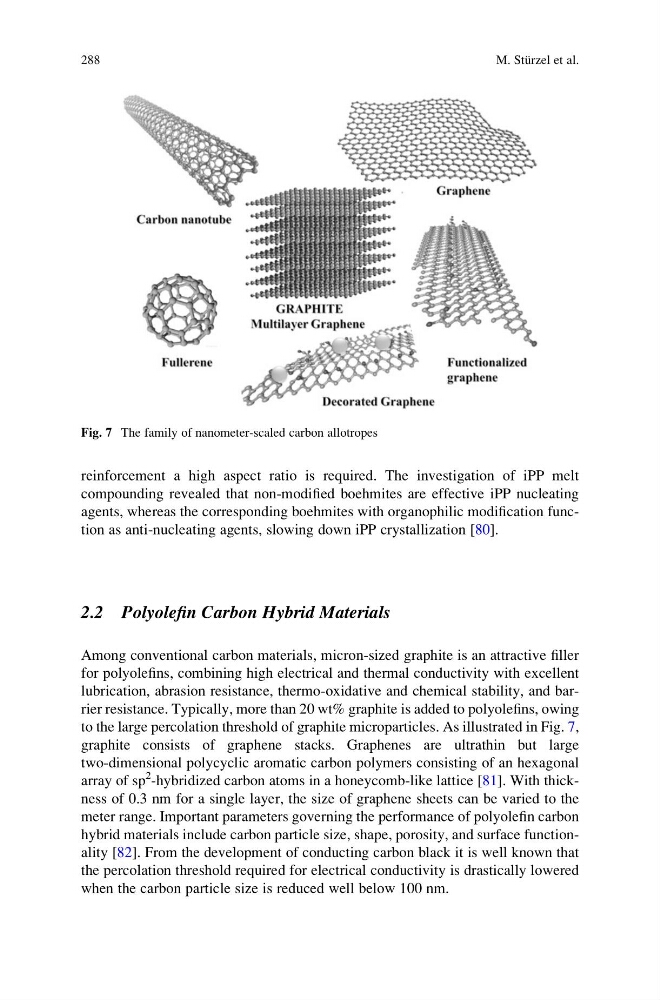
to the large percolation threshold of graphite microparticles. As illustrated in Fig. 7,
graphite consists of graphene stacks. Graphenes are ultrathin but large
two-dimensional polycyclic aromatic carbon polymers consisting of an hexagonal
array of sp
2 -hybridized carbon atoms in a honeycomb-like lattice [81]. With thickness of 0.3 nm for a single layer, the size of graphene sheets can be varied to the
meter range. Important parameters governing the performance of polyolefin carbon
hybrid materials include carbon particle size, shape, porosity, and surface functionality [82]. From the development of conducting carbon black it is well known that
the percolation threshold required for electrical conductivity is drastically lowered
when the carbon particle size is reduced well below 100 nm.
Fig. 7 The family of nanometer-scaled carbon allotropes
288
M. Stu ¨rzel et al.
compounding revealed that non-modified boehmites are effective iPP nucleating
agents, whereas the corresponding boehmites with organophilic modification function as anti-nucleating agents, slowing down iPP crystallization [80].
2.2 Polyolefin Carbon Hybrid Materials
Among conventional carbon materials, micron-sized graphite is an attractive filler
for polyolefins, combining high electrical and thermal conductivity with excellent
lubrication, abrasion resistance, thermo-oxidative and chemical stability, and barrier resistance. Typically, more than 20 wt% graphite is added to polyolefins, owing
to the large percolation threshold of graphite microparticles. As illustrated in Fig. 7,
graphite consists of graphene stacks. Graphenes are ultrathin but large
two-dimensional polycyclic aromatic carbon polymers consisting of an hexagonal
array of sp
2 -hybridized carbon atoms in a honeycomb-like lattice [81]. With thickness of 0.3 nm for a single layer, the size of graphene sheets can be varied to the
meter range. Important parameters governing the performance of polyolefin carbon
hybrid materials include carbon particle size, shape, porosity, and surface functionality [82]. From the development of conducting carbon black it is well known that
the percolation threshold required for electrical conductivity is drastically lowered
when the carbon particle size is reduced well below 100 nm.
Fig. 7 The family of nanometer-scaled carbon allotropes
288
M. Stu ¨rzel et al.