

MAO-tethered boehmite accounted for 100% increase in catalyst activity. Although
the homogenous catalyst caused severe reactor fouling, boehmite-supported
metallocene catalysts afforded excellent morphology control without any indication
of dust-like polyolefin particle formation.
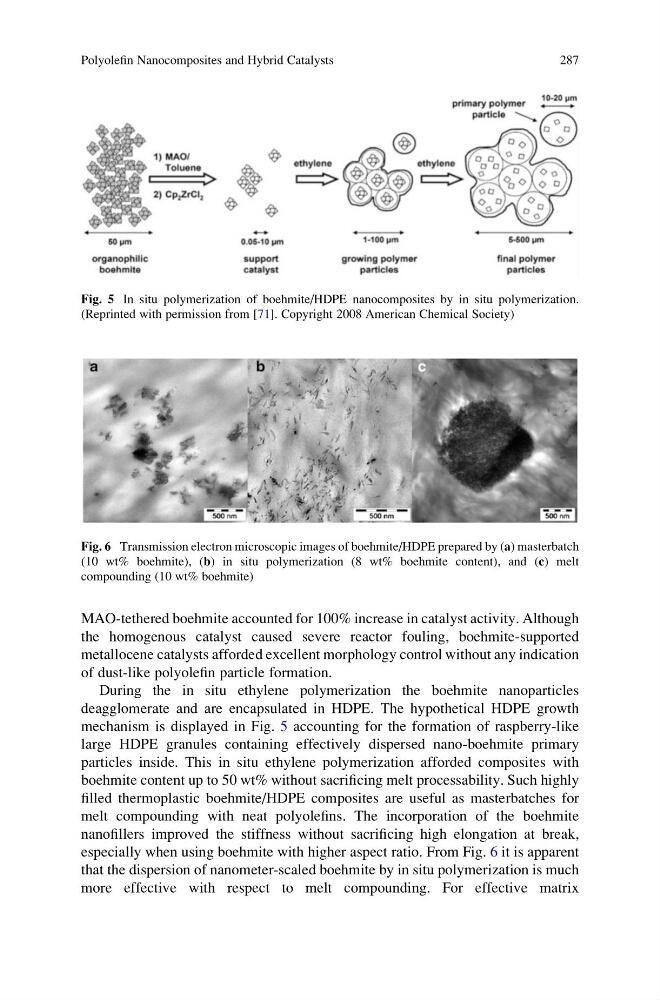
During the in situ ethylene polymerization the boehmite nanoparticles
deagglomerate and are encapsulated in HDPE. The hypothetical HDPE growth
mechanism is displayed in Fig. 5 accounting for the formation of raspberry-like
large HDPE granules containing effectively dispersed nano-boehmite primary
particles inside. This in situ ethylene polymerization afforded composites with
boehmite content up to 50 wt% without sacrificing melt processability. Such highly
filled thermoplastic boehmite/HDPE composites are useful as masterbatches for
melt compounding with neat polyolefins. The incorporation of the boehmite
nanofillers improved the stiffness without sacrificing high elongation at break,
especially when using boehmite with higher aspect ratio. From Fig. 6 it is apparent
that the dispersion of nanometer-scaled boehmite by in situ polymerization is much
more effective with respect to melt compounding. For effective matrix
Fig. 5 In situ polymerization of boehmite/HDPE nanocomposites by in situ polymerization.
(Reprinted with permission from [71]. Copyright 2008 American Chemical Society)
Fig. 6 Transmission electron microscopic images of boehmite/HDPE prepared by (a) masterbatch
(10 wt% boehmite), (b) in situ polymerization (8 wt% boehmite content), and (c) melt
compounding (10 wt% boehmite)
Polyolefin Nanocomposites and Hybrid Catalysts
287
the homogenous catalyst caused severe reactor fouling, boehmite-supported
metallocene catalysts afforded excellent morphology control without any indication
of dust-like polyolefin particle formation.
During the in situ ethylene polymerization the boehmite nanoparticles
deagglomerate and are encapsulated in HDPE. The hypothetical HDPE growth
mechanism is displayed in Fig. 5 accounting for the formation of raspberry-like
large HDPE granules containing effectively dispersed nano-boehmite primary
particles inside. This in situ ethylene polymerization afforded composites with
boehmite content up to 50 wt% without sacrificing melt processability. Such highly
filled thermoplastic boehmite/HDPE composites are useful as masterbatches for
melt compounding with neat polyolefins. The incorporation of the boehmite
nanofillers improved the stiffness without sacrificing high elongation at break,
especially when using boehmite with higher aspect ratio. From Fig. 6 it is apparent
that the dispersion of nanometer-scaled boehmite by in situ polymerization is much
more effective with respect to melt compounding. For effective matrix
Fig. 5 In situ polymerization of boehmite/HDPE nanocomposites by in situ polymerization.
(Reprinted with permission from [71]. Copyright 2008 American Chemical Society)
Fig. 6 Transmission electron microscopic images of boehmite/HDPE prepared by (a) masterbatch
(10 wt% boehmite), (b) in situ polymerization (8 wt% boehmite content), and (c) melt
compounding (10 wt% boehmite)
Polyolefin Nanocomposites and Hybrid Catalysts
287