

bis(imino)pyridine-Fe on organophilic montmorillonite enabled partial exfoliation in
ethylene polymerization and higher crystallinity compared to homogeneous in situ
polymerizations [62]. Wei et al. [63] incorporated silica particles between clay layers
by means of olefin polymerization on Cp 2 ZrCl 2 /MAO supported on clay/silica
blends, affording enhancements in stiffness and particle morphology. Polymerization
filling with traditional Ziegler catalysts [64, 65] as well as single-site metallocenes
[66] afforded iPP nanocomposites containing exfoliated clay. Effective organoclay
exfoliation and covalent attachment of exfoliated organoclay to the polyolefin matrix
was achieved by Shin et al. who used vinyl-functional organoclay modification [67].
Coates et al. immobilized diimine-palladium catalysts in organophilic fluorohectorite
modified with alkyl amonium cations [68]. Others immobilized diimine-nickel
catalysts to obtain exfoliated clay with bimodal polyethylene [58, 69].
Nanometer-scaled boehmites are attractive support materials for single-site
catalysts used for in situ nanocomposite formation [70–74]. Prepared from aluminum metal and alcohol in the Sasol process [75], nanometer-scaled boehmites are
readily prepared and rendered organophilic by surface modification with various
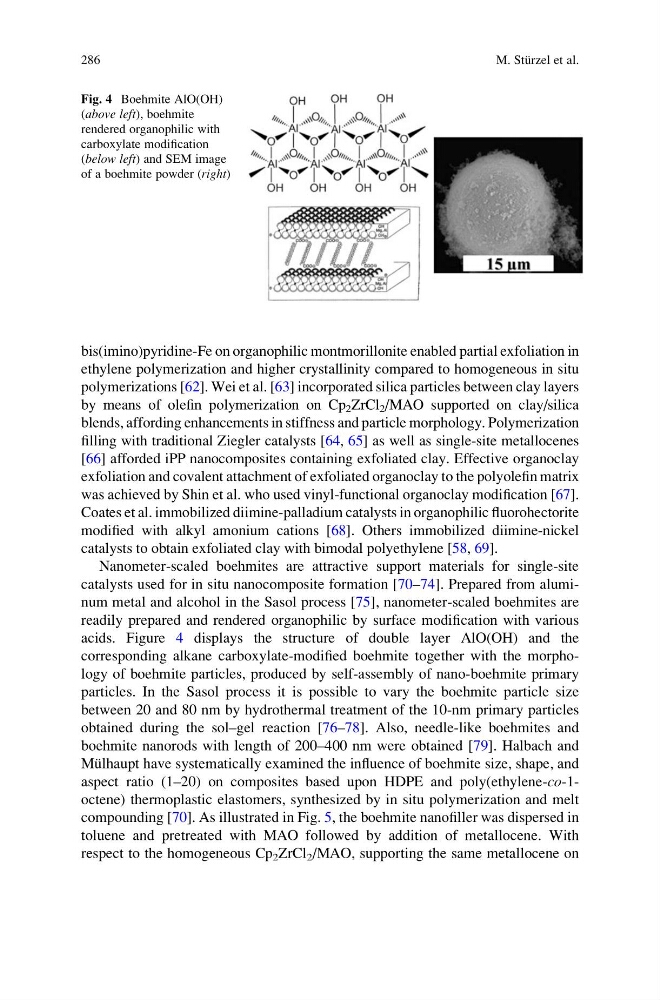
acids. Figure 4 displays the structure of double layer AlO(OH) and the
corresponding alkane carboxylate-modified boehmite together with the morphology of boehmite particles, produced by self-assembly of nano-boehmite primary
particles. In the Sasol process it is possible to vary the boehmite particle size
between 20 and 80 nm by hydrothermal treatment of the 10-nm primary particles
obtained during the sol–gel reaction [76–78]. Also, needle-like boehmites and
boehmite nanorods with length of 200–400 nm were obtained [79]. Halbach and
Mu ¨lhaupt have systematically examined the influence of boehmite size, shape, and
aspect ratio (1–20) on composites based upon HDPE and poly(ethylene-co-1octene) thermoplastic elastomers, synthesized by in situ polymerization and melt
compounding [70]. As illustrated in Fig. 5, the boehmite nanofiller was dispersed in
toluene and pretreated with MAO followed by addition of metallocene. With
respect to the homogeneous Cp 2 ZrCl 2 /MAO, supporting the same metallocene on
Fig. 4 Boehmite AlO(OH)
(above left), boehmite
rendered organophilic with
carboxylate modification
(below left) and SEM image
of a boehmite powder (right)
286
M. Stu ¨rzel et al.
ethylene polymerization and higher crystallinity compared to homogeneous in situ
polymerizations [62]. Wei et al. [63] incorporated silica particles between clay layers
by means of olefin polymerization on Cp 2 ZrCl 2 /MAO supported on clay/silica
blends, affording enhancements in stiffness and particle morphology. Polymerization
filling with traditional Ziegler catalysts [64, 65] as well as single-site metallocenes
[66] afforded iPP nanocomposites containing exfoliated clay. Effective organoclay
exfoliation and covalent attachment of exfoliated organoclay to the polyolefin matrix
was achieved by Shin et al. who used vinyl-functional organoclay modification [67].
Coates et al. immobilized diimine-palladium catalysts in organophilic fluorohectorite
modified with alkyl amonium cations [68]. Others immobilized diimine-nickel
catalysts to obtain exfoliated clay with bimodal polyethylene [58, 69].
Nanometer-scaled boehmites are attractive support materials for single-site
catalysts used for in situ nanocomposite formation [70–74]. Prepared from aluminum metal and alcohol in the Sasol process [75], nanometer-scaled boehmites are
readily prepared and rendered organophilic by surface modification with various
acids. Figure 4 displays the structure of double layer AlO(OH) and the
corresponding alkane carboxylate-modified boehmite together with the morphology of boehmite particles, produced by self-assembly of nano-boehmite primary
particles. In the Sasol process it is possible to vary the boehmite particle size
between 20 and 80 nm by hydrothermal treatment of the 10-nm primary particles
obtained during the sol–gel reaction [76–78]. Also, needle-like boehmites and
boehmite nanorods with length of 200–400 nm were obtained [79]. Halbach and
Mu ¨lhaupt have systematically examined the influence of boehmite size, shape, and
aspect ratio (1–20) on composites based upon HDPE and poly(ethylene-co-1octene) thermoplastic elastomers, synthesized by in situ polymerization and melt
compounding [70]. As illustrated in Fig. 5, the boehmite nanofiller was dispersed in
toluene and pretreated with MAO followed by addition of metallocene. With
respect to the homogeneous Cp 2 ZrCl 2 /MAO, supporting the same metallocene on
Fig. 4 Boehmite AlO(OH)
(above left), boehmite
rendered organophilic with
carboxylate modification
(below left) and SEM image
of a boehmite powder (right)
286
M. Stu ¨rzel et al.