

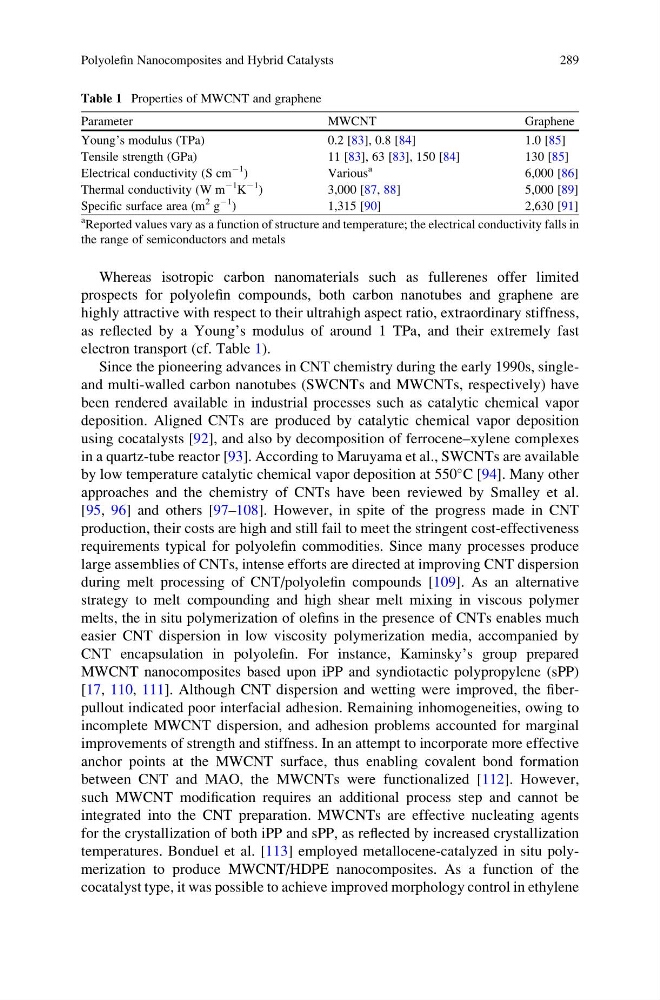
Whereas isotropic carbon nanomaterials such as fullerenes offer limited
prospects for polyolefin compounds, both carbon nanotubes and graphene are
highly attractive with respect to their ultrahigh aspect ratio, extraordinary stiffness,
as reflected by a Young’s modulus of around 1 TPa, and their extremely fast
electron transport (cf. Table 1).
Since the pioneering advances in CNT chemistry during the early 1990s, singleand multi-walled carbon nanotubes (SWCNTs and MWCNTs, respectively) have
been rendered available in industrial processes such as catalytic chemical vapor
deposition. Aligned CNTs are produced by catalytic chemical vapor deposition
using cocatalysts [92], and also by decomposition of ferrocene–xylene complexes
in a quartz-tube reactor [93]. According to Maruyama et al., SWCNTs are available
by low temperature catalytic chemical vapor deposition at 550
C [94]. Many other
approaches and the chemistry of CNTs have been reviewed by Smalley et al.
[95, 96] and others [97–108]. However, in spite of the progress made in CNT
production, their costs are high and still fail to meet the stringent cost-effectiveness
requirements typical for polyolefin commodities. Since many processes produce
large assemblies of CNTs, intense efforts are directed at improving CNT dispersion
during melt processing of CNT/polyolefin compounds [109]. As an alternative
strategy to melt compounding and high shear melt mixing in viscous polymer
melts, the in situ polymerization of olefins in the presence of CNTs enables much
easier CNT dispersion in low viscosity polymerization media, accompanied by
CNT encapsulation in polyolefin. For instance, Kaminsky’s group prepared
MWCNT nanocomposites based upon iPP and syndiotactic polypropylene (sPP)
[17, 110, 111]. Although CNT dispersion and wetting were improved, the fiberpullout indicated poor interfacial adhesion. Remaining inhomogeneities, owing to
incomplete MWCNT dispersion, and adhesion problems accounted for marginal
improvements of strength and stiffness. In an attempt to incorporate more effective
anchor points at the MWCNT surface, thus enabling covalent bond formation
between CNT and MAO, the MWCNTs were functionalized [112]. However,
such MWCNT modification requires an additional process step and cannot be
integrated into the CNT preparation. MWCNTs are effective nucleating agents
for the crystallization of both iPP and sPP, as reflected by increased crystallization
temperatures. Bonduel et al. [113] employed metallocene-catalyzed in situ polymerization to produce MWCNT/HDPE nanocomposites. As a function of the
cocatalyst type, it was possible to achieve improved morphology control in ethylene
Table 1 Properties of MWCNT and graphene
Parameter
MWCNT
Graphene
Young’s modulus (TPa)
0.2 [83], 0.8 [84]
1.0 [85]
Tensile strength (GPa)
11 [83], 63 [83], 150 [84]
130 [85]
Electrical conductivity (S cm
À1
)
Various
a
6,000 [86]
Thermal conductivity (W m
À1
K
À1
)
3,000 [87, 88]
5,000 [89]
Specific surface area (m
2 g
À1 )
1,315 [90]
2,630 [91]
a
Reported values vary as a function of structure and temperature; the electrical conductivity falls in
the range of semiconductors and metals
Polyolefin Nanocomposites and Hybrid Catalysts
289
prospects for polyolefin compounds, both carbon nanotubes and graphene are
highly attractive with respect to their ultrahigh aspect ratio, extraordinary stiffness,
as reflected by a Young’s modulus of around 1 TPa, and their extremely fast
electron transport (cf. Table 1).
Since the pioneering advances in CNT chemistry during the early 1990s, singleand multi-walled carbon nanotubes (SWCNTs and MWCNTs, respectively) have
been rendered available in industrial processes such as catalytic chemical vapor
deposition. Aligned CNTs are produced by catalytic chemical vapor deposition
using cocatalysts [92], and also by decomposition of ferrocene–xylene complexes
in a quartz-tube reactor [93]. According to Maruyama et al., SWCNTs are available
by low temperature catalytic chemical vapor deposition at 550
C [94]. Many other
approaches and the chemistry of CNTs have been reviewed by Smalley et al.
[95, 96] and others [97–108]. However, in spite of the progress made in CNT
production, their costs are high and still fail to meet the stringent cost-effectiveness
requirements typical for polyolefin commodities. Since many processes produce
large assemblies of CNTs, intense efforts are directed at improving CNT dispersion
during melt processing of CNT/polyolefin compounds [109]. As an alternative
strategy to melt compounding and high shear melt mixing in viscous polymer
melts, the in situ polymerization of olefins in the presence of CNTs enables much
easier CNT dispersion in low viscosity polymerization media, accompanied by
CNT encapsulation in polyolefin. For instance, Kaminsky’s group prepared
MWCNT nanocomposites based upon iPP and syndiotactic polypropylene (sPP)
[17, 110, 111]. Although CNT dispersion and wetting were improved, the fiberpullout indicated poor interfacial adhesion. Remaining inhomogeneities, owing to
incomplete MWCNT dispersion, and adhesion problems accounted for marginal
improvements of strength and stiffness. In an attempt to incorporate more effective
anchor points at the MWCNT surface, thus enabling covalent bond formation
between CNT and MAO, the MWCNTs were functionalized [112]. However,
such MWCNT modification requires an additional process step and cannot be
integrated into the CNT preparation. MWCNTs are effective nucleating agents
for the crystallization of both iPP and sPP, as reflected by increased crystallization
temperatures. Bonduel et al. [113] employed metallocene-catalyzed in situ polymerization to produce MWCNT/HDPE nanocomposites. As a function of the
cocatalyst type, it was possible to achieve improved morphology control in ethylene
Table 1 Properties of MWCNT and graphene
Parameter
MWCNT
Graphene
Young’s modulus (TPa)
0.2 [83], 0.8 [84]
1.0 [85]
Tensile strength (GPa)
11 [83], 63 [83], 150 [84]
130 [85]
Electrical conductivity (S cm
À1
)
Various
a
6,000 [86]
Thermal conductivity (W m
À1
K
À1
)
3,000 [87, 88]
5,000 [89]
Specific surface area (m
2 g
À1 )
1,315 [90]
2,630 [91]
a
Reported values vary as a function of structure and temperature; the electrical conductivity falls in
the range of semiconductors and metals
Polyolefin Nanocomposites and Hybrid Catalysts
289