

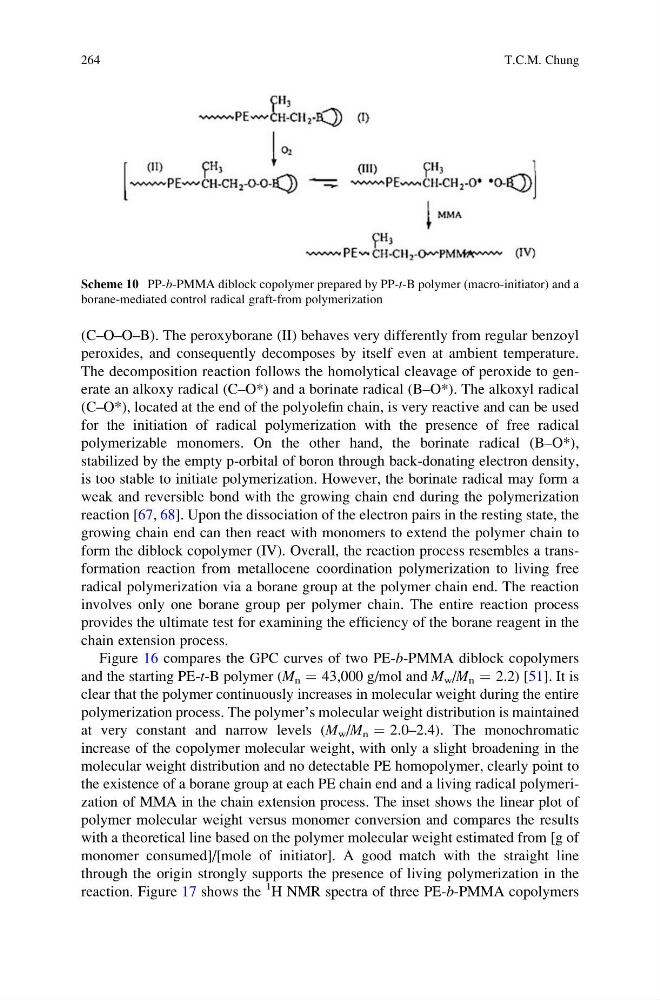
(C–O–O–B). The peroxyborane (II) behaves very differently from regular benzoyl
peroxides, and consequently decomposes by itself even at ambient temperature.
The decomposition reaction follows the homolytical cleavage of peroxide to generate an alkoxy radical (C–O*) and a borinate radical (B–O*). The alkoxyl radical
(C–O*), located at the end of the polyolefin chain, is very reactive and can be used
for the initiation of radical polymerization with the presence of free radical
polymerizable monomers. On the other hand, the borinate radical (B–O*),
stabilized by the empty p-orbital of boron through back-donating electron density,
is too stable to initiate polymerization. However, the borinate radical may form a
weak and reversible bond with the growing chain end during the polymerization
reaction [67, 68]. Upon the dissociation of the electron pairs in the resting state, the
growing chain end can then react with monomers to extend the polymer chain to
form the diblock copolymer (IV). Overall, the reaction process resembles a transformation reaction from metallocene coordination polymerization to living free
radical polymerization via a borane group at the polymer chain end. The reaction
involves only one borane group per polymer chain. The entire reaction process
provides the ultimate test for examining the efficiency of the borane reagent in the
chain extension process.
Figure 16 compares the GPC curves of two PE-b-PMMA diblock copolymers
and the starting PE-t-B polymer (M n ¼ 43,000 g/mol and M w /M n ¼ 2.2) [51]. It is
clear that the polymer continuously increases in molecular weight during the entire
polymerization process. The polymer’s molecular weight distribution is maintained
at very constant and narrow levels (M w /M n ¼ 2.0–2.4). The monochromatic
increase of the copolymer molecular weight, with only a slight broadening in the
molecular weight distribution and no detectable PE homopolymer, clearly point to
the existence of a borane group at each PE chain end and a living radical polymerization of MMA in the chain extension process. The inset shows the linear plot of
polymer molecular weight versus monomer conversion and compares the results
with a theoretical line based on the polymer molecular weight estimated from [g of
monomer consumed]/[mole of initiator]. A good match with the straight line
through the origin strongly supports the presence of living polymerization in the
reaction. Figure 17 shows the
1 H NMR spectra of three PE-b-PMMA copolymers
Scheme 10 PP-b-PMMA diblock copolymer prepared by PP-t-B polymer (macro-initiator) and a
borane-mediated control radical graft-from polymerization
264
T.C.M. Chung
peroxides, and consequently decomposes by itself even at ambient temperature.
The decomposition reaction follows the homolytical cleavage of peroxide to generate an alkoxy radical (C–O*) and a borinate radical (B–O*). The alkoxyl radical
(C–O*), located at the end of the polyolefin chain, is very reactive and can be used
for the initiation of radical polymerization with the presence of free radical
polymerizable monomers. On the other hand, the borinate radical (B–O*),
stabilized by the empty p-orbital of boron through back-donating electron density,
is too stable to initiate polymerization. However, the borinate radical may form a
weak and reversible bond with the growing chain end during the polymerization
reaction [67, 68]. Upon the dissociation of the electron pairs in the resting state, the
growing chain end can then react with monomers to extend the polymer chain to
form the diblock copolymer (IV). Overall, the reaction process resembles a transformation reaction from metallocene coordination polymerization to living free
radical polymerization via a borane group at the polymer chain end. The reaction
involves only one borane group per polymer chain. The entire reaction process
provides the ultimate test for examining the efficiency of the borane reagent in the
chain extension process.
Figure 16 compares the GPC curves of two PE-b-PMMA diblock copolymers
and the starting PE-t-B polymer (M n ¼ 43,000 g/mol and M w /M n ¼ 2.2) [51]. It is
clear that the polymer continuously increases in molecular weight during the entire
polymerization process. The polymer’s molecular weight distribution is maintained
at very constant and narrow levels (M w /M n ¼ 2.0–2.4). The monochromatic
increase of the copolymer molecular weight, with only a slight broadening in the
molecular weight distribution and no detectable PE homopolymer, clearly point to
the existence of a borane group at each PE chain end and a living radical polymerization of MMA in the chain extension process. The inset shows the linear plot of
polymer molecular weight versus monomer conversion and compares the results
with a theoretical line based on the polymer molecular weight estimated from [g of
monomer consumed]/[mole of initiator]. A good match with the straight line
through the origin strongly supports the presence of living polymerization in the
reaction. Figure 17 shows the
1 H NMR spectra of three PE-b-PMMA copolymers
Scheme 10 PP-b-PMMA diblock copolymer prepared by PP-t-B polymer (macro-initiator) and a
borane-mediated control radical graft-from polymerization
264
T.C.M. Chung