

temperature, elasticity, etc. They are highly effective interfacial agents for improving the compatibility of polyolefin blends and composites.
Scheme 10 illustrates a borane-terminated PE (PE-t-B), discussed in Sect. 2.2,
which is transformed to the PE macro-initiator for forming a polyethylene-blockpolymethylmethacrylate (PE-b-PMMA) diblock copolymer. The terminal borane
group in PE (I) can be spontaneously oxidized to a peroxide (B–O–O–C) moiety (II)
even at a very low temperature (À65
C). Due to the unfavorable ring strain increase
by inserting oxygen into the C–B bonds in the bicyclic ring of 9-BBN, which
destroys the stable double chair-form structure, the oxidation reaction selectively
takes place at the C–B bond in the linear alkyl group to produce peroxyborane
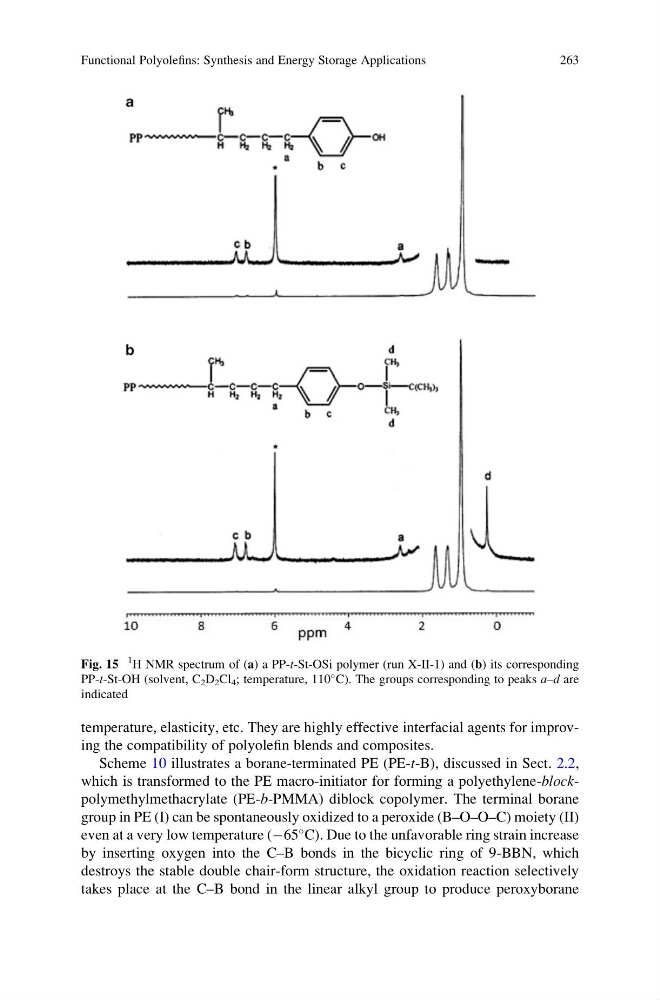
Fig. 15
1
H NMR spectrum of (a) a PP-t-St-OSi polymer (run X-II-1) and (b) its corresponding
PP-t-St-OH (solvent, C 2 D 2 Cl 4 ; temperature, 110
C). The groups corresponding to peaks a–d are
indicated
Functional Polyolefins: Synthesis and Energy Storage Applications
263
Scheme 10 illustrates a borane-terminated PE (PE-t-B), discussed in Sect. 2.2,
which is transformed to the PE macro-initiator for forming a polyethylene-blockpolymethylmethacrylate (PE-b-PMMA) diblock copolymer. The terminal borane
group in PE (I) can be spontaneously oxidized to a peroxide (B–O–O–C) moiety (II)
even at a very low temperature (À65
C). Due to the unfavorable ring strain increase
by inserting oxygen into the C–B bonds in the bicyclic ring of 9-BBN, which
destroys the stable double chair-form structure, the oxidation reaction selectively
takes place at the C–B bond in the linear alkyl group to produce peroxyborane
Fig. 15
1
H NMR spectrum of (a) a PP-t-St-OSi polymer (run X-II-1) and (b) its corresponding
PP-t-St-OH (solvent, C 2 D 2 Cl 4 ; temperature, 110
C). The groups corresponding to peaks a–d are
indicated
Functional Polyolefins: Synthesis and Energy Storage Applications
263