

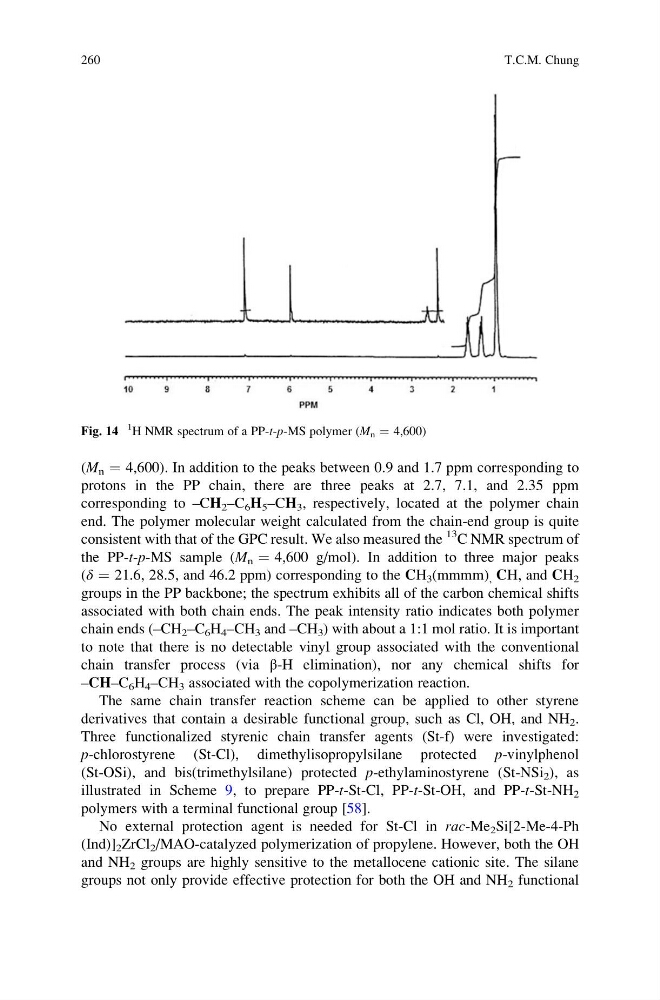
(M n ¼ 4,600). In addition to the peaks between 0.9 and 1.7 ppm corresponding to
protons in the PP chain, there are three peaks at 2.7, 7.1, and 2.35 ppm
corresponding to –CH 2 –C 6 H 5 –CH 3 , respectively, located at the polymer chain
end. The polymer molecular weight calculated from the chain-end group is quite
consistent with that of the GPC result. We also measured the
13 C NMR spectrum of
the PP-t-p-MS sample (M n ¼ 4,600 g/mol). In addition to three major peaks
(δ ¼ 21.6, 28.5, and 46.2 ppm) corresponding to the CH 3 (mmmm) , CH, and CH 2
groups in the PP backbone; the spectrum exhibits all of the carbon chemical shifts
associated with both chain ends. The peak intensity ratio indicates both polymer
chain ends (–CH 2 –C 6 H 4 –CH 3 and –CH 3 ) with about a 1:1 mol ratio. It is important
to note that there is no detectable vinyl group associated with the conventional
chain transfer process (via β-H elimination), nor any chemical shifts for
–CH–C 6 H 4 –CH 3 associated with the copolymerization reaction.
The same chain transfer reaction scheme can be applied to other styrene
derivatives that contain a desirable functional group, such as Cl, OH, and NH 2 .
Three functionalized styrenic chain transfer agents (St-f) were investigated:
p-chlorostyrene (St-Cl), dimethylisopropylsilane protected p-vinylphenol
(St-OSi), and bis(trimethylsilane) protected p-ethylaminostyrene (St-NSi 2 ), as
illustrated in Scheme 9, to prepare PP-t-St-Cl, PP-t-St-OH, and PP-t-St-NH 2
polymers with a terminal functional group [58].
No external protection agent is needed for St-Cl in rac-Me 2 Si[2-Me-4-Ph
(Ind)] 2 ZrCl 2 /MAO-catalyzed polymerization of propylene. However, both the OH
and NH 2 groups are highly sensitive to the metallocene cationic site. The silane
groups not only provide effective protection for both the OH and NH 2 functional
Fig. 14
1
H NMR spectrum of a PP-t-p-MS polymer (M n ¼ 4,600)
260
T.C.M. Chung
protons in the PP chain, there are three peaks at 2.7, 7.1, and 2.35 ppm
corresponding to –CH 2 –C 6 H 5 –CH 3 , respectively, located at the polymer chain
end. The polymer molecular weight calculated from the chain-end group is quite
consistent with that of the GPC result. We also measured the
13 C NMR spectrum of
the PP-t-p-MS sample (M n ¼ 4,600 g/mol). In addition to three major peaks
(δ ¼ 21.6, 28.5, and 46.2 ppm) corresponding to the CH 3 (mmmm) , CH, and CH 2
groups in the PP backbone; the spectrum exhibits all of the carbon chemical shifts
associated with both chain ends. The peak intensity ratio indicates both polymer
chain ends (–CH 2 –C 6 H 4 –CH 3 and –CH 3 ) with about a 1:1 mol ratio. It is important
to note that there is no detectable vinyl group associated with the conventional
chain transfer process (via β-H elimination), nor any chemical shifts for
–CH–C 6 H 4 –CH 3 associated with the copolymerization reaction.
The same chain transfer reaction scheme can be applied to other styrene
derivatives that contain a desirable functional group, such as Cl, OH, and NH 2 .
Three functionalized styrenic chain transfer agents (St-f) were investigated:
p-chlorostyrene (St-Cl), dimethylisopropylsilane protected p-vinylphenol
(St-OSi), and bis(trimethylsilane) protected p-ethylaminostyrene (St-NSi 2 ), as
illustrated in Scheme 9, to prepare PP-t-St-Cl, PP-t-St-OH, and PP-t-St-NH 2
polymers with a terminal functional group [58].
No external protection agent is needed for St-Cl in rac-Me 2 Si[2-Me-4-Ph
(Ind)] 2 ZrCl 2 /MAO-catalyzed polymerization of propylene. However, both the OH
and NH 2 groups are highly sensitive to the metallocene cationic site. The silane
groups not only provide effective protection for both the OH and NH 2 functional
Fig. 14
1
H NMR spectrum of a PP-t-p-MS polymer (M n ¼ 4,600)
260
T.C.M. Chung