

groups during the metallocene catalysis but also can be completely deprotected by
aqueous HCl solution during the sample workup procedure. The overall reaction
especially benefits from the very small quantity of the chain transfer agent needed
in the preparation of high polymers. Therefore, the additional protection–
deprotection step causes almost no change in polymerization conditions.
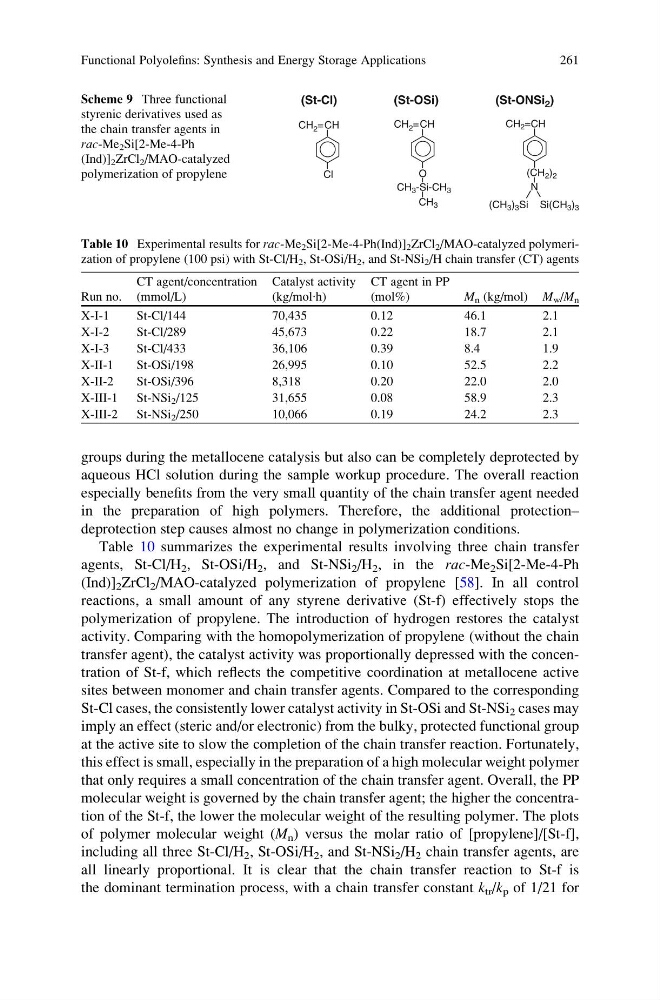
Table 10 summarizes the experimental results involving three chain transfer
agents, St-Cl/H 2 , St-OSi/H 2 , and St-NSi 2 /H 2 , in the rac-Me 2 Si[2-Me-4-Ph
(Ind)] 2 ZrCl 2 /MAO-catalyzed polymerization of propylene [58]. In all control
reactions, a small amount of any styrene derivative (St-f) effectively stops the
polymerization of propylene. The introduction of hydrogen restores the catalyst
activity. Comparing with the homopolymerization of propylene (without the chain
transfer agent), the catalyst activity was proportionally depressed with the concentration of St-f, which reflects the competitive coordination at metallocene active
sites between monomer and chain transfer agents. Compared to the corresponding
St-Cl cases, the consistently lower catalyst activity in St-OSi and St-NSi 2 cases may
imply an effect (steric and/or electronic) from the bulky, protected functional group
at the active site to slow the completion of the chain transfer reaction. Fortunately,
this effect is small, especially in the preparation of a high molecular weight polymer
that only requires a small concentration of the chain transfer agent. Overall, the PP
molecular weight is governed by the chain transfer agent; the higher the concentration of the St-f, the lower the molecular weight of the resulting polymer. The plots
of polymer molecular weight (M n ) versus the molar ratio of [propylene]/[St-f],
including all three St-Cl/H 2 , St-OSi/H 2 , and St-NSi 2 /H 2 chain transfer agents, are
all linearly proportional. It is clear that the chain transfer reaction to St-f is
the dominant termination process, with a chain transfer constant k tr /k p of 1/21 for
(St-Cl)
(St-OSi)
(St-ONSi 2 2 )
CH 2 =CH
CH 2 =CH
CH 2 =CH
Cl
O
CH 3 -Si-CH 3
CH 3
N
(CH 3 ) 3 Si Si(CH 3 ) 3
(CH 2 ) 2
Scheme 9 Three functional
styrenic derivatives used as
the chain transfer agents in
rac-Me 2 Si[2-Me-4-Ph
(Ind)] 2 ZrCl 2 /MAO-catalyzed
polymerization of propylene
Table 10 Experimental results for rac-Me 2 Si[2-Me-4-Ph(Ind)] 2 ZrCl 2 /MAO-catalyzed polymerization of propylene (100 psi) with St-Cl/H 2 , St-OSi/H 2 , and St-NSi 2 /H chain transfer (CT) agents
Run no.
CT agent/concentration
(mmol/L)
Catalyst activity
(kg/mol∙h)
CT agent in PP
(mol%)
M n (kg/mol) M w /M n
X-I-1
St-Cl/144
70,435
0.12
46.1
2.1
X-I-2
St-Cl/289
45,673
0.22
18.7
2.1
X-I-3
St-Cl/433
36,106
0.39
8.4
1.9
X-II-1
St-OSi/198
26,995
0.10
52.5
2.2
X-II-2
St-OSi/396
8,318
0.20
22.0
2.0
X-III-1 St-NSi 2 /125
31,655
0.08
58.9
2.3
X-III-2 St-NSi 2 /250
10,066
0.19
24.2
2.3
Functional Polyolefins: Synthesis and Energy Storage Applications
261
aqueous HCl solution during the sample workup procedure. The overall reaction
especially benefits from the very small quantity of the chain transfer agent needed
in the preparation of high polymers. Therefore, the additional protection–
deprotection step causes almost no change in polymerization conditions.
Table 10 summarizes the experimental results involving three chain transfer
agents, St-Cl/H 2 , St-OSi/H 2 , and St-NSi 2 /H 2 , in the rac-Me 2 Si[2-Me-4-Ph
(Ind)] 2 ZrCl 2 /MAO-catalyzed polymerization of propylene [58]. In all control
reactions, a small amount of any styrene derivative (St-f) effectively stops the
polymerization of propylene. The introduction of hydrogen restores the catalyst
activity. Comparing with the homopolymerization of propylene (without the chain
transfer agent), the catalyst activity was proportionally depressed with the concentration of St-f, which reflects the competitive coordination at metallocene active
sites between monomer and chain transfer agents. Compared to the corresponding
St-Cl cases, the consistently lower catalyst activity in St-OSi and St-NSi 2 cases may
imply an effect (steric and/or electronic) from the bulky, protected functional group
at the active site to slow the completion of the chain transfer reaction. Fortunately,
this effect is small, especially in the preparation of a high molecular weight polymer
that only requires a small concentration of the chain transfer agent. Overall, the PP
molecular weight is governed by the chain transfer agent; the higher the concentration of the St-f, the lower the molecular weight of the resulting polymer. The plots
of polymer molecular weight (M n ) versus the molar ratio of [propylene]/[St-f],
including all three St-Cl/H 2 , St-OSi/H 2 , and St-NSi 2 /H 2 chain transfer agents, are
all linearly proportional. It is clear that the chain transfer reaction to St-f is
the dominant termination process, with a chain transfer constant k tr /k p of 1/21 for
(St-Cl)
(St-OSi)
(St-ONSi 2 2 )
CH 2 =CH
CH 2 =CH
CH 2 =CH
Cl
O
CH 3 -Si-CH 3
CH 3
N
(CH 3 ) 3 Si Si(CH 3 ) 3
(CH 2 ) 2
Scheme 9 Three functional
styrenic derivatives used as
the chain transfer agents in
rac-Me 2 Si[2-Me-4-Ph
(Ind)] 2 ZrCl 2 /MAO-catalyzed
polymerization of propylene
Table 10 Experimental results for rac-Me 2 Si[2-Me-4-Ph(Ind)] 2 ZrCl 2 /MAO-catalyzed polymerization of propylene (100 psi) with St-Cl/H 2 , St-OSi/H 2 , and St-NSi 2 /H chain transfer (CT) agents
Run no.
CT agent/concentration
(mmol/L)
Catalyst activity
(kg/mol∙h)
CT agent in PP
(mol%)
M n (kg/mol) M w /M n
X-I-1
St-Cl/144
70,435
0.12
46.1
2.1
X-I-2
St-Cl/289
45,673
0.22
18.7
2.1
X-I-3
St-Cl/433
36,106
0.39
8.4
1.9
X-II-1
St-OSi/198
26,995
0.10
52.5
2.2
X-II-2
St-OSi/396
8,318
0.20
22.0
2.0
X-III-1 St-NSi 2 /125
31,655
0.08
58.9
2.3
X-III-2 St-NSi 2 /250
10,066
0.19
24.2
2.3
Functional Polyolefins: Synthesis and Energy Storage Applications
261