

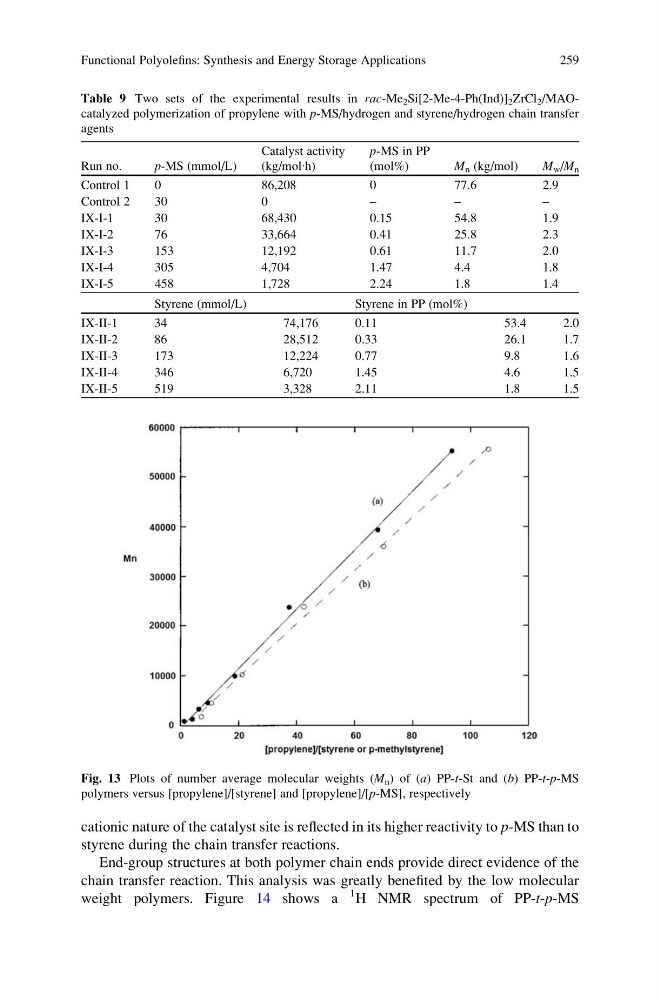
cationic nature of the catalyst site is reflected in its higher reactivity to p-MS than to
styrene during the chain transfer reactions.
End-group structures at both polymer chain ends provide direct evidence of the
chain transfer reaction. This analysis was greatly benefited by the low molecular
weight polymers. Figure 14 shows a
1 H NMR spectrum of PP-t-p-MS
Table 9 Two sets of the experimental results in rac-Me 2 Si[2-Me-4-Ph(Ind)] 2 ZrCl 2 /MAOcatalyzed polymerization of propylene with p-MS/hydrogen and styrene/hydrogen chain transfer
agents
Run no.
p-MS (mmol/L)
Catalyst activity
(kg/mol∙h)
p-MS in PP
(mol%)
M n (kg/mol)
M w /M n
Control 1
0
86,208
0
77.6
2.9
Control 2
30
0
–
–
–
IX-I-1
30
68,430
0.15
54.8
1.9
IX-I-2
76
33,664
0.41
25.8
2.3
IX-I-3
153
12,192
0.61
11.7
2.0
IX-I-4
305
4,704
1.47
4.4
1.8
IX-I-5
458
1,728
2.24
1.8
1.4
Styrene (mmol/L)
Styrene in PP (mol%)
IX-II-1
34
74,176
0.11
53.4
2.0
IX-II-2
86
28,512
0.33
26.1
1.7
IX-II-3
173
12,224
0.77
9.8
1.6
IX-II-4
346
6,720
1.45
4.6
1.5
IX-II-5
519
3,328
2.11
1.8
1.5
Fig. 13 Plots of number average molecular weights (M n ) of (a) PP-t-St and (b) PP-t-p-MS
polymers versus [propylene]/[styrene] and [propylene]/[p-MS], respectively
Functional Polyolefins: Synthesis and Energy Storage Applications
259
styrene during the chain transfer reactions.
End-group structures at both polymer chain ends provide direct evidence of the
chain transfer reaction. This analysis was greatly benefited by the low molecular
weight polymers. Figure 14 shows a
1 H NMR spectrum of PP-t-p-MS
Table 9 Two sets of the experimental results in rac-Me 2 Si[2-Me-4-Ph(Ind)] 2 ZrCl 2 /MAOcatalyzed polymerization of propylene with p-MS/hydrogen and styrene/hydrogen chain transfer
agents
Run no.
p-MS (mmol/L)
Catalyst activity
(kg/mol∙h)
p-MS in PP
(mol%)
M n (kg/mol)
M w /M n
Control 1
0
86,208
0
77.6
2.9
Control 2
30
0
–
–
–
IX-I-1
30
68,430
0.15
54.8
1.9
IX-I-2
76
33,664
0.41
25.8
2.3
IX-I-3
153
12,192
0.61
11.7
2.0
IX-I-4
305
4,704
1.47
4.4
1.8
IX-I-5
458
1,728
2.24
1.8
1.4
Styrene (mmol/L)
Styrene in PP (mol%)
IX-II-1
34
74,176
0.11
53.4
2.0
IX-II-2
86
28,512
0.33
26.1
1.7
IX-II-3
173
12,224
0.77
9.8
1.6
IX-II-4
346
6,720
1.45
4.6
1.5
IX-II-5
519
3,328
2.11
1.8
1.5
Fig. 13 Plots of number average molecular weights (M n ) of (a) PP-t-St and (b) PP-t-p-MS
polymers versus [propylene]/[styrene] and [propylene]/[p-MS], respectively
Functional Polyolefins: Synthesis and Energy Storage Applications
259