

conditions. From a steric viewpoint, logically the reactivity of a borane chain
transfer agent should follow the H–B > CH 3 –B > C 2 H 5 –B sequence [54, 55].
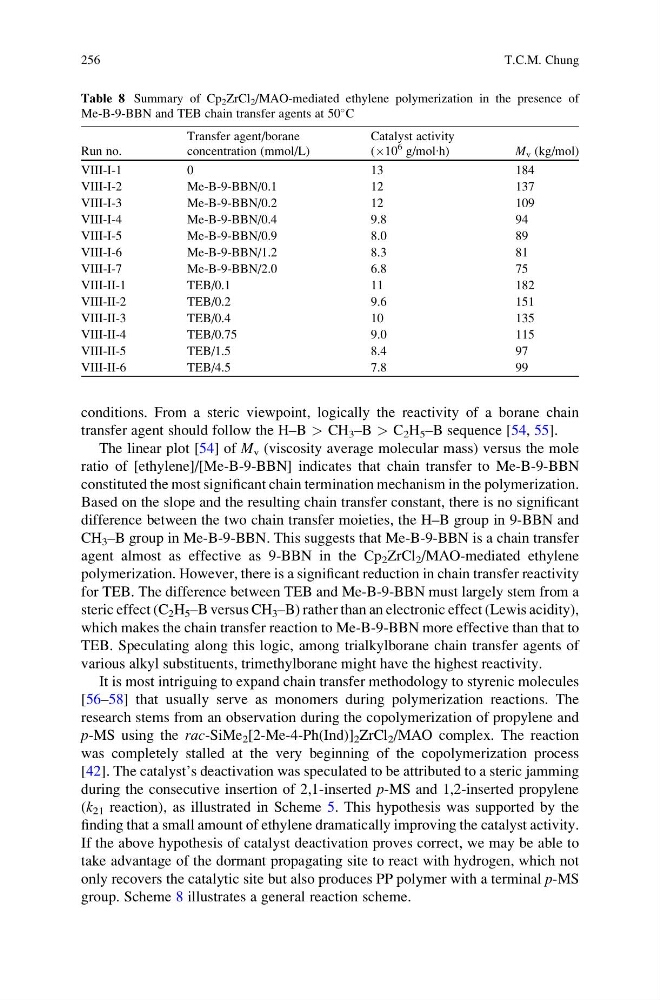
The linear plot [54] of M v (viscosity average molecular mass) versus the mole
ratio of [ethylene]/[Me-B-9-BBN] indicates that chain transfer to Me-B-9-BBN
constituted the most significant chain termination mechanism in the polymerization.
Based on the slope and the resulting chain transfer constant, there is no significant
difference between the two chain transfer moieties, the H–B group in 9-BBN and
CH 3 –B group in Me-B-9-BBN. This suggests that Me-B-9-BBN is a chain transfer
agent almost as effective as 9-BBN in the Cp 2 ZrCl 2 /MAO-mediated ethylene
polymerization. However, there is a significant reduction in chain transfer reactivity
for TEB. The difference between TEB and Me-B-9-BBN must largely stem from a
steric effect (C 2 H 5 –B versus CH 3 –B) rather than an electronic effect (Lewis acidity),
which makes the chain transfer reaction to Me-B-9-BBN more effective than that to
TEB. Speculating along this logic, among trialkylborane chain transfer agents of
various alkyl substituents, trimethylborane might have the highest reactivity.
It is most intriguing to expand chain transfer methodology to styrenic molecules
[56–58] that usually serve as monomers during polymerization reactions. The
research stems from an observation during the copolymerization of propylene and
p-MS using the rac-SiMe 2 [2-Me-4-Ph(Ind)] 2 ZrCl 2 /MAO complex. The reaction
was completely stalled at the very beginning of the copolymerization process
[42]. The catalyst’s deactivation was speculated to be attributed to a steric jamming
during the consecutive insertion of 2,1-inserted p-MS and 1,2-inserted propylene
(k 21 reaction), as illustrated in Scheme 5. This hypothesis was supported by the
finding that a small amount of ethylene dramatically improving the catalyst activity.
If the above hypothesis of catalyst deactivation proves correct, we may be able to
take advantage of the dormant propagating site to react with hydrogen, which not
only recovers the catalytic site but also produces PP polymer with a terminal p-MS
group. Scheme 8 illustrates a general reaction scheme.
Table 8 Summary of Cp 2 ZrCl 2 /MAO-mediated ethylene polymerization in the presence of
Me-B-9-BBN and TEB chain transfer agents at 50
C
Run no.
Transfer agent/borane
concentration (mmol/L)
Catalyst activity
(Â10
6 g/mol∙h)
M v (kg/mol)
VIII-I-1
0
13
184
VIII-I-2
Me-B-9-BBN/0.1
12
137
VIII-I-3
Me-B-9-BBN/0.2
12
109
VIII-I-4
Me-B-9-BBN/0.4
9.8
94
VIII-I-5
Me-B-9-BBN/0.9
8.0
89
VIII-I-6
Me-B-9-BBN/1.2
8.3
81
VIII-I-7
Me-B-9-BBN/2.0
6.8
75
VIII-II-1
TEB/0.1
11
182
VIII-II-2
TEB/0.2
9.6
151
VIII-II-3
TEB/0.4
10
135
VIII-II-4
TEB/0.75
9.0
115
VIII-II-5
TEB/1.5
8.4
97
VIII-II-6
TEB/4.5
7.8
99
256
T.C.M. Chung
transfer agent should follow the H–B > CH 3 –B > C 2 H 5 –B sequence [54, 55].
The linear plot [54] of M v (viscosity average molecular mass) versus the mole
ratio of [ethylene]/[Me-B-9-BBN] indicates that chain transfer to Me-B-9-BBN
constituted the most significant chain termination mechanism in the polymerization.
Based on the slope and the resulting chain transfer constant, there is no significant
difference between the two chain transfer moieties, the H–B group in 9-BBN and
CH 3 –B group in Me-B-9-BBN. This suggests that Me-B-9-BBN is a chain transfer
agent almost as effective as 9-BBN in the Cp 2 ZrCl 2 /MAO-mediated ethylene
polymerization. However, there is a significant reduction in chain transfer reactivity
for TEB. The difference between TEB and Me-B-9-BBN must largely stem from a
steric effect (C 2 H 5 –B versus CH 3 –B) rather than an electronic effect (Lewis acidity),
which makes the chain transfer reaction to Me-B-9-BBN more effective than that to
TEB. Speculating along this logic, among trialkylborane chain transfer agents of
various alkyl substituents, trimethylborane might have the highest reactivity.
It is most intriguing to expand chain transfer methodology to styrenic molecules
[56–58] that usually serve as monomers during polymerization reactions. The
research stems from an observation during the copolymerization of propylene and
p-MS using the rac-SiMe 2 [2-Me-4-Ph(Ind)] 2 ZrCl 2 /MAO complex. The reaction
was completely stalled at the very beginning of the copolymerization process
[42]. The catalyst’s deactivation was speculated to be attributed to a steric jamming
during the consecutive insertion of 2,1-inserted p-MS and 1,2-inserted propylene
(k 21 reaction), as illustrated in Scheme 5. This hypothesis was supported by the
finding that a small amount of ethylene dramatically improving the catalyst activity.
If the above hypothesis of catalyst deactivation proves correct, we may be able to
take advantage of the dormant propagating site to react with hydrogen, which not
only recovers the catalytic site but also produces PP polymer with a terminal p-MS
group. Scheme 8 illustrates a general reaction scheme.
Table 8 Summary of Cp 2 ZrCl 2 /MAO-mediated ethylene polymerization in the presence of
Me-B-9-BBN and TEB chain transfer agents at 50
C
Run no.
Transfer agent/borane
concentration (mmol/L)
Catalyst activity
(Â10
6 g/mol∙h)
M v (kg/mol)
VIII-I-1
0
13
184
VIII-I-2
Me-B-9-BBN/0.1
12
137
VIII-I-3
Me-B-9-BBN/0.2
12
109
VIII-I-4
Me-B-9-BBN/0.4
9.8
94
VIII-I-5
Me-B-9-BBN/0.9
8.0
89
VIII-I-6
Me-B-9-BBN/1.2
8.3
81
VIII-I-7
Me-B-9-BBN/2.0
6.8
75
VIII-II-1
TEB/0.1
11
182
VIII-II-2
TEB/0.2
9.6
151
VIII-II-3
TEB/0.4
10
135
VIII-II-4
TEB/0.75
9.0
115
VIII-II-5
TEB/1.5
8.4
97
VIII-II-6
TEB/4.5
7.8
99
256
T.C.M. Chung