

coordination at the titanocene active sites between monomers and chain transfer
agents. The syndiotacticity and melting temperatures of all s-PS-t-B polymers are
similar to those of the s-PS polymer. The 9-BBN chain transfer agent did not
interfere with the regio- and stereoselective insertion process.
At the same time, the extension of this chemistry to prepare borane-terminated
isotactic PP (i-PP-t-B) is much more difficult [54]. The iso-specific polymerization
of propylene is limited to only a few steric-specific catalyst systems with a limited
special opening for coordination. In addition, most of the iso-specific catalysts with
only perfluoroborate activators show very poor catalyst activity. In other words, we
have to use MAO activator and identify suitable reaction conditions. We can then
carry out the metallocene-mediated propylene polymerization without encountering
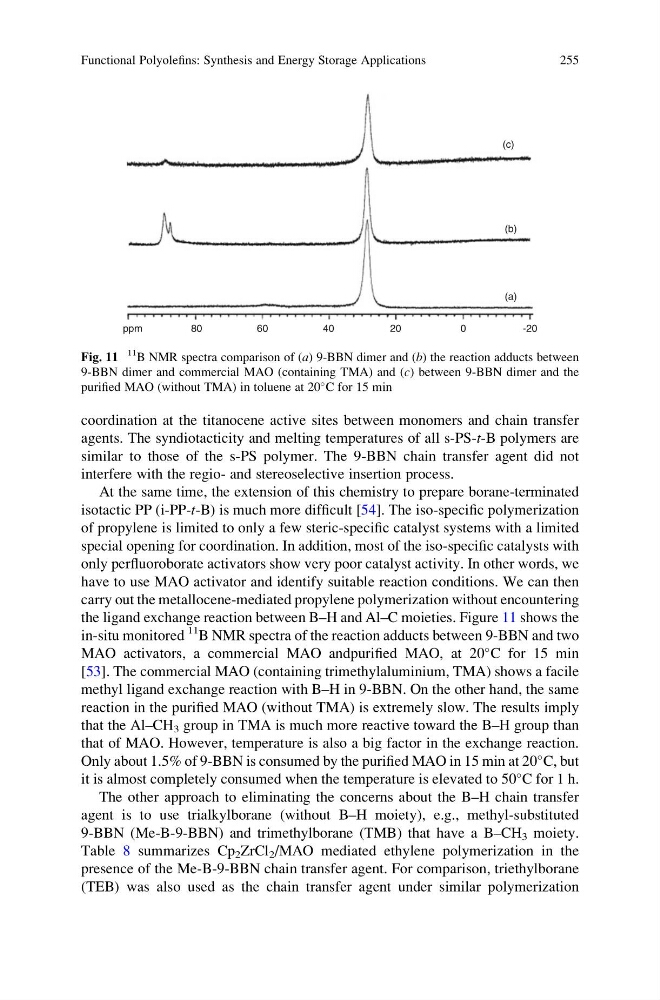
the ligand exchange reaction between B–H and Al–C moieties. Figure 11 shows the
in-situ monitored
11 B NMR spectra of the reaction adducts between 9-BBN and two
MAO activators, a commercial MAO andpurified MAO, at 20
C for 15 min
[53]. The commercial MAO (containing trimethylaluminium, TMA) shows a facile
methyl ligand exchange reaction with B–H in 9-BBN. On the other hand, the same
reaction in the purified MAO (without TMA) is extremely slow. The results imply
that the Al–CH 3 group in TMA is much more reactive toward the B–H group than
that of MAO. However, temperature is also a big factor in the exchange reaction.
Only about 1.5% of 9-BBN is consumed by the purified MAO in 15 min at 20
C, but
it is almost completely consumed when the temperature is elevated to 50
C for 1 h.
The other approach to eliminating the concerns about the B–H chain transfer
agent is to use trialkylborane (without B–H moiety), e.g., methyl-substituted
9-BBN (Me-B-9-BBN) and trimethylborane (TMB) that have a B–CH 3 moiety.
Table 8 summarizes Cp 2 ZrCl 2 /MAO mediated ethylene polymerization in the
presence of the Me-B-9-BBN chain transfer agent. For comparison, triethylborane
(TEB) was also used as the chain transfer agent under similar polymerization
ppm
80
60
40
20
0
-20
(c)
(b)
(a)
Fig. 11
11
B NMR spectra comparison of (a) 9-BBN dimer and (b) the reaction adducts between
9-BBN dimer and commercial MAO (containing TMA) and (c) between 9-BBN dimer and the
purified MAO (without TMA) in toluene at 20
C for 15 min
Functional Polyolefins: Synthesis and Energy Storage Applications
255
agents. The syndiotacticity and melting temperatures of all s-PS-t-B polymers are
similar to those of the s-PS polymer. The 9-BBN chain transfer agent did not
interfere with the regio- and stereoselective insertion process.
At the same time, the extension of this chemistry to prepare borane-terminated
isotactic PP (i-PP-t-B) is much more difficult [54]. The iso-specific polymerization
of propylene is limited to only a few steric-specific catalyst systems with a limited
special opening for coordination. In addition, most of the iso-specific catalysts with
only perfluoroborate activators show very poor catalyst activity. In other words, we
have to use MAO activator and identify suitable reaction conditions. We can then
carry out the metallocene-mediated propylene polymerization without encountering
the ligand exchange reaction between B–H and Al–C moieties. Figure 11 shows the
in-situ monitored
11 B NMR spectra of the reaction adducts between 9-BBN and two
MAO activators, a commercial MAO andpurified MAO, at 20
C for 15 min
[53]. The commercial MAO (containing trimethylaluminium, TMA) shows a facile
methyl ligand exchange reaction with B–H in 9-BBN. On the other hand, the same
reaction in the purified MAO (without TMA) is extremely slow. The results imply
that the Al–CH 3 group in TMA is much more reactive toward the B–H group than
that of MAO. However, temperature is also a big factor in the exchange reaction.
Only about 1.5% of 9-BBN is consumed by the purified MAO in 15 min at 20
C, but
it is almost completely consumed when the temperature is elevated to 50
C for 1 h.
The other approach to eliminating the concerns about the B–H chain transfer
agent is to use trialkylborane (without B–H moiety), e.g., methyl-substituted
9-BBN (Me-B-9-BBN) and trimethylborane (TMB) that have a B–CH 3 moiety.
Table 8 summarizes Cp 2 ZrCl 2 /MAO mediated ethylene polymerization in the
presence of the Me-B-9-BBN chain transfer agent. For comparison, triethylborane
(TEB) was also used as the chain transfer agent under similar polymerization
ppm
80
60
40
20
0
-20
(c)
(b)
(a)
Fig. 11
11
B NMR spectra comparison of (a) 9-BBN dimer and (b) the reaction adducts between
9-BBN dimer and commercial MAO (containing TMA) and (c) between 9-BBN dimer and the
purified MAO (without TMA) in toluene at 20
C for 15 min
Functional Polyolefins: Synthesis and Energy Storage Applications
255