

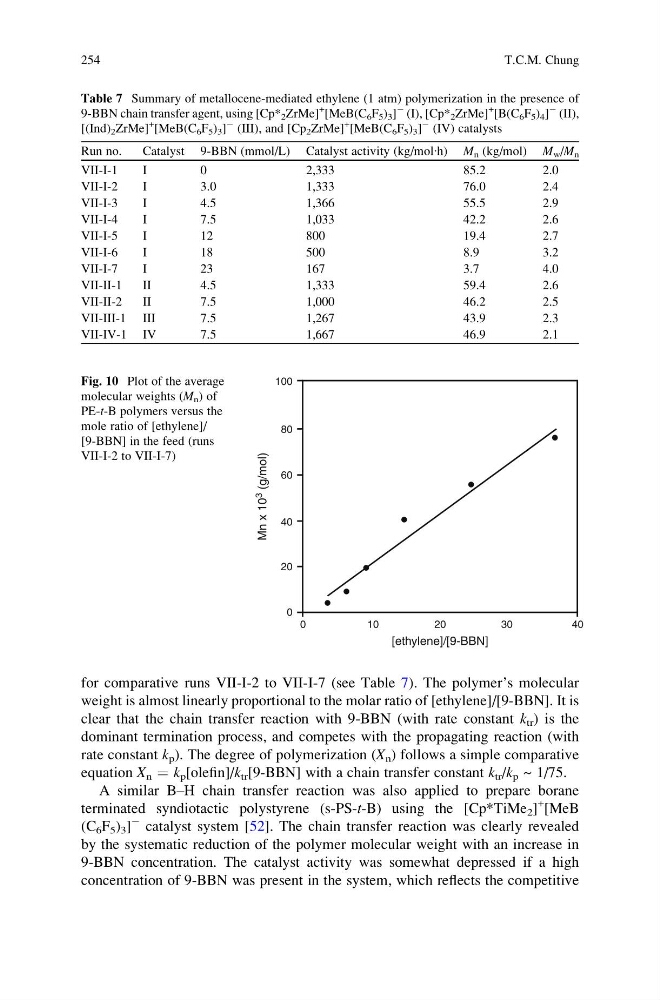
for comparative runs VII-I-2 to VII-I-7 (see Table 7). The polymer’s molecular
weight is almost linearly proportional to the molar ratio of [ethylene]/[9-BBN]. It is
clear that the chain transfer reaction with 9-BBN (with rate constant k tr ) is the
dominant termination process, and competes with the propagating reaction (with
rate constant k p ). The degree of polymerization (X n ) follows a simple comparative
equation X n ¼ k p [olefin]/k tr [9-BBN] with a chain transfer constant k tr /k p ~ 1/75.
A similar B–H chain transfer reaction was also applied to prepare borane
terminated syndiotactic polystyrene (s-PS-t-B) using the [Cp*TiMe 2 ]
+
[MeB
(C 6 F 5 ) 3 ]
À catalyst system [52]. The chain transfer reaction was clearly revealed
by the systematic reduction of the polymer molecular weight with an increase in
9-BBN concentration. The catalyst activity was somewhat depressed if a high
concentration of 9-BBN was present in the system, which reflects the competitive
Table 7 Summary of metallocene-mediated ethylene (1 atm) polymerization in the presence of
9-BBN chain transfer agent, using [Cp* 2 ZrMe]
+ [MeB(C 6 F 5 ) 3 ]
À (I), [Cp* 2 ZrMe]
+ [B(C 6 F 5 ) 4 ]
À (II),
[(Ind) 2 ZrMe]
+ [MeB(C 6 F 5 ) 3 ]
À (III), and [Cp 2 ZrMe]
+ [MeB(C 6 F 5 ) 3 ]
À (IV) catalysts
Run no.
Catalyst 9-BBN (mmol/L) Catalyst activity (kg/mol∙h) M n (kg/mol) M w /M n
VII-I-1
I
0
2,333
85.2
2.0
VII-I-2
I
3.0
1,333
76.0
2.4
VII-I-3
I
4.5
1,366
55.5
2.9
VII-I-4
I
7.5
1,033
42.2
2.6
VII-I-5
I
12
800
19.4
2.7
VII-I-6
I
18
500
8.9
3.2
VII-I-7
I
23
167
3.7
4.0
VII-II-1
II
4.5
1,333
59.4
2.6
VII-II-2
II
7.5
1,000
46.2
2.5
VII-III-1 III
7.5
1,267
43.9
2.3
VII-IV-1 IV
7.5
1,667
46.9
2.1
100
80
60
40
Mn x 10
3
(g/mol)
20
0
0
1 0
2 0
[ethylene]/[9-BBN]
30
40
Fig. 10 Plot of the average
molecular weights (M n ) of
PE-t-B polymers versus the
mole ratio of [ethylene]/
[9-BBN] in the feed (runs
VII-I-2 to VII-I-7)
254
T.C.M. Chung
weight is almost linearly proportional to the molar ratio of [ethylene]/[9-BBN]. It is
clear that the chain transfer reaction with 9-BBN (with rate constant k tr ) is the
dominant termination process, and competes with the propagating reaction (with
rate constant k p ). The degree of polymerization (X n ) follows a simple comparative
equation X n ¼ k p [olefin]/k tr [9-BBN] with a chain transfer constant k tr /k p ~ 1/75.
A similar B–H chain transfer reaction was also applied to prepare borane
terminated syndiotactic polystyrene (s-PS-t-B) using the [Cp*TiMe 2 ]
+
[MeB
(C 6 F 5 ) 3 ]
À catalyst system [52]. The chain transfer reaction was clearly revealed
by the systematic reduction of the polymer molecular weight with an increase in
9-BBN concentration. The catalyst activity was somewhat depressed if a high
concentration of 9-BBN was present in the system, which reflects the competitive
Table 7 Summary of metallocene-mediated ethylene (1 atm) polymerization in the presence of
9-BBN chain transfer agent, using [Cp* 2 ZrMe]
+ [MeB(C 6 F 5 ) 3 ]
À (I), [Cp* 2 ZrMe]
+ [B(C 6 F 5 ) 4 ]
À (II),
[(Ind) 2 ZrMe]
+ [MeB(C 6 F 5 ) 3 ]
À (III), and [Cp 2 ZrMe]
+ [MeB(C 6 F 5 ) 3 ]
À (IV) catalysts
Run no.
Catalyst 9-BBN (mmol/L) Catalyst activity (kg/mol∙h) M n (kg/mol) M w /M n
VII-I-1
I
0
2,333
85.2
2.0
VII-I-2
I
3.0
1,333
76.0
2.4
VII-I-3
I
4.5
1,366
55.5
2.9
VII-I-4
I
7.5
1,033
42.2
2.6
VII-I-5
I
12
800
19.4
2.7
VII-I-6
I
18
500
8.9
3.2
VII-I-7
I
23
167
3.7
4.0
VII-II-1
II
4.5
1,333
59.4
2.6
VII-II-2
II
7.5
1,000
46.2
2.5
VII-III-1 III
7.5
1,267
43.9
2.3
VII-IV-1 IV
7.5
1,667
46.9
2.1
100
80
60
40
Mn x 10
3
(g/mol)
20
0
0
1 0
2 0
[ethylene]/[9-BBN]
30
40
Fig. 10 Plot of the average
molecular weights (M n ) of
PE-t-B polymers versus the
mole ratio of [ethylene]/
[9-BBN] in the feed (runs
VII-I-2 to VII-I-7)
254
T.C.M. Chung