

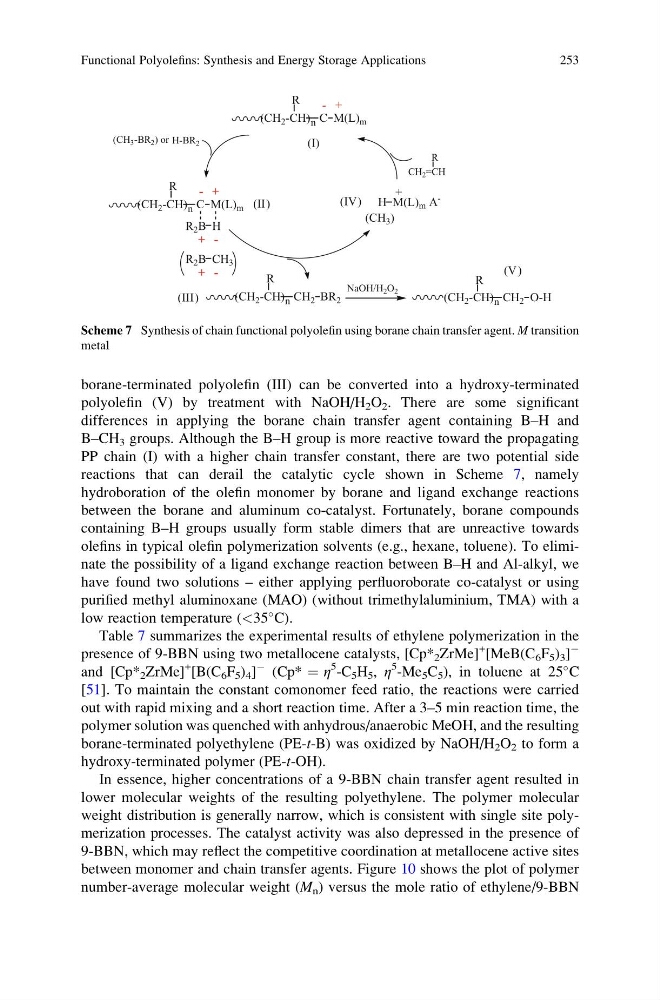
borane-terminated polyolefin (III) can be converted into a hydroxy-terminated
polyolefin (V) by treatment with NaOH/H 2 O 2 . There are some significant
differences in applying the borane chain transfer agent containing B–H and
B–CH 3 groups. Although the B–H group is more reactive toward the propagating
PP chain (I) with a higher chain transfer constant, there are two potential side
reactions that can derail the catalytic cycle shown in Scheme 7, namely
hydroboration of the olefin monomer by borane and ligand exchange reactions
between the borane and aluminum co-catalyst. Fortunately, borane compounds
containing B–H groups usually form stable dimers that are unreactive towards
olefins in typical olefin polymerization solvents (e.g., hexane, toluene). To eliminate the possibility of a ligand exchange reaction between B–H and Al-alkyl, we
have found two solutions – either applying perfluoroborate co-catalyst or using
purified methyl aluminoxane (MAO) (without trimethylaluminium, TMA) with a
low reaction temperature (<35
C).
Table 7 summarizes the experimental results of ethylene polymerization in the
presence of 9-BBN using two metallocene catalysts, [Cp* 2 ZrMe]
+
[MeB(C 6 F 5 ) 3 ]
À
and [Cp* 2 ZrMe]
+
[B(C 6 F 5 ) 4 ]
À (Cp* ¼ η
5 -C 5 H 5 , η
5 -Me 5 C 5 ), in toluene at 25
C
[51]. To maintain the constant comonomer feed ratio, the reactions were carried
out with rapid mixing and a short reaction time. After a 3–5 min reaction time, the
polymer solution was quenched with anhydrous/anaerobic MeOH, and the resulting
borane-terminated polyethylene (PE-t-B) was oxidized by NaOH/H 2 O 2 to form a
hydroxy-terminated polymer (PE-t-OH).
In essence, higher concentrations of a 9-BBN chain transfer agent resulted in
lower molecular weights of the resulting polyethylene. The polymer molecular
weight distribution is generally narrow, which is consistent with single site polymerization processes. The catalyst activity was also depressed in the presence of
9-BBN, which may reflect the competitive coordination at metallocene active sites
between monomer and chain transfer agents. Figure 10 shows the plot of polymer
number-average molecular weight (M n ) versus the mole ratio of ethylene/9-BBN
(CH 2 -CH) C M(L) m
n
R
- +
(CH 2 -CH) C M(L) m
n
R
- +
R 2 B H
+ -
CH 2 =CH
R
H-BR 2
(CH 3 -BR 2 ) or
(CH 2 -CH) CH 2 BR 2
n
R
H M(L) m A
-
(CH 3 )
+
n
R
NaOH/H 2 O 2
(CH 2 -CH) CH 2 O-H
R 2 B CH 3
+ -
(I)
(II)
(III)
(IV)
(V )
Scheme 7 Synthesis of chain functional polyolefin using borane chain transfer agent. M transition
metal
Functional Polyolefins: Synthesis and Energy Storage Applications
253
polyolefin (V) by treatment with NaOH/H 2 O 2 . There are some significant
differences in applying the borane chain transfer agent containing B–H and
B–CH 3 groups. Although the B–H group is more reactive toward the propagating
PP chain (I) with a higher chain transfer constant, there are two potential side
reactions that can derail the catalytic cycle shown in Scheme 7, namely
hydroboration of the olefin monomer by borane and ligand exchange reactions
between the borane and aluminum co-catalyst. Fortunately, borane compounds
containing B–H groups usually form stable dimers that are unreactive towards
olefins in typical olefin polymerization solvents (e.g., hexane, toluene). To eliminate the possibility of a ligand exchange reaction between B–H and Al-alkyl, we
have found two solutions – either applying perfluoroborate co-catalyst or using
purified methyl aluminoxane (MAO) (without trimethylaluminium, TMA) with a
low reaction temperature (<35
C).
Table 7 summarizes the experimental results of ethylene polymerization in the
presence of 9-BBN using two metallocene catalysts, [Cp* 2 ZrMe]
+
[MeB(C 6 F 5 ) 3 ]
À
and [Cp* 2 ZrMe]
+
[B(C 6 F 5 ) 4 ]
À (Cp* ¼ η
5 -C 5 H 5 , η
5 -Me 5 C 5 ), in toluene at 25
C
[51]. To maintain the constant comonomer feed ratio, the reactions were carried
out with rapid mixing and a short reaction time. After a 3–5 min reaction time, the
polymer solution was quenched with anhydrous/anaerobic MeOH, and the resulting
borane-terminated polyethylene (PE-t-B) was oxidized by NaOH/H 2 O 2 to form a
hydroxy-terminated polymer (PE-t-OH).
In essence, higher concentrations of a 9-BBN chain transfer agent resulted in
lower molecular weights of the resulting polyethylene. The polymer molecular
weight distribution is generally narrow, which is consistent with single site polymerization processes. The catalyst activity was also depressed in the presence of
9-BBN, which may reflect the competitive coordination at metallocene active sites
between monomer and chain transfer agents. Figure 10 shows the plot of polymer
number-average molecular weight (M n ) versus the mole ratio of ethylene/9-BBN
(CH 2 -CH) C M(L) m
n
R
- +
(CH 2 -CH) C M(L) m
n
R
- +
R 2 B H
+ -
CH 2 =CH
R
H-BR 2
(CH 3 -BR 2 ) or
(CH 2 -CH) CH 2 BR 2
n
R
H M(L) m A
-
(CH 3 )
+
n
R
NaOH/H 2 O 2
(CH 2 -CH) CH 2 O-H
R 2 B CH 3
+ -
(I)
(II)
(III)
(IV)
(V )
Scheme 7 Synthesis of chain functional polyolefin using borane chain transfer agent. M transition
metal
Functional Polyolefins: Synthesis and Energy Storage Applications
253