

metal) and B–H or (B–CH 3 ) bonds, due to the favorable acid–base interaction
between the cationic metal center and anionic hydride. This ligand exchange
reaction results in a borane-terminated polyolefin (III) and a new active site (IV)
that can reinitiate polymerization. Ideally, this chain transfer reaction should not
change the overall catalyst activity, and each polymer will contain a terminal
borane group with an average polymer molecular weight that is inversely
proportional to the molar ratio of [chain transfer agent]/[olefin]. The resulting
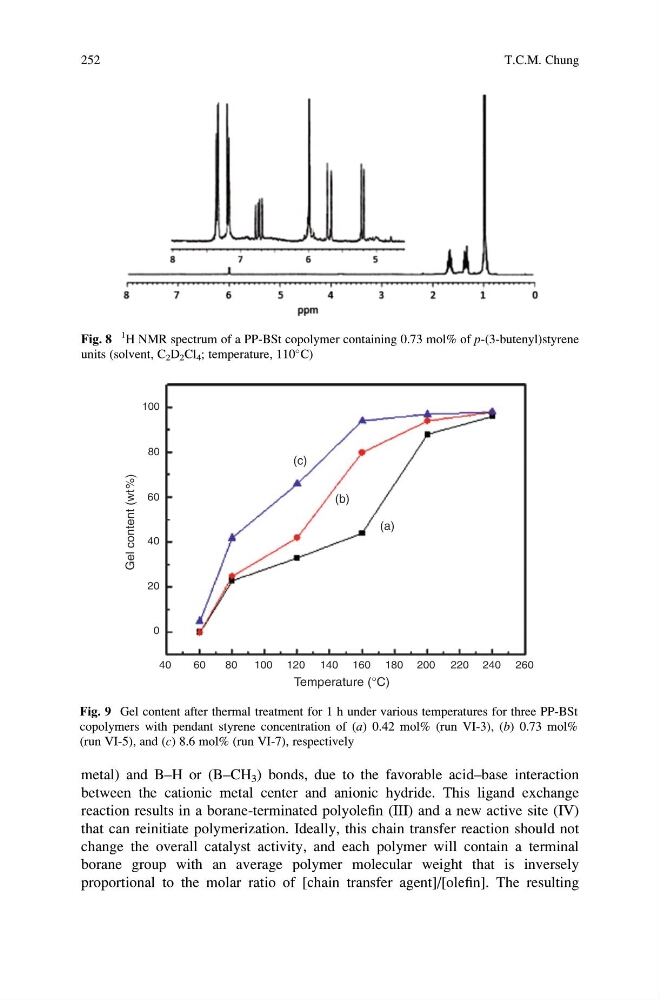
Fig. 8
1
H NMR spectrum of a PP-BSt copolymer containing 0.73 mol% of p-(3-butenyl)styrene
units (solvent, C 2 D 2 Cl 4 ; temperature, 110
C)
100
80
(c)
(b)
(a)
Gel content (wt%)
60
40
20
40
60
80
100 120 140 160
Temperature (°C)
180 200 220 240 260
0
Fig. 9 Gel content after thermal treatment for 1 h under various temperatures for three PP-BSt
copolymers with pendant styrene concentration of (a) 0.42 mol% (run VI-3), (b) 0.73 mol%
(run VI-5), and (c) 8.6 mol% (run VI-7), respectively
252
T.C.M. Chung
between the cationic metal center and anionic hydride. This ligand exchange
reaction results in a borane-terminated polyolefin (III) and a new active site (IV)
that can reinitiate polymerization. Ideally, this chain transfer reaction should not
change the overall catalyst activity, and each polymer will contain a terminal
borane group with an average polymer molecular weight that is inversely
proportional to the molar ratio of [chain transfer agent]/[olefin]. The resulting
Fig. 8
1
H NMR spectrum of a PP-BSt copolymer containing 0.73 mol% of p-(3-butenyl)styrene
units (solvent, C 2 D 2 Cl 4 ; temperature, 110
C)
100
80
(c)
(b)
(a)
Gel content (wt%)
60
40
20
40
60
80
100 120 140 160
Temperature (°C)
180 200 220 240 260
0
Fig. 9 Gel content after thermal treatment for 1 h under various temperatures for three PP-BSt
copolymers with pendant styrene concentration of (a) 0.42 mol% (run VI-3), (b) 0.73 mol%
(run VI-5), and (c) 8.6 mol% (run VI-7), respectively
252
T.C.M. Chung