

crosslinking efficiency, which is particularly important for the PP-BSt copolymer
with <1 mol% of pendant styrene units. Beyond 200
C, the interchain reaction can
effectively take place. Despite very different styrene contents, all three copolymers
exhibit near completely crosslinked x-PP products.
2.2 Polyolefins with a Chain-End Functional Group
As shown in Scheme 2, we have extended the functionalization chemistry to prepare
polyolefins with a terminal functional group. With the advantage of a well-defined
metallocene-mediated α-olefin polymerization mechanism, our thought was to
introduce a suitable “reactive” chain transfer agent that can be selectively
incorporated at the polyolefin chain end. The in-situ formed “reactive” terminal
group can be effectively interconverted to a terminal functional group under mild
reaction conditions. A polymer containing a terminal functional group will not
change the intrinsic properties, such as T g and T m , of the polymer. However, the
terminal functional group presents a unique opportunity to serve as the connection
site for constructing multi-segmented polymers, even polymers with complex
supermolecular structures. In the polyolefin, the opportunity is even more intriguing
due to the lack of functionality and difficulty in preparing polyolefin block/graft
copolymers and long chain branched polymer structures. In our laboratory, we have
investigated several organoboranes (containing the B–H and B–CH 3 moieties) as the
chain transfer agents [51–55] for olefin polymerizations, as illustrated in Scheme 7.
Given the facile ligand exchange between B–H (or B–CH 3 ) bonds and most metalalkyl groups, it would be logical to expect a fast chain transfer reaction to take place
in most metallocene catalyst systems. The resulting borane-terminated polyolefin is
a highly versatile intermediate that can be converted into a broad range of polar
group-terminated polyolefins and diblock copolymers containing both polyolefin
and functional polymer segments (Section 3).
In the presence of a borane chain transfer agent containing a B–H (or B–CH 3 )
group, the metallocene-mediated propagating PP chain (I in Scheme 7) engages in a
facile ligand exchange reaction (II) between C–M (where M indicates transition
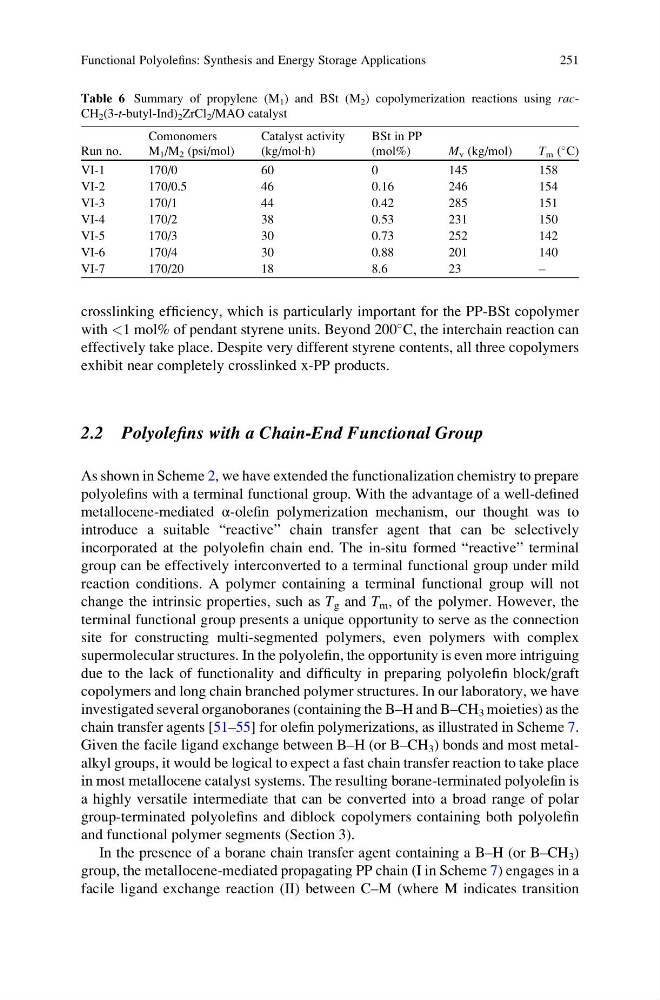
Table 6 Summary of propylene (M 1 ) and BSt (M 2 ) copolymerization reactions using racCH 2 (3-t-butyl-Ind) 2 ZrCl 2 /MAO catalyst
Run no.
Comonomers
M 1 /M 2 (psi/mol)
Catalyst activity
(kg/mol∙h)
BSt in PP
(mol%)
M v (kg/mol)
T m (
C)
VI-1
170/0
60
0
145
158
VI-2
170/0.5
46
0.16
246
154
VI-3
170/1
44
0.42
285
151
VI-4
170/2
38
0.53
231
150
VI-5
170/3
30
0.73
252
142
VI-6
170/4
30
0.88
201
140
VI-7
170/20
18
8.6
23
–
Functional Polyolefins: Synthesis and Energy Storage Applications
251
with <1 mol% of pendant styrene units. Beyond 200
C, the interchain reaction can
effectively take place. Despite very different styrene contents, all three copolymers
exhibit near completely crosslinked x-PP products.
2.2 Polyolefins with a Chain-End Functional Group
As shown in Scheme 2, we have extended the functionalization chemistry to prepare
polyolefins with a terminal functional group. With the advantage of a well-defined
metallocene-mediated α-olefin polymerization mechanism, our thought was to
introduce a suitable “reactive” chain transfer agent that can be selectively
incorporated at the polyolefin chain end. The in-situ formed “reactive” terminal
group can be effectively interconverted to a terminal functional group under mild
reaction conditions. A polymer containing a terminal functional group will not
change the intrinsic properties, such as T g and T m , of the polymer. However, the
terminal functional group presents a unique opportunity to serve as the connection
site for constructing multi-segmented polymers, even polymers with complex
supermolecular structures. In the polyolefin, the opportunity is even more intriguing
due to the lack of functionality and difficulty in preparing polyolefin block/graft
copolymers and long chain branched polymer structures. In our laboratory, we have
investigated several organoboranes (containing the B–H and B–CH 3 moieties) as the
chain transfer agents [51–55] for olefin polymerizations, as illustrated in Scheme 7.
Given the facile ligand exchange between B–H (or B–CH 3 ) bonds and most metalalkyl groups, it would be logical to expect a fast chain transfer reaction to take place
in most metallocene catalyst systems. The resulting borane-terminated polyolefin is
a highly versatile intermediate that can be converted into a broad range of polar
group-terminated polyolefins and diblock copolymers containing both polyolefin
and functional polymer segments (Section 3).
In the presence of a borane chain transfer agent containing a B–H (or B–CH 3 )
group, the metallocene-mediated propagating PP chain (I in Scheme 7) engages in a
facile ligand exchange reaction (II) between C–M (where M indicates transition
Table 6 Summary of propylene (M 1 ) and BSt (M 2 ) copolymerization reactions using racCH 2 (3-t-butyl-Ind) 2 ZrCl 2 /MAO catalyst
Run no.
Comonomers
M 1 /M 2 (psi/mol)
Catalyst activity
(kg/mol∙h)
BSt in PP
(mol%)
M v (kg/mol)
T m (
C)
VI-1
170/0
60
0
145
158
VI-2
170/0.5
46
0.16
246
154
VI-3
170/1
44
0.42
285
151
VI-4
170/2
38
0.53
231
150
VI-5
170/3
30
0.73
252
142
VI-6
170/4
30
0.88
201
140
VI-7
170/20
18
8.6
23
–
Functional Polyolefins: Synthesis and Energy Storage Applications
251