

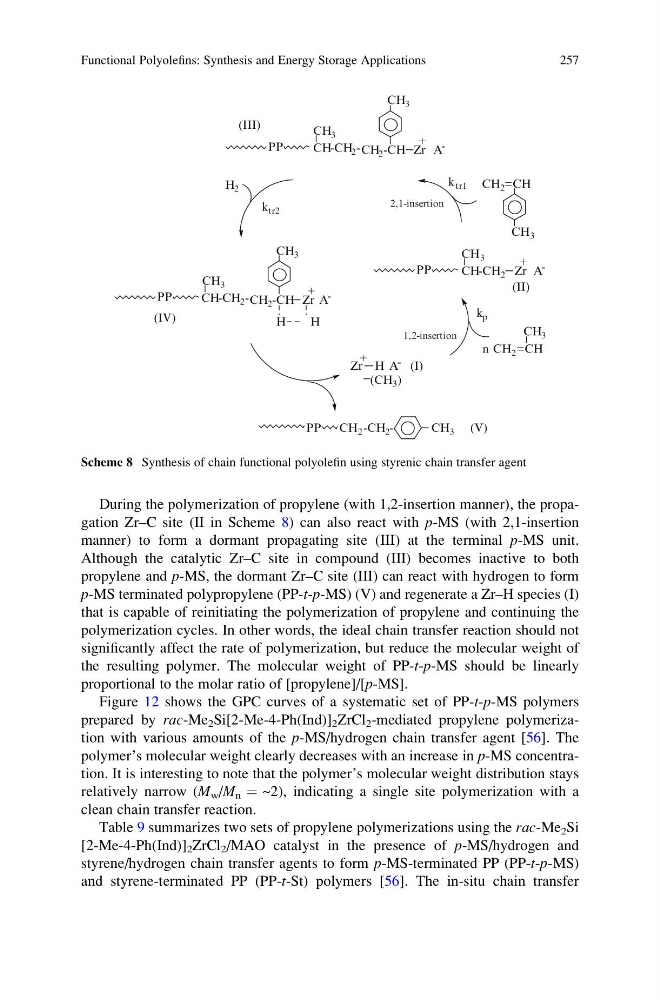
During the polymerization of propylene (with 1,2-insertion manner), the propagation Zr–C site (II in Scheme 8) can also react with p-MS (with 2,1-insertion
manner) to form a dormant propagating site (III) at the terminal p-MS unit.
Although the catalytic Zr–C site in compound (III) becomes inactive to both
propylene and p-MS, the dormant Zr–C site (III) can react with hydrogen to form
p-MS terminated polypropylene (PP-t-p-MS) (V) and regenerate a Zr–H species (I)
that is capable of reinitiating the polymerization of propylene and continuing the
polymerization cycles. In other words, the ideal chain transfer reaction should not
significantly affect the rate of polymerization, but reduce the molecular weight of
the resulting polymer. The molecular weight of PP-t-p-MS should be linearly
proportional to the molar ratio of [propylene]/[p-MS].
Figure 12 shows the GPC curves of a systematic set of PP-t-p-MS polymers
prepared by rac-Me 2 Si[2-Me-4-Ph(Ind)] 2 ZrCl 2 -mediated propylene polymerization with various amounts of the p-MS/hydrogen chain transfer agent [56]. The
polymer’s molecular weight clearly decreases with an increase in p-MS concentration. It is interesting to note that the polymer’s molecular weight distribution stays
relatively narrow (M w /M n ¼ ~2), indicating a single site polymerization with a
clean chain transfer reaction.
Table 9 summarizes two sets of propylene polymerizations using the rac-Me 2 Si
[2-Me-4-Ph(Ind)] 2 ZrCl 2 /MAO catalyst in the presence of p-MS/hydrogen and
styrene/hydrogen chain transfer agents to form p-MS-terminated PP (PP-t-p-MS)
and styrene-terminated PP (PP-t-St) polymers [56]. The in-situ chain transfer
CH 3
CH 3
CH 3
CH 3
A -
+
-
A
+
PP
CH 2 -CH 2 -
n CH 2 =CH
Zr H
PP
k p
k tr1
H 2
CH 3
CH-CH 2
CH 3
Zr
1,2-insertion
Zr
CH 3
CH-CH 2 -
PP
+ -
A
CH 2 -CH
CH 2 =CH
2,1-insertion
CH 2 -CH
A -
+
PP
CH-CH 2 -
CH 3
Zr
H
H
k tr2
(CH 3 )
(I)
(II)
(III)
(IV)
(V)
Scheme 8 Synthesis of chain functional polyolefin using styrenic chain transfer agent
Functional Polyolefins: Synthesis and Energy Storage Applications
257
manner) to form a dormant propagating site (III) at the terminal p-MS unit.
Although the catalytic Zr–C site in compound (III) becomes inactive to both
propylene and p-MS, the dormant Zr–C site (III) can react with hydrogen to form
p-MS terminated polypropylene (PP-t-p-MS) (V) and regenerate a Zr–H species (I)
that is capable of reinitiating the polymerization of propylene and continuing the
polymerization cycles. In other words, the ideal chain transfer reaction should not
significantly affect the rate of polymerization, but reduce the molecular weight of
the resulting polymer. The molecular weight of PP-t-p-MS should be linearly
proportional to the molar ratio of [propylene]/[p-MS].
Figure 12 shows the GPC curves of a systematic set of PP-t-p-MS polymers
prepared by rac-Me 2 Si[2-Me-4-Ph(Ind)] 2 ZrCl 2 -mediated propylene polymerization with various amounts of the p-MS/hydrogen chain transfer agent [56]. The
polymer’s molecular weight clearly decreases with an increase in p-MS concentration. It is interesting to note that the polymer’s molecular weight distribution stays
relatively narrow (M w /M n ¼ ~2), indicating a single site polymerization with a
clean chain transfer reaction.
Table 9 summarizes two sets of propylene polymerizations using the rac-Me 2 Si
[2-Me-4-Ph(Ind)] 2 ZrCl 2 /MAO catalyst in the presence of p-MS/hydrogen and
styrene/hydrogen chain transfer agents to form p-MS-terminated PP (PP-t-p-MS)
and styrene-terminated PP (PP-t-St) polymers [56]. The in-situ chain transfer
CH 3
CH 3
CH 3
CH 3
A -
+
-
A
+
PP
CH 2 -CH 2 -
n CH 2 =CH
Zr H
PP
k p
k tr1
H 2
CH 3
CH-CH 2
CH 3
Zr
1,2-insertion
Zr
CH 3
CH-CH 2 -
PP
+ -
A
CH 2 -CH
CH 2 =CH
2,1-insertion
CH 2 -CH
A -
+
PP
CH-CH 2 -
CH 3
Zr
H
H
k tr2
(CH 3 )
(I)
(II)
(III)
(IV)
(V)
Scheme 8 Synthesis of chain functional polyolefin using styrenic chain transfer agent
Functional Polyolefins: Synthesis and Energy Storage Applications
257