

with or without p-MS, only a small reduction in molecular weight arises from the
incorporation of p-MS. Furthermore, the polymer molecular weight is relatively
high (M w ~200,000 g/mol) and is not significantly dependent on the content of
p-MS. The molecular weight distributions (M w /M n < 2.5), similar to most
metallocene polymers, indicate a single-site reaction.
Figure 4 shows several DSC curves of EP-p-MS terpolymers [43]. Each curve
has only a sharp T g transition in a flat baseline, without any detectable melting
point. The T g is clearly a function of the propylene and p-MS contents. Comparing
the ethylene/propylene copolymers (without p-MS units), the T g transitions are
linearly proportional to the propylene contents and level off at about À50
C with
~50% propylene content (similar results were reported for the ethylene propylene
diene monomer case). The T g transition significantly increases with the
incorporation of p-MS into ethylene/propylene copolymers. It is interesting to
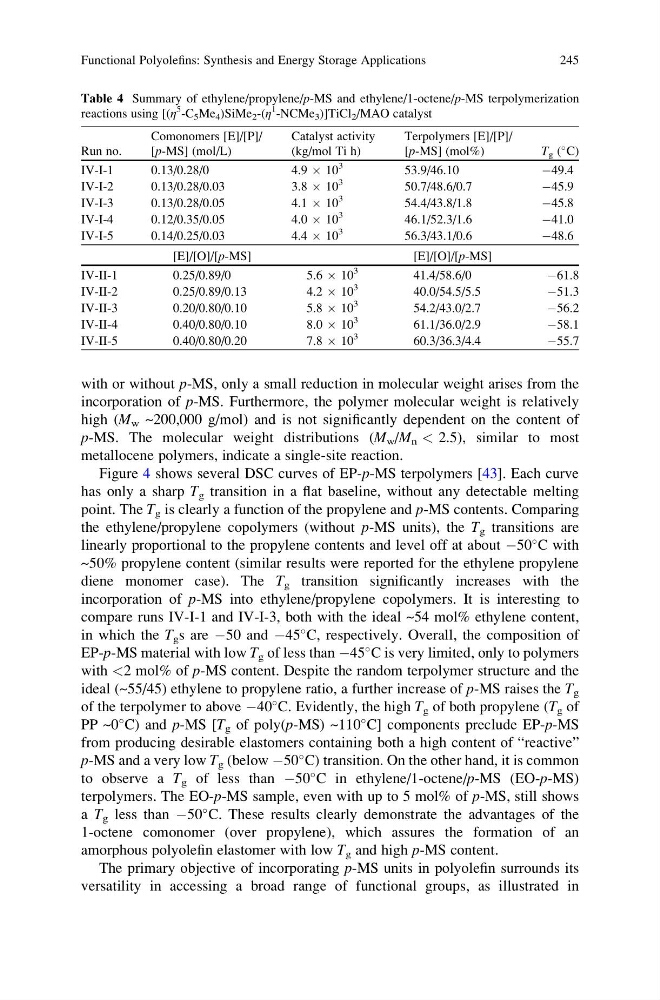
compare runs IV-I-1 and IV-I-3, both with the ideal ~54 mol% ethylene content,
in which the T g s are À50 and À45
C, respectively. Overall, the composition of
EP-p-MS material with low T g of less than À45
C is very limited, only to polymers
with <2 mol% of p-MS content. Despite the random terpolymer structure and the
ideal (~55/45) ethylene to propylene ratio, a further increase of p-MS raises the T g
of the terpolymer to above À40
C. Evidently, the high T g of both propylene (T g of
PP ~0
C) and p-MS [T g of poly(p-MS) ~110
C] components preclude EP-p-MS
from producing desirable elastomers containing both a high content of “reactive”
p-MS and a very low T g (below À50
C) transition. On the other hand, it is common
to observe a T g of less than À50
C in ethylene/1-octene/p-MS (EO-p-MS)
terpolymers. The EO-p-MS sample, even with up to 5 mol% of p-MS, still shows
a T g less than À50
C. These results clearly demonstrate the advantages of the
1-octene comonomer (over propylene), which assures the formation of an
amorphous polyolefin elastomer with low T g and high p-MS content.
The primary objective of incorporating p-MS units in polyolefin surrounds its
versatility in accessing a broad range of functional groups, as illustrated in
Table 4 Summary of ethylene/propylene/p-MS and ethylene/1-octene/p-MS terpolymerization
reactions using [(η
5
-C 5 Me 4 )SiMe 2 -(η
1
-NCMe 3 )]TiCl 2 /MAO catalyst
Run no.
Comonomers [E]/[P]/
[p-MS] (mol/L)
Catalyst activity
(kg/mol Ti h)
Terpolymers [E]/[P]/
[p-MS] (mol%)
T g (
C)
IV-I-1
0.13/0.28/0
4.9 Â 10
3
53.9/46.10
À49.4
IV-I-2
0.13/0.28/0.03
3.8 Â 10
3
50.7/48.6/0.7
À45.9
IV-I-3
0.13/0.28/0.05
4.1 Â 10
3
54.4/43.8/1.8
À45.8
IV-I-4
0.12/0.35/0.05
4.0 Â 10
3
46.1/52.3/1.6
À41.0
IV-I-5
0.14/0.25/0.03
4.4 Â 10
3
56.3/43.1/0.6
À48.6
[E]/[O]/[p-MS]
[E]/[O]/[p-MS]
IV-II-1
0.25/0.89/0
5.6 Â 10
3
41.4/58.6/0
À61.8
IV-II-2
0.25/0.89/0.13
4.2 Â 10
3
40.0/54.5/5.5
À51.3
IV-II-3
0.20/0.80/0.10
5.8 Â 10
3
54.2/43.0/2.7
À56.2
IV-II-4
0.40/0.80/0.10
8.0 Â 10
3
61.1/36.0/2.9
À58.1
IV-II-5
0.40/0.80/0.20
7.8 Â 10
3
60.3/36.3/4.4
À55.7
Functional Polyolefins: Synthesis and Energy Storage Applications
245
incorporation of p-MS. Furthermore, the polymer molecular weight is relatively
high (M w ~200,000 g/mol) and is not significantly dependent on the content of
p-MS. The molecular weight distributions (M w /M n < 2.5), similar to most
metallocene polymers, indicate a single-site reaction.
Figure 4 shows several DSC curves of EP-p-MS terpolymers [43]. Each curve
has only a sharp T g transition in a flat baseline, without any detectable melting
point. The T g is clearly a function of the propylene and p-MS contents. Comparing
the ethylene/propylene copolymers (without p-MS units), the T g transitions are
linearly proportional to the propylene contents and level off at about À50
C with
~50% propylene content (similar results were reported for the ethylene propylene
diene monomer case). The T g transition significantly increases with the
incorporation of p-MS into ethylene/propylene copolymers. It is interesting to
compare runs IV-I-1 and IV-I-3, both with the ideal ~54 mol% ethylene content,
in which the T g s are À50 and À45
C, respectively. Overall, the composition of
EP-p-MS material with low T g of less than À45
C is very limited, only to polymers
with <2 mol% of p-MS content. Despite the random terpolymer structure and the
ideal (~55/45) ethylene to propylene ratio, a further increase of p-MS raises the T g
of the terpolymer to above À40
C. Evidently, the high T g of both propylene (T g of
PP ~0
C) and p-MS [T g of poly(p-MS) ~110
C] components preclude EP-p-MS
from producing desirable elastomers containing both a high content of “reactive”
p-MS and a very low T g (below À50
C) transition. On the other hand, it is common
to observe a T g of less than À50
C in ethylene/1-octene/p-MS (EO-p-MS)
terpolymers. The EO-p-MS sample, even with up to 5 mol% of p-MS, still shows
a T g less than À50
C. These results clearly demonstrate the advantages of the
1-octene comonomer (over propylene), which assures the formation of an
amorphous polyolefin elastomer with low T g and high p-MS content.
The primary objective of incorporating p-MS units in polyolefin surrounds its
versatility in accessing a broad range of functional groups, as illustrated in
Table 4 Summary of ethylene/propylene/p-MS and ethylene/1-octene/p-MS terpolymerization
reactions using [(η
5
-C 5 Me 4 )SiMe 2 -(η
1
-NCMe 3 )]TiCl 2 /MAO catalyst
Run no.
Comonomers [E]/[P]/
[p-MS] (mol/L)
Catalyst activity
(kg/mol Ti h)
Terpolymers [E]/[P]/
[p-MS] (mol%)
T g (
C)
IV-I-1
0.13/0.28/0
4.9 Â 10
3
53.9/46.10
À49.4
IV-I-2
0.13/0.28/0.03
3.8 Â 10
3
50.7/48.6/0.7
À45.9
IV-I-3
0.13/0.28/0.05
4.1 Â 10
3
54.4/43.8/1.8
À45.8
IV-I-4
0.12/0.35/0.05
4.0 Â 10
3
46.1/52.3/1.6
À41.0
IV-I-5
0.14/0.25/0.03
4.4 Â 10
3
56.3/43.1/0.6
À48.6
[E]/[O]/[p-MS]
[E]/[O]/[p-MS]
IV-II-1
0.25/0.89/0
5.6 Â 10
3
41.4/58.6/0
À61.8
IV-II-2
0.25/0.89/0.13
4.2 Â 10
3
40.0/54.5/5.5
À51.3
IV-II-3
0.20/0.80/0.10
5.8 Â 10
3
54.2/43.0/2.7
À56.2
IV-II-4
0.40/0.80/0.10
8.0 Â 10
3
61.1/36.0/2.9
À58.1
IV-II-5
0.40/0.80/0.20
7.8 Â 10
3
60.3/36.3/4.4
À55.7
Functional Polyolefins: Synthesis and Energy Storage Applications
245