

reactions, it is also rather interesting to expand the polyolefin elastomer to new
classes containing high α-olefins, such as 1-octene (instead of propylene), which
can effectively prevent the crystallization of small consecutive ethylene units and
provide low T g properties. Table 4 summarizes the terpolymerization reactions of
ethylene/propylene/p-MS (E/P/p-MS) and ethylene/1-octene/p-MS (E/O/p-MS)
terpolymerization reactions using the [C 5 Me 4 (SiMe 2 N
t
Bu)]TiCl 2 /MAO catalyst
[43]. Overall, this CGC metallocene catalyst shows excellent activity in all terpolymerization reactions, with comparative reactivities between ethylene/propylene
and ethylene/1-octene and with good incorporation of p-MS in the resulting
terpolymers. The incorporation of p-MS seems relatively insensitive to the
ethylene/propylene or ethylene/1-octene feed ratio. Comparing runs IV-I-1 versus
IV-I-2 and IV-I-3 (Table 4), with the same amount of ethylene and propylene feeds,
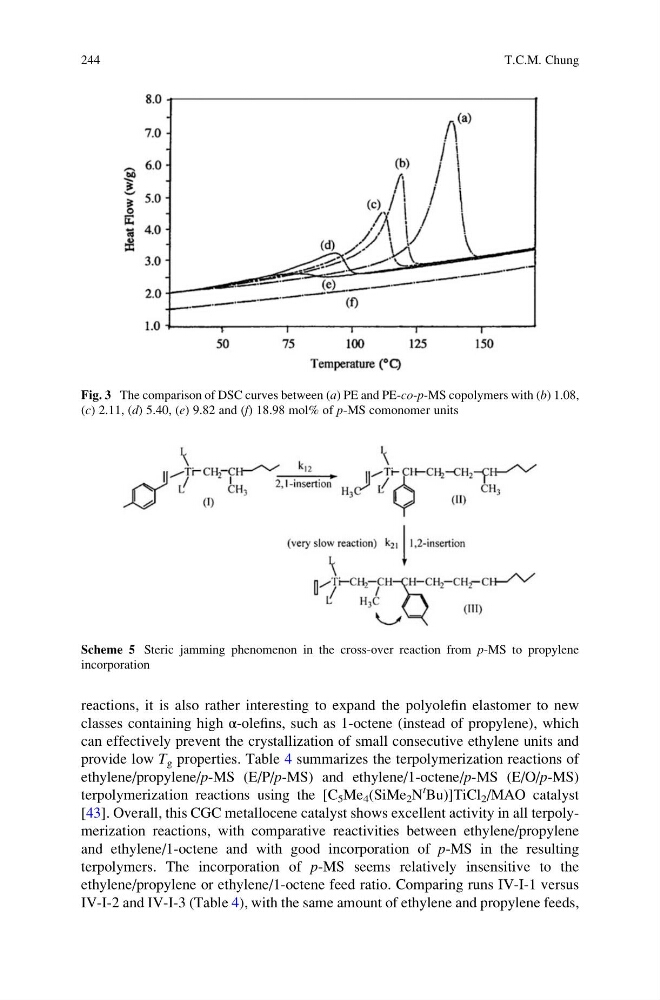
Fig. 3 The comparison of DSC curves between (a) PE and PE-co-p-MS copolymers with (b) 1.08,
(c) 2.11, (d) 5.40, (e) 9.82 and (f) 18.98 mol% of p-MS comonomer units
Scheme 5 Steric jamming phenomenon in the cross-over reaction from p-MS to propylene
incorporation
244
T.C.M. Chung
classes containing high α-olefins, such as 1-octene (instead of propylene), which
can effectively prevent the crystallization of small consecutive ethylene units and
provide low T g properties. Table 4 summarizes the terpolymerization reactions of
ethylene/propylene/p-MS (E/P/p-MS) and ethylene/1-octene/p-MS (E/O/p-MS)
terpolymerization reactions using the [C 5 Me 4 (SiMe 2 N
t
Bu)]TiCl 2 /MAO catalyst
[43]. Overall, this CGC metallocene catalyst shows excellent activity in all terpolymerization reactions, with comparative reactivities between ethylene/propylene
and ethylene/1-octene and with good incorporation of p-MS in the resulting
terpolymers. The incorporation of p-MS seems relatively insensitive to the
ethylene/propylene or ethylene/1-octene feed ratio. Comparing runs IV-I-1 versus
IV-I-2 and IV-I-3 (Table 4), with the same amount of ethylene and propylene feeds,
Fig. 3 The comparison of DSC curves between (a) PE and PE-co-p-MS copolymers with (b) 1.08,
(c) 2.11, (d) 5.40, (e) 9.82 and (f) 18.98 mol% of p-MS comonomer units
Scheme 5 Steric jamming phenomenon in the cross-over reaction from p-MS to propylene
incorporation
244
T.C.M. Chung