

The copolymerization of propylene and p-MS [42] was investigated using
iso-specific metallocene catalysts, including {SiMe 2 [2-Me-5-Ph(Ind)] 2 }ZrCl 2 and
Et(Ind) 2 ZrCl 2 . Overall, these metallocene catalysts were not very effective in
producing PP-p-MS copolymers, as measured by catalyst activity and p-MS
incorporation. Compared to the results seen in the homopolymerization of propylene, the presence of even a small amount of p-MS in these cases shows severely
reduced catalyst activity. These results are completely opposite to those observed in
the corresponding ethylene/p-MS copolymerization reactions. The drastic difference is attributed to the steric jamming phenomenon in the cross-over reaction from
p-MS to propylene, as illustrated in Scheme 5. It is well known that in metallocene
catalytic polymerization, the insertion of the styrene monomer is predominately
2,1-insertion, whereas the 1,2-insertion of the propylene monomer is dominant.
Once the propagating PP chain has a chance to react with the p-MS monomer via
2,1-insertion, the bulky p-phenyl group in the last unit of the growing chain (II in
Scheme 5) is adjacent to the central metal atom and blocks the upcoming
1,2-insertion of a propylene unit. Because the homopolymerization of p-MS via
the metallocene coordination mechanism is known to be near zero, the metallocene
active site at the p-MS unit dramatically slows the propagation process.
The steric jamming problem can be overcome by adding a small amount of
ethylene [43]. The sluggish propagating chain end of the p-MS unit allows the
insertion of ethylene, which re-energizes the propagation process. In fact, the
catalyst activity of ethylene/propylene/p-MS terpolymerization is higher than that
of the corresponding ethylene or propylene homopolymerization reactions. These
experimental results strongly support the steric jamming theory in the metallocene
copolymerization of the propylene and styrenic monomer. Furthermore, it is peculiar to prepare ethylene/propylene/p-MS elastomers with a low T g (below À45
C)
and completely amorphous morphology. The incorporated p-MS units offer the
“reactive” sites for a crosslinking reaction to form a stable EP network structure.
With the unprecedented capability of the metallocene catalyst in copolymerization
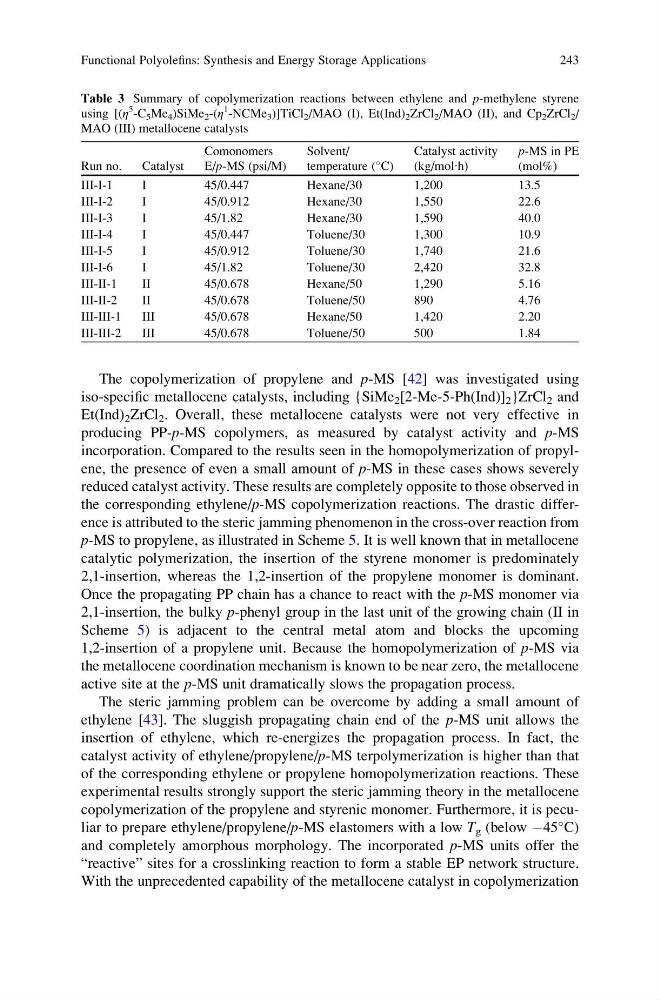
Table 3 Summary of copolymerization reactions between ethylene and p-methylene styrene
using [(η
5
-C 5 Me 4 )SiMe 2 -(η
1
-NCMe 3 )]TiCl 2 /MAO (I), Et(Ind) 2 ZrCl 2 /MAO (II), and Cp 2 ZrCl 2 /
MAO (III) metallocene catalysts
Run no.
Catalyst
Comonomers
E/p-MS (psi/M)
Solvent/
temperature (
C)
Catalyst activity
(kg/mol∙h)
p-MS in PE
(mol%)
III-I-1
I
45/0.447
Hexane/30
1,200
13.5
III-I-2
I
45/0.912
Hexane/30
1,550
22.6
III-I-3
I
45/1.82
Hexane/30
1,590
40.0
III-I-4
I
45/0.447
Toluene/30
1,300
10.9
III-I-5
I
45/0.912
Toluene/30
1,740
21.6
III-I-6
I
45/1.82
Toluene/30
2,420
32.8
III-II-1
II
45/0.678
Hexane/50
1,290
5.16
III-II-2
II
45/0.678
Toluene/50
890
4.76
III-III-1
III
45/0.678
Hexane/50
1,420
2.20
III-III-2
III
45/0.678
Toluene/50
500
1.84
Functional Polyolefins: Synthesis and Energy Storage Applications
243
iso-specific metallocene catalysts, including {SiMe 2 [2-Me-5-Ph(Ind)] 2 }ZrCl 2 and
Et(Ind) 2 ZrCl 2 . Overall, these metallocene catalysts were not very effective in
producing PP-p-MS copolymers, as measured by catalyst activity and p-MS
incorporation. Compared to the results seen in the homopolymerization of propylene, the presence of even a small amount of p-MS in these cases shows severely
reduced catalyst activity. These results are completely opposite to those observed in
the corresponding ethylene/p-MS copolymerization reactions. The drastic difference is attributed to the steric jamming phenomenon in the cross-over reaction from
p-MS to propylene, as illustrated in Scheme 5. It is well known that in metallocene
catalytic polymerization, the insertion of the styrene monomer is predominately
2,1-insertion, whereas the 1,2-insertion of the propylene monomer is dominant.
Once the propagating PP chain has a chance to react with the p-MS monomer via
2,1-insertion, the bulky p-phenyl group in the last unit of the growing chain (II in
Scheme 5) is adjacent to the central metal atom and blocks the upcoming
1,2-insertion of a propylene unit. Because the homopolymerization of p-MS via
the metallocene coordination mechanism is known to be near zero, the metallocene
active site at the p-MS unit dramatically slows the propagation process.
The steric jamming problem can be overcome by adding a small amount of
ethylene [43]. The sluggish propagating chain end of the p-MS unit allows the
insertion of ethylene, which re-energizes the propagation process. In fact, the
catalyst activity of ethylene/propylene/p-MS terpolymerization is higher than that
of the corresponding ethylene or propylene homopolymerization reactions. These
experimental results strongly support the steric jamming theory in the metallocene
copolymerization of the propylene and styrenic monomer. Furthermore, it is peculiar to prepare ethylene/propylene/p-MS elastomers with a low T g (below À45
C)
and completely amorphous morphology. The incorporated p-MS units offer the
“reactive” sites for a crosslinking reaction to form a stable EP network structure.
With the unprecedented capability of the metallocene catalyst in copolymerization
Table 3 Summary of copolymerization reactions between ethylene and p-methylene styrene
using [(η
5
-C 5 Me 4 )SiMe 2 -(η
1
-NCMe 3 )]TiCl 2 /MAO (I), Et(Ind) 2 ZrCl 2 /MAO (II), and Cp 2 ZrCl 2 /
MAO (III) metallocene catalysts
Run no.
Catalyst
Comonomers
E/p-MS (psi/M)
Solvent/
temperature (
C)
Catalyst activity
(kg/mol∙h)
p-MS in PE
(mol%)
III-I-1
I
45/0.447
Hexane/30
1,200
13.5
III-I-2
I
45/0.912
Hexane/30
1,550
22.6
III-I-3
I
45/1.82
Hexane/30
1,590
40.0
III-I-4
I
45/0.447
Toluene/30
1,300
10.9
III-I-5
I
45/0.912
Toluene/30
1,740
21.6
III-I-6
I
45/1.82
Toluene/30
2,420
32.8
III-II-1
II
45/0.678
Hexane/50
1,290
5.16
III-II-2
II
45/0.678
Toluene/50
890
4.76
III-III-1
III
45/0.678
Hexane/50
1,420
2.20
III-III-2
III
45/0.678
Toluene/50
500
1.84
Functional Polyolefins: Synthesis and Energy Storage Applications
243