

The resulting poly(ethylene-co-p-methylstyrene) (PE-p-MS) copolymers show
narrow molecular weight (M w /M n ¼ 2–3) and composition distributions, implying
the single-site polymerization mechanism. Figure 3 compares DSC curves between
the PE homopolymer and several PE-p-MS copolymers prepared by the
[C 5 Me 4 (SiMe 2 N
t Bu)]TiCl 2 /MAO catalyst at 40
C in toluene. Even a small amount
(~1 mol%) of p-MS comonomer incorporation has a significant effect to the
crystallization of polyethylene. Overall, the melting point (T m ) and crystallinity
(χ c ) of the copolymer are strongly related to the density of the comonomer; the
higher the density, the lower the T m and χ c . Only a single peak is observed
throughout the entire composition range and the melting peak completely
disappears at ~10 mol% of p-MS concentration. A similar general trend was also
observed in the DSC curves of PE-p-MS copolymers prepared by the Et(Ind) 2 ZrCl 2 /
MAO catalyst. The systematic decrease in T m and uniform reduction of the crystalline curve imply the homogeneous reduction of PE consecutive sequences. It is
interesting to note that the T m peak (ranging from 80
C to 45
C, as shown in Fig. 3,
curve e) of the copolymer containing 9.82 mol% of p-MS covers a similar T m range
(45–55
C) as paraffin wax. This PE-p-MS copolymer consists of an average of
20–22 consecutive methylene units, which is in the molecular weight range of solid
paraffin wax.
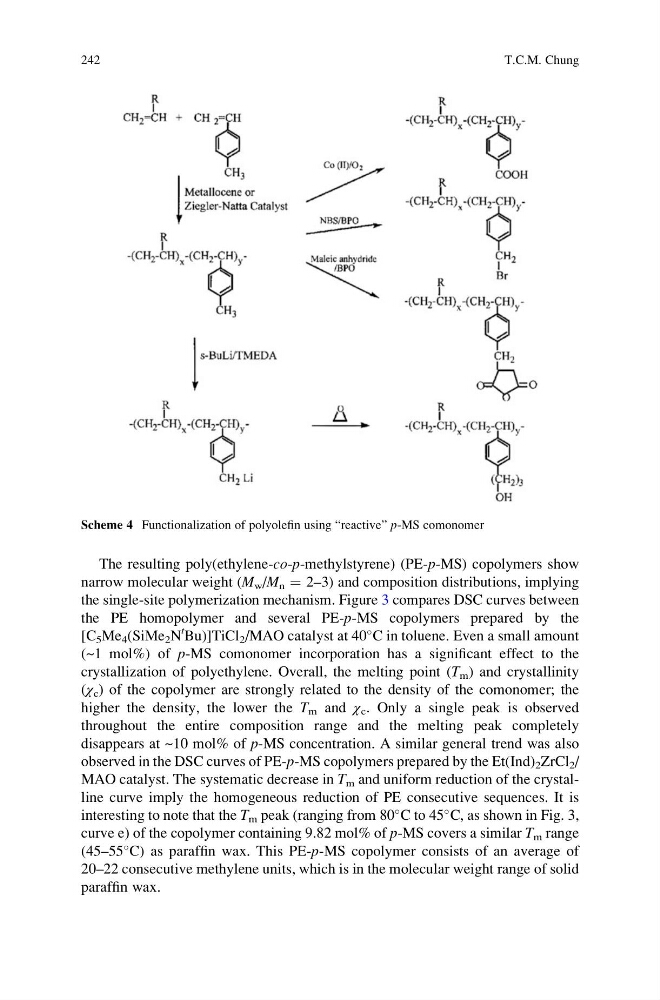
Scheme 4 Functionalization of polyolefin using “reactive” p-MS comonomer
242
T.C.M. Chung
narrow molecular weight (M w /M n ¼ 2–3) and composition distributions, implying
the single-site polymerization mechanism. Figure 3 compares DSC curves between
the PE homopolymer and several PE-p-MS copolymers prepared by the
[C 5 Me 4 (SiMe 2 N
t Bu)]TiCl 2 /MAO catalyst at 40
C in toluene. Even a small amount
(~1 mol%) of p-MS comonomer incorporation has a significant effect to the
crystallization of polyethylene. Overall, the melting point (T m ) and crystallinity
(χ c ) of the copolymer are strongly related to the density of the comonomer; the
higher the density, the lower the T m and χ c . Only a single peak is observed
throughout the entire composition range and the melting peak completely
disappears at ~10 mol% of p-MS concentration. A similar general trend was also
observed in the DSC curves of PE-p-MS copolymers prepared by the Et(Ind) 2 ZrCl 2 /
MAO catalyst. The systematic decrease in T m and uniform reduction of the crystalline curve imply the homogeneous reduction of PE consecutive sequences. It is
interesting to note that the T m peak (ranging from 80
C to 45
C, as shown in Fig. 3,
curve e) of the copolymer containing 9.82 mol% of p-MS covers a similar T m range
(45–55
C) as paraffin wax. This PE-p-MS copolymer consists of an average of
20–22 consecutive methylene units, which is in the molecular weight range of solid
paraffin wax.
Scheme 4 Functionalization of polyolefin using “reactive” p-MS comonomer
242
T.C.M. Chung