

Table 3 summarizes some ethylene/p-MS copolymerization results using three
metallocene catalysts: [C 5 Me 4 (SiMe 2 N
t
Bu)]TiCl 2 , Et(Ind) 2 ZrCl 2 , and Cp 2 ZrCl 2
[40, 41]. As expected, the copolymerization efficiency follows the sequence of
[C 5 Me 4 (SiMe 2 N
t Bu)]TiCl 2 > Et(Ind) 2 ZrCl 2 > Cp 2 ZrCl 2 . The spatial opening at
the active site of [C 5 Me 4 (SiMe 2 N
t
Bu)]TiCl 2 /MAO offers a high p-MS conversion
and copolymers with a broad range of p-MS concentrations. In general, the catalyst
activity systematically increases with the increase of p-MS content, due to the
improvement of monomer diffusion in the lower crystalline copolymer structures.
The catalyst activity attains a value of more than 2.4 Â 10
3 kg polymer/mol Ti h (in
run III-I-6), which is four times the value of homopolymerization of ethylene under
similar reaction conditions. It is interesting to note that there exists a very small
solvent (hexane and toluene) effect due to [C 5 Me 4 (SiMe 2 N
t
Bu)]TiCl 2 /MAO
catalyst activity, yet a very significant difference in both Et(Ind) 2 ZrCl 2 and
Cp 2 ZrCl 2 catalyst systems.
Table 2 Summary of copolymerization reactions between propylene or 1-octene and 5-hexenyl9-BBN using TiCl 3 AA/Et 2 AlCl catalyst
Run
no.
α-Olefin
Borane
comonomer
(mol%)
Reaction
temperature /
time (
C/min)
Borane in
copolymer
(mol%)
Molecular
weight (g/mol)
II-I-1
Propylene
5
70/60
1.4
210,000
II-I-2
Propylene
10
70/60
2.6
183,000
II-I-3
Propylene
15
70/60
4.1
174,000
II-II-1
1-Octene
25
25/90
15
242,000
II-II-2
1-Octene
50
25/90
40
126,000
II-II-3
1-Octene
75
25/90
65
66,000
Endo >
(e)
(e)
(d)
(d)
(c)
(c)
(b)
(b)
(a)
(a)
Temperature (°c)
-125 -100 -75 -50 -25
0
25 50 4000
3000
2000
Wavenumber (cm
-1 )
1600
1200
800
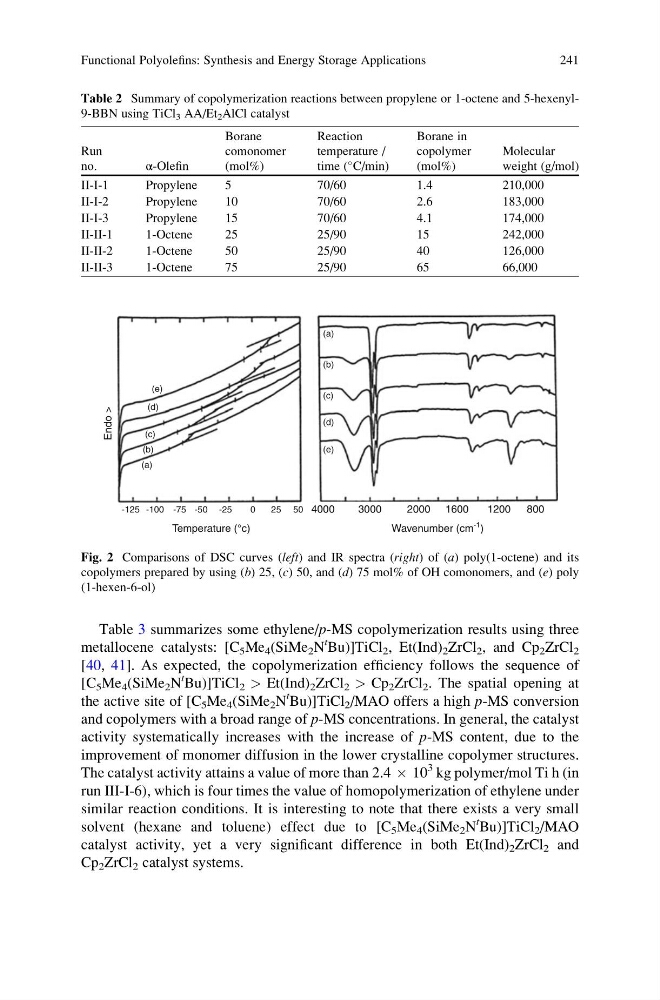
Fig. 2 Comparisons of DSC curves (left) and IR spectra (right) of (a) poly(1-octene) and its
copolymers prepared by using (b) 25, (c) 50, and (d) 75 mol% of OH comonomers, and (e) poly
(1-hexen-6-ol)
Functional Polyolefins: Synthesis and Energy Storage Applications
241
metallocene catalysts: [C 5 Me 4 (SiMe 2 N
t
Bu)]TiCl 2 , Et(Ind) 2 ZrCl 2 , and Cp 2 ZrCl 2
[40, 41]. As expected, the copolymerization efficiency follows the sequence of
[C 5 Me 4 (SiMe 2 N
t Bu)]TiCl 2 > Et(Ind) 2 ZrCl 2 > Cp 2 ZrCl 2 . The spatial opening at
the active site of [C 5 Me 4 (SiMe 2 N
t
Bu)]TiCl 2 /MAO offers a high p-MS conversion
and copolymers with a broad range of p-MS concentrations. In general, the catalyst
activity systematically increases with the increase of p-MS content, due to the
improvement of monomer diffusion in the lower crystalline copolymer structures.
The catalyst activity attains a value of more than 2.4 Â 10
3 kg polymer/mol Ti h (in
run III-I-6), which is four times the value of homopolymerization of ethylene under
similar reaction conditions. It is interesting to note that there exists a very small
solvent (hexane and toluene) effect due to [C 5 Me 4 (SiMe 2 N
t
Bu)]TiCl 2 /MAO
catalyst activity, yet a very significant difference in both Et(Ind) 2 ZrCl 2 and
Cp 2 ZrCl 2 catalyst systems.
Table 2 Summary of copolymerization reactions between propylene or 1-octene and 5-hexenyl9-BBN using TiCl 3 AA/Et 2 AlCl catalyst
Run
no.
α-Olefin
Borane
comonomer
(mol%)
Reaction
temperature /
time (
C/min)
Borane in
copolymer
(mol%)
Molecular
weight (g/mol)
II-I-1
Propylene
5
70/60
1.4
210,000
II-I-2
Propylene
10
70/60
2.6
183,000
II-I-3
Propylene
15
70/60
4.1
174,000
II-II-1
1-Octene
25
25/90
15
242,000
II-II-2
1-Octene
50
25/90
40
126,000
II-II-3
1-Octene
75
25/90
65
66,000
Endo >
(e)
(e)
(d)
(d)
(c)
(c)
(b)
(b)
(a)
(a)
Temperature (°c)
-125 -100 -75 -50 -25
0
25 50 4000
3000
2000
Wavenumber (cm
-1 )
1600
1200
800
Fig. 2 Comparisons of DSC curves (left) and IR spectra (right) of (a) poly(1-octene) and its
copolymers prepared by using (b) 25, (c) 50, and (d) 75 mol% of OH comonomers, and (e) poly
(1-hexen-6-ol)
Functional Polyolefins: Synthesis and Energy Storage Applications
241