

A similar functionalization route was extended to higher α-olefin copolymers [31,
32]. Both isospecific metallocene and heterogeneous Ziegler–Natta catalysts were
employed in propylene and 1-octene copolymerization reactions with 5-hexenyl-9BBN. With the general phenomenon in Ziegler–Natta-mediated copolymerization,
the bigger the size of the monomer the lower the reactivity and the more easily it can
copolymerize the borane monomer with high α-olefins. Table 2 summarizes several
copolymerization results for propylene and 5-hexenyl-9-BBN and for 1-octene and
5-hexenyl-9-BBN using the TiCl 3 AA/Et 2 AlCl catalyst. It is obvious that propylene
was preferentially polymerized and consumed in the propylene/5-hexenyl-9-BBN
copolymerization. On the other hand, a significantly higher comparative comonomer reactivity was observed between 1-octene and 5-hexenyl-9-BBN.
Figure 2 compares infrared (IR) and differential scanning calorimetry (DSC)
curves for three poly(1-octene) copolymers containing 15, 40, and 65 mol% of
1-hexen-6-ol units (runs II-II-1, II-II-2 and II-II-3, respectively), and two
homopolymers, i.e., poly(1-octene) and poly(1-hexen-6-ol). The systematic
increase in OH content, corresponding well with the borane comonomer mole
ratio, indicates the comparative reactivity between 1-octene and 5-hexenyl-9BBN. Only one glass transition temperature (T g ) is observed for each sample,
which reveals the absence of a macroscopic phase separation, implying that the
copolymer samples are fairly homogeneous. In fact, a linear relationship between
the T g and the weight fraction of either monomer has been taken as a qualitative
indication of the homogeneity and random nature of the copolymer samples.
Based on the same three considerations (i.e., stability, solubility, and versatility)
of the “reactive” comonomer, we also investigated p-methylstyrene (p-MS)
[40–44]. The major advantages of p-MS are its commercial availability, easy
incorporation into the polyolefin, and versatility in functionalization chemistry
under various reaction mechanisms, including free radical, cationic, and anionic
processes. The benzylic protons are known to be readily reactive in many chemical
reactions (such as halogenation, metallation, and oxidation) to form a desirable
functional group at the benzylic position under mild reaction conditions, as
illustrated in Scheme 4.
118
116
114
112
110
108
(a)
(b)
106
104
102
34 36 38 40 42 44 46 48
Minutes
mV
50 52 54 56 58 60
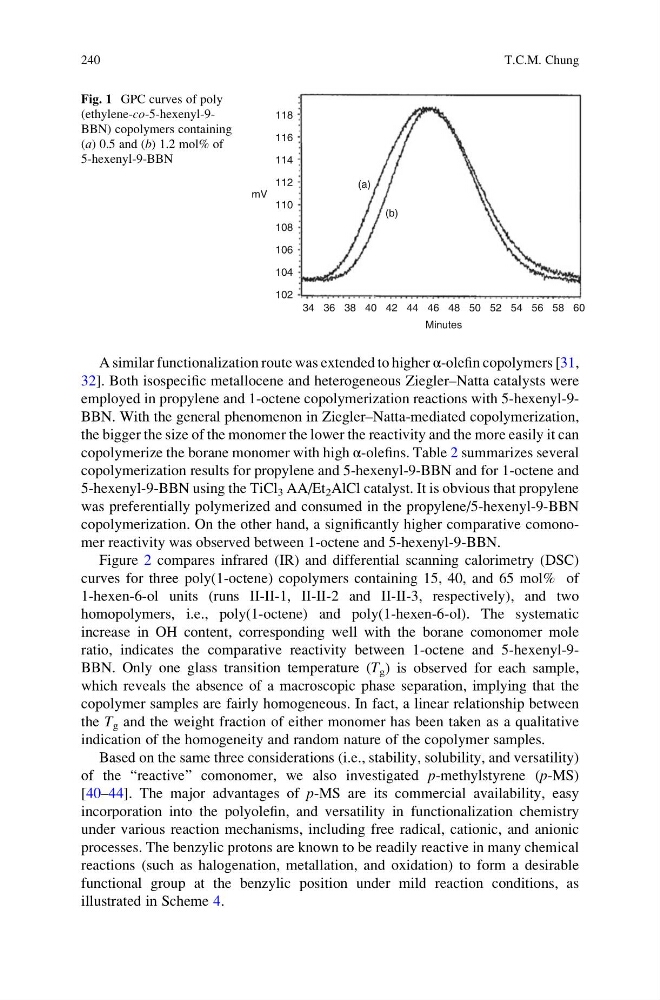
Fig. 1 GPC curves of poly
(ethylene-co-5-hexenyl-9BBN) copolymers containing
(a) 0.5 and (b) 1.2 mol% of
5-hexenyl-9-BBN
240
T.C.M. Chung
32]. Both isospecific metallocene and heterogeneous Ziegler–Natta catalysts were
employed in propylene and 1-octene copolymerization reactions with 5-hexenyl-9BBN. With the general phenomenon in Ziegler–Natta-mediated copolymerization,
the bigger the size of the monomer the lower the reactivity and the more easily it can
copolymerize the borane monomer with high α-olefins. Table 2 summarizes several
copolymerization results for propylene and 5-hexenyl-9-BBN and for 1-octene and
5-hexenyl-9-BBN using the TiCl 3 AA/Et 2 AlCl catalyst. It is obvious that propylene
was preferentially polymerized and consumed in the propylene/5-hexenyl-9-BBN
copolymerization. On the other hand, a significantly higher comparative comonomer reactivity was observed between 1-octene and 5-hexenyl-9-BBN.
Figure 2 compares infrared (IR) and differential scanning calorimetry (DSC)
curves for three poly(1-octene) copolymers containing 15, 40, and 65 mol% of
1-hexen-6-ol units (runs II-II-1, II-II-2 and II-II-3, respectively), and two
homopolymers, i.e., poly(1-octene) and poly(1-hexen-6-ol). The systematic
increase in OH content, corresponding well with the borane comonomer mole
ratio, indicates the comparative reactivity between 1-octene and 5-hexenyl-9BBN. Only one glass transition temperature (T g ) is observed for each sample,
which reveals the absence of a macroscopic phase separation, implying that the
copolymer samples are fairly homogeneous. In fact, a linear relationship between
the T g and the weight fraction of either monomer has been taken as a qualitative
indication of the homogeneity and random nature of the copolymer samples.
Based on the same three considerations (i.e., stability, solubility, and versatility)
of the “reactive” comonomer, we also investigated p-methylstyrene (p-MS)
[40–44]. The major advantages of p-MS are its commercial availability, easy
incorporation into the polyolefin, and versatility in functionalization chemistry
under various reaction mechanisms, including free radical, cationic, and anionic
processes. The benzylic protons are known to be readily reactive in many chemical
reactions (such as halogenation, metallation, and oxidation) to form a desirable
functional group at the benzylic position under mild reaction conditions, as
illustrated in Scheme 4.
118
116
114
112
110
108
(a)
(b)
106
104
102
34 36 38 40 42 44 46 48
Minutes
mV
50 52 54 56 58 60
Fig. 1 GPC curves of poly
(ethylene-co-5-hexenyl-9BBN) copolymers containing
(a) 0.5 and (b) 1.2 mol% of
5-hexenyl-9-BBN
240
T.C.M. Chung